
Confused about the different GCSE exam boards?
You’re not alone. With names like AQA, Edexcel, OCR, WJEC and CCEA thrown around, it’s easy to feel overwhelmed, especially as schools and even individual subjects, may use different exam boards.
This guide will explain each exam board, how they compare, and what it means for GCSE preparation.
Understanding the differences between exam boards can help students revise more effectively and approach past papers and assessments with greater confidence.
In this guide, we’ll break down:
- What an exam board does
- The differences between the five main GCSE boards
- Why understanding your board matters for revision and GCSE success
What are GCSE exam boards and why do they matter?
GCSE exam boards are the organisations responsible for setting and marking exam papers. They design the content, structure, and assessment criteria for each GCSE subject. While all boards follow the national curriculum requirements set by Ofqual, the way topics are taught, assessed, and worded can differ between boards.
Knowing the exam board helps to:
- Focus revision on the right content
- Practise with past papers that match exam style
- Understand how exams will be marked
Where is each GCSE exam board used?
Most students in England, Wales and Northern Ireland sit exams from one of five main boards. The subject department usually chooses the school's board and will stay consistent throughout the GCSE course.
- AQA, Edexcel and OCR are used in schools across England
- WJEC (Eduqas) is common in Wales and is also used by some schools in England
- CCEA is mainly used in Northern Ireland
Schools will share which board they're using for each GCSE subject, or you can work it out by checking course specifications or past papers provided in class.
Format and structure
While all boards assess the same subject areas, they may differ in:
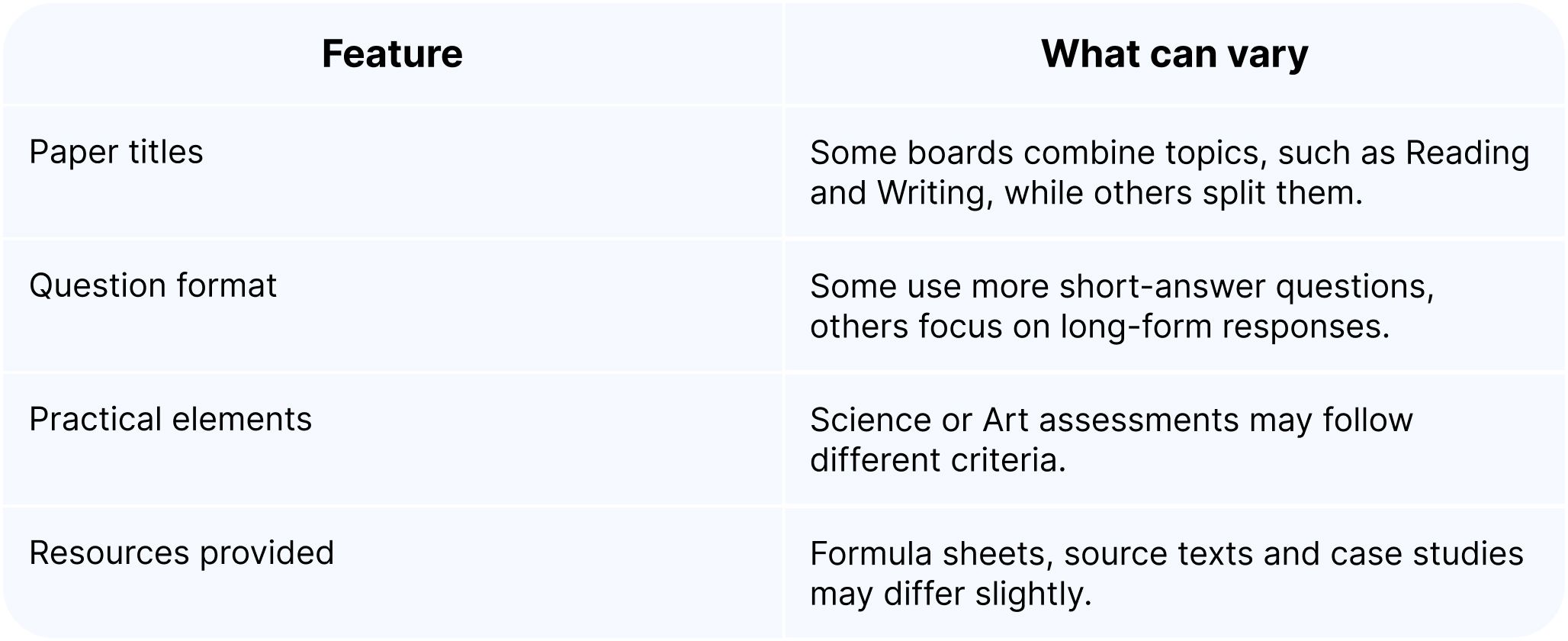
Understanding these differences helps to target revision more effectively and avoid surprises on exam day.
GCSE Exam Boards Overview
Here’s a quick guide to the five main boards and what they’re known for:
AQA
(Assessment and Qualifications Alliance)
- One of the largest boards in the UK
- Popular for English, Science and Humanities
- Known for detailed mark schemes and balanced papers
- Website: aqa.org.uk
Edexcel
(Pearson Edexcel)
- Run by the global education company Pearson
- Offers both GCSE and International GCSE qualifications
- Frequently used for Maths and Business Studies
- Known for structured, clearly scaffolded exam papers
- Website: qualifications.pearson.com
OCR
(Oxford, Cambridge and RSA Examinations)
- Part of Cambridge University Press and Assessment
- Offers both academic and vocational qualifications
- Known for subjects like Computer Science and History
- Website: ocr.org.uk
WJEC
(Welsh Joint Education Committee)
- The main exam board for schools in Wales
- Offers qualifications through its English brand, Eduqas
- Used by some English schools for English, Drama and RE
- Website: eduqas.co.uk
CCEA
(Council for the Curriculum, Examinations and Assessment)
- Northern Ireland’s dedicated exam board
- Covers all major subjects for GCSE and A level in Northern Ireland
- Website: ccea.org.uk
Marking and Grading
All exam boards use the same 9 to 1 grading system, and Ofqual regulates marking to ensure fairness.
Each board:
- Trains examiners to mark consistently across subjects
- Publishes grade boundaries after results are in
- Allows for appeals and reviews of marking
Grade boundaries can differ slightly between boards depending on the difficulty of each paper in a given year.