Back to blog

Key Stage 2 English glossary

By
Atom
|
November 28, 2025

Confused about clauses and conjunctions? Perplexed about progressive and perfect tenses? You’re in the right place.

Learn about all the terminology your child will encounter in Key Stage 2 English and beyond. Feel confident helping your child with their English homework!

Grammar

Adjectives and adverbs

An adjective describes a noun or a pronoun (big, brilliant, shy). An adverb describes a verb, adjective, or another adverb or clause. It can tell us about the manner, frequency, time, place, or degree of an action (quickly, often, yesterday, really, here).

Adverbial

An adverbial is a phrase that functions as an adverb (during the summer, within the hotel).

Comparative adjective

A comparative adjective is used to compare one noun to another noun. A comparative adjective often ends in ‘-er’ (larger, funnier, more beautiful).

Modal adverb

A modal adverb describes how likely something is (perhaps, obviously, undeniably).

Superlative adjective

A superlative adjective is a word that is used to describe a noun as having more of a particular quality than another. A superlative adjective often ends in ‘-est’ (best, warmest, coolest).

Conjunctions and clauses

A conjunction is a word that links together words, phrases and clauses (and, because). A clause is a phrase which contains a subject and a verb, and is split into main clauses and subordinate clauses.

Coordinating conjunction

A coordinating conjunction links together words, phrases and clauses of equal importance (for, and, nor, but, or, yet, so).

Main clause

A main clause can stand alone as a sentence (she flipped the pancake expertly).

Relative clause

A relative clause is a type of subordinate clause. It modifies a noun by using a relative pronoun (who, that) to refer back to the noun. However, this might also be omitted (the man (who) I was meeting was late).

Subordinate clause

A subordinate clause begins with a subordinating conjunction. It cannot stand alone as a sentence (although it was late, due to the rain).

Subordinating conjunction

A subordinating conjunction introduces a subordinate clause (until, because, since).

Determiners

A determiner is a word used in front of nouns or noun phrases to identify the noun (my, this, their).

Article

An article is a type of determiner. There are three articles in the English language: ‘a’, ‘an’ and ‘the’.

Definite article

‘The’ is the definite article. It is a type of determiner used in front of nouns or noun phrases to show that the noun is known.

Demonstrative determiner

A demonstrative determiner ‘points’ at a specific noun that the speaker is referring to (this/that pen, those/these toys).

Infinite article

There are two infinite articles: ‘a’ and ‘an’. These are the types of determiners used in front of nouns or noun phrases to show that the noun is unknown.

Interrogative determiner

An interrogative determiner is used to ask questions about a noun (which hat, what year, whose dog).

Possessive determiner

A possessive determiner tells us who the noun belongs to (my, your, his, our).

Quantifier

A quantifier tells us how much of a noun there is (three, less, another).

Nouns

A noun is a word used to identify a person, place, or a thing (flower, desk, sky).

Abstract noun

An abstract noun is intangible. It can include feelings or concepts (sadness, peace, time).

Collective noun

A collective noun refers to a group of people, animals or things (herd, fleet).

Common noun

A common noun is a non-specific person, place or thing. Most nouns are common nouns (dog, tree).

Compound noun

A compound noun is where two or more words join together to form a noun (rainbow, cowboy).

Concrete noun

A concrete noun is a tangible object that we can detect with our senses (flower, sofa, spaghetti).

Countable noun

A countable noun can be counted and pluralised (two cups).

Proper noun

A proper noun is a specific name, like the name of a city, country, brand or person. Proper nouns are always capitalised (London, Sarah, Italy, Atom Learning).

Uncountable noun

An uncountable noun cannot be counted. It only has one form, so there is no singular/plural (water, flour).

Prepositions

A preposition is a word which connects nouns, pronouns and noun phrases to another word (in, with, beside, among).

Participle preposition

A participle preposition is a word that ends with ‘-en’, ‘-ing’ or ‘-ed’ that acts as a preposition (give, considering, provided).

Phasal preposition

Phrasal preposition is where two or more words function as a single preposition (in spite of, next to).

Pronouns

A pronoun is a word that is used in place of a noun to avoid repetition (she, myself).

Demonstrative pronoun

A demonstrative pronoun replaces a noun phrase when we ‘point’ at things or people (these, this, that).

Personal pronoun

A personal pronoun replaces the subject or object that is already known (she, me, we).

Possessive pronoun

A possessive pronoun replaces noun phrases that tell you who owns something (mine, ours).

Reflexive pronoun

A reflexive pronoun is used to refer back to a subject (themselves).

Relative pronoun

A relative pronoun introduces relative clauses and gives extra information about a noun (who, which).

Sentences

A sentence is a group of words that can stand on their own and make sense without any other words or phrases. Sentences start with a capital letter and end with a full stop, exclamation mark or question mark.

Complex sentence

A complex sentence is made up of one main clause and one or more subordinate clauses (when I grow up, I want to be a teacher).

Compound sentence

A compound sentence is made up of two main clauses, joined together with a coordinating conjunction (I opened the door and she walked in).

Simple sentence

A simple sentence is made up of just one clause (I opened the door).

Verbs

A verb expresses a state or action (run, eat, feel).

Infinite verb

An infinite verb is the most basic form of the verb. It always takes the form ‘to’ + verb (to paint, to sing)

Modal verb

A modal verb expresses how certain or possible an action is (will, might, should). It must be followed by another verb (will go, should eat).

Phrasal verb

A phrasal verb is made up of a verb + either an adverb or a preposition (look after, take down, break up).

Verb agreement

In a sentence, the subject and the verb need to agree with each other. This means they both need to be singular or they both need to be plural, and the verb form must match the person.

First person

First person is when the sentence is written from the point of view of the person or people involved (I, we).

Perfect tense

Perfect tense describes actions that have been started and completed (he had walked).

This can be split into the past perfect tense (he had walked), the present perfect tense (he has walked) and the future perfect tense (he will have walked).

Progressive tense

The progressive tense describes an event which is ongoing, or that happened and will happen for a long period of time. It's also known as the continuous tense (they are singing).

The progressive tense can be split into the past progressive tense (they were singing), the present progressive tense (they are singing) and the future progressive tense (they will be singing).

Second person

Second person is used when the sentence addresses someone directly (you).

Simple tense

Simple tense is used to talk about actions happening right now, or actions that happen regularly.

This can be split into the simple past tense (I walked), the simple present tense (I walk) and the simple future tense (I will walk).

Third person

Third person is used when the sentence talks about other people (he, she, they, it).
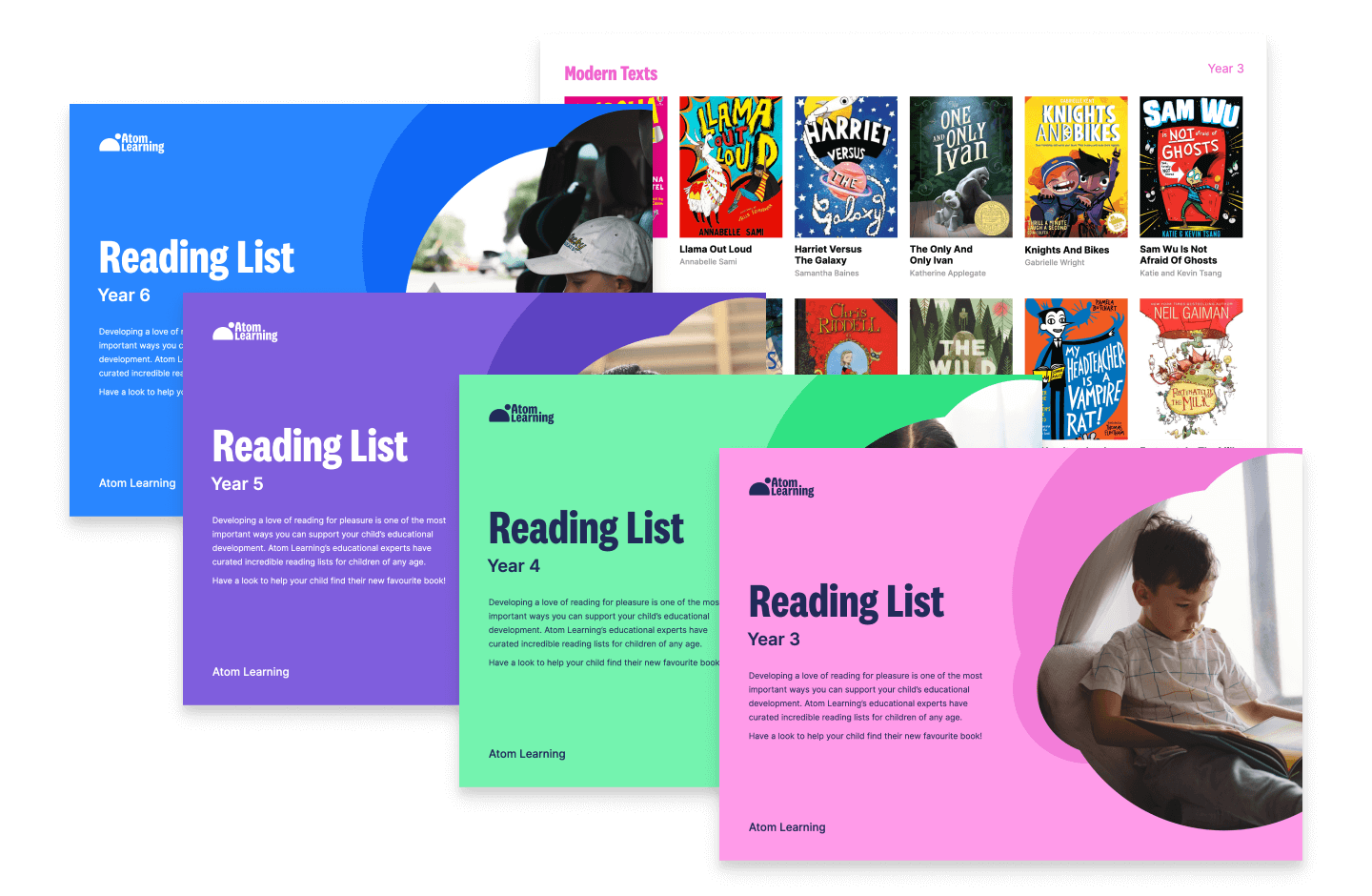
Download free Key Stage 2 reading lists

Find your child’s next great read. Atom’s free KS2 reading lists include carefully chosen books to help children aged 7–11 build comprehension, expand vocabulary and develop a genuine love of reading. Perfect for reading at home or alongside school learning.

Send me the lists

Literary devices

Literary devices are techniques that writers use to make their writing more exciting and expressive.

Alliteration

Alliteration is when words that are close together begin with the same sound or letter (A cute and cuddly cat, wet and windy weather).

Analogy

An analogy is a comparison between one thing and another (as cool as ice).

Figurative language

Figurative language is the use of words or phrases to create a special meaning. Its meaning shouldn’t be taken as fact, but creatively interpreted. Types of figurative language are similes, metaphors, and personification.

Idiom

An idiom is an expression which does not have a literal meaning (It’s raining cats and dogs).

Metaphor

A metaphor describes something as being something else (Her eyes were diamonds).

Onomatopoeia

Onomatopoeia is when a word sounds like the noise it is referencing (bang, sizzle, pop).

Personification

Personification is when non-human objects are given human abilities, characteristics, or personalities (The wind swept the leaves into a dance).

Simile

A simile describes things as being like something else (He slept like a log).

Persuasive devices

Persuasive devices are techniques that writers use to persuade their audience to agree with them. They can also be known as rhetorical devices.

Anecdote

An anecdote is a story from someone’s life (I remember when we used to go down to the river after school).

Direct address

Direct address is when the writer speaks directly to the reader or listener (Keep reading, if you dare!).

Emotive language

Emotive language describes words that are chosen to create an emotional response (You can help fix this appalling problem).

Hyperbole

Hyperbole is when the author deliberately exaggerates a situation (His house is as big as the Moon!).

Power of three

The 'power of three' is the name for a list which only contains three items for special effect (She was strong, witty and rebellious).

Repetition

Repetition is when a word or phrase is repeated (He droned on and on and on).

Rhetorical question

A rhetorical question is a type of question used to make a point, rather than to get an answer (What are you waiting for?).

Statistics

Statistics is another word for facts and figures (Over 4,000 people…).

Technical language

Technical language describes words that are only used in a specific topic area.

Punctuation

Punctuation refers to the marks made to separate sentences and to clarify their meaning.

Apostrophe

An apostrophe is used to show a contraction (missing letters or numbers) or possession (can’t, would’ve, Fiona’s party).

Brackets

Brackets are used to show that the enclosed text is a short aside, or to clarify extra information (Szabina (my yoga teacher) is Bulgarian).

Colon

A colon is used after a main clause to add emphasis to a word or phrase, or used to introduce a quotation, list or explanation (A whale is not a fish: it is a mammal).

Comma

A comma is a punctuation mark that has lots of uses. These include:

  • separating items in a list (We need apples, bananas, crisps and milk)
  • after fronted adverbials (Yesterday, I went to the library)
  • to show parentheses (The calf, which was born yesterday, was called Joseph)
  • to indicate an addressee (What do you think, Freddie?)
  • after a fronted subordinate clause (When I get older, I would like to be a lawyer)
  • to punctuate direct speech (He asked, “What do you mean?”)

Ellipsis

Ellipses have several uses. They can show that word(s) have been removed from a quote, are used to create suspense by adding a pause at the end of a sentence, and show the trailing off of a thought (We crept into the dark cave…).

Exclamation mark

An exclamation mark is used to mark the end of an exclamation. An exclamation mark usually indicates strong emotions such as surprise, shock, anger or joy (What an awful mess!).

Full stop

A full stop is used to mark the end of a statement or a command (This where I live.).

Hyphen

A hyphen is used to join two or more words together to communicate a single idea (twenty-two, left-handed).

Inverted commas

Inverted commas are used to show direct speech (“Great!” he cried).

Question mark

A question mark is used to mark the end of a question (What do you mean?).

Semicolon

A semicolon is used to join two closely related sentences together. They can also be used to separate multi-word items in a list (Let’s go to the library; I want to read).

Sentence enders

Sentence enders are the group of punctuation marks that end a sentence – a full stop (.), an exclamation mark (!) and a question mark (?).

Vocabulary

Vocabulary refers to a collection of words. It includes different types of words.

Abbreviation

An abbreviation is a word that has been shortened, but keeps its meaning (vet is an abbreviation of veterinarian).

Acronym

An acronym is a type of abbreviation where the initial letters of each word are pronounced as a single word (RAdio Detection And Ranging = radar).

Antonym

An antonym is a word that has the opposite meaning to another word (small, large).

Contraction

A contraction is a type of abbreviation where two words have been put together to form one word. An apostrophe is used in place of the missing letters (wasn’t, I’m, would’ve).

Definition

Definition refers to the meaning of a worse or phrase.

Etymology

Etymology is the history and origin of new words.

Gendered words

Gendered words tell us the assumed gender (male or female) of a noun. Some are formed by adding a suffix (godess, heroine).

Homograph

Homographs are two or more words that are spelt the same, but are pronounced differently and have different meanings (bow, present, tear).

Homonym

Homonyms are pairs or groups of words that sound the same, are spelt the same, but have different meanings (bat, lie, bear).

Homophone

Homophones are two or more words that sound the same, but are spelled differently and have different meanings (boy and buoy, know and no).

Initialism

Initialisms are formed from the initial letters of each word. Every initial is pronounced as an individual letter (date of birth = DOB, please turn over = PTO).

Parts of speech

Parts of speech refers to the type of word (also known as a ‘word class’) (noun, adjective, verb, adverb).

Prefix

A prefix consists of letters added to the beginning of a root word to change its meaning (minibar, nanotechnology).

Root word

A root word is a word that new words are derived from (For example, happy is the root word of happiness).

Suffix

A suffix consists of letters added to the end of a root word to change its meaning (seedling, droplet, pipette).

Synonym

A synonym is a word that has the same meaning as another word (big, huge, large).

Word family

A word family is a group of words that are derived from the same root word (helpful, helper, helping, helpless).

No items found.
No items found.
No items found.
No items found.

Build strong English, maths and science skills.

Want to support what your child is learning at school, or help them stretch beyond it? Atom gives them the right blend of challenge and support. Help them strengthen foundations, deepen understanding, and grow confident in the subjects that matter most for Key Stage 2 and beyond. 

  • Follow personalised weekly learning plans that adapt to your child’s level and keep them progressing in English, maths and science. 
  • Learn through interactive lessons that stretch their thinking and reinforce key skills. 
  • Track progress topic by topic. See their strengths and pinpoint where they need to improve. 
Strengthen foundations and build confidence.

Start your free trial and help your child make real school progress today.

Try Atom for free

Contents