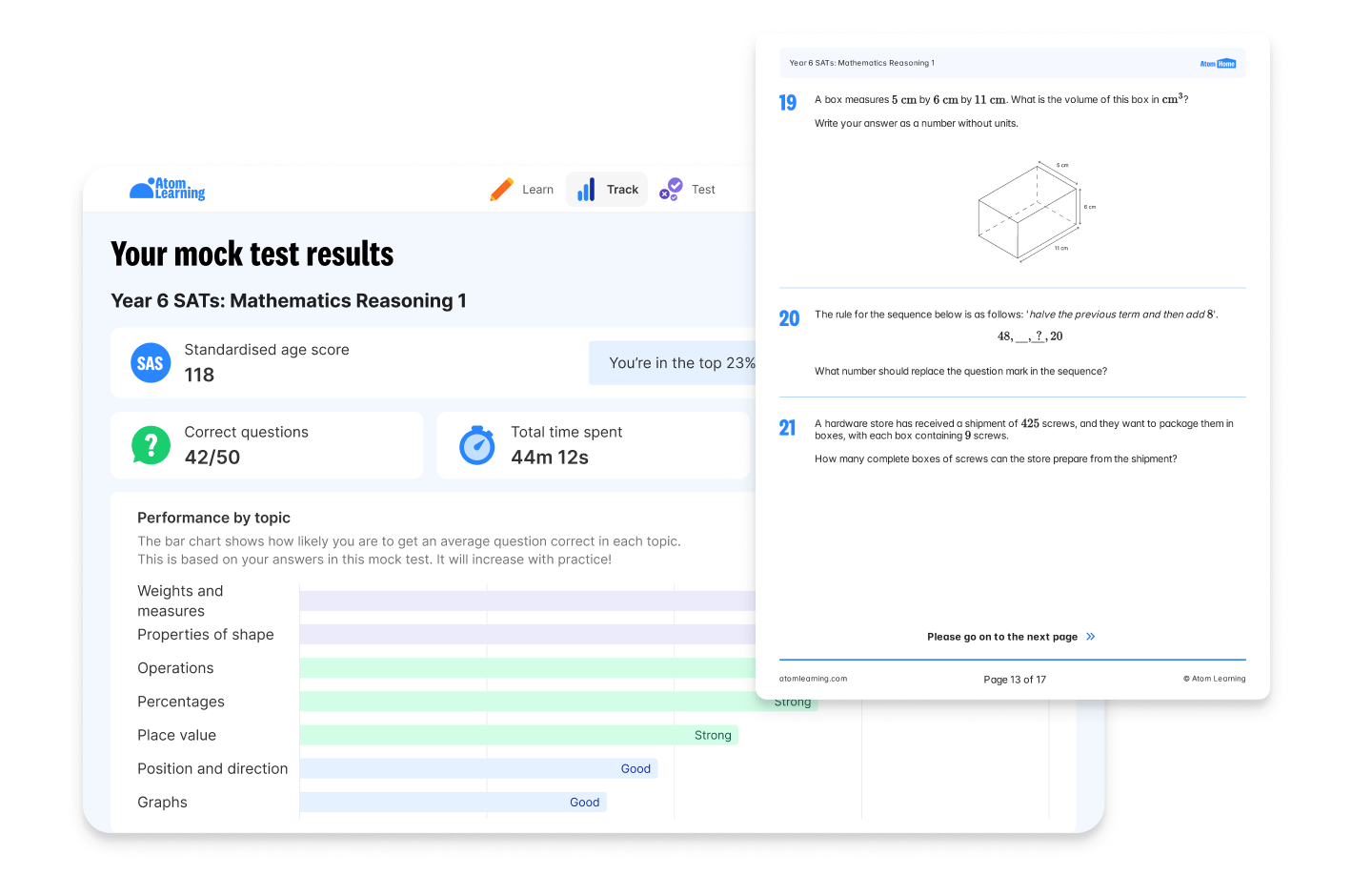
If you have a child in Year 6, they'll take SATs exams in May. Learn all about Year 6 SATs, download past SATs papers and get helpful resources to prepare here.
What are the Year 6 SATs?
Year 6 Standard Assessment Tests (SATs) are designed to assess your child’s knowledge of the Key Stage 2 national curriculum. They're taken in May of Year 6, when children are 10 or 11. The exams test children's understanding of what they have learned during the second stage of primary school, in Years 3, 4, 5 and 6 (ages 7–11).
SATs are compulsory at state primary schools in England. Private prep schools can choose whether pupils take SATs.
What do the Year 6 SATs cover?
The 2025 Key Stage 2 SATs cover these key learning areas:
- English reading
- English spelling, punctuation and grammar
- Maths
Teacher assessments are also used to test children's performance in writing, speaking and listening, and usually science.
Are the Year 6 SATs important?
SATs are important to give teachers and parents an insight into children's strengths and areas for development. The results help teachers understand which pupils need extra support as they prepare to finish primary school and start secondary school. They're also used by the government to review the quality of education at schools across the country.
Some secondary schools use Year 6 SATs results (alongside Year 7 CAT exams) to help group students into sets or streams. Being confident and prepared for SATs will in turn help your child to enter Year 7 in a high set.
When are SATs in 2025?
The Key Stage 2 SATs are timetabled from Monday 12th May to Thursday 15th May 2024.
Monday 12th May
- English paper 1: SPAG test (grammar and punctuation) – 45 minutes, worth 50 marks
- English paper 2: SPAG test (spelling) – 15-20 minutes, worth 20 marks
Tuesday 13th May
- English paper 3: reading test – 60 minutes, worth 50 marks
Wednesday 14th May
- Maths paper 1: arithmetic – 30 minutes, worth 30 marks
- Maths paper 2: reasoning – 40 minutes, worth 40 marks
Thursday 15th May
- Maths paper 3: reasoning – 40 minutes, worth 40 marks
Year 6 SATs past papers (2024)

Maths papers and answers

English (SPaG) papers and answers

English (reading) papers and answers
Free SATs resources
Year 6 English SATs guide
Year 6 maths SATs guide
Key Stage 2 spelling guide
How are the Year 6 SATs marked?
After taking the test in May, the Year 6 SATs papers are marked by external markers instead of your child's teachers. You should get your child's SATs results during the first two weeks of July.
The new SATs marking scheme is based on age-related expectations. For each SATs paper, your child will get:
- A raw score
- A scaled score
- An outcome code
Schools usually give parents the scaled score, outcome code or both. You are unlikely to be given your child's raw scores.
What are age-related expectations?
It used to be that children were given a national curriculum level from 1–6. They were expected to achieve at least a level 4 in English, maths and science by the time they left primary school. There were concerns that these levels were vague, unhelpful to parents, and could cause children to develop a fixed mindset about their ability for learning.
In most schools, the old levels scheme has been replaced with age-related expectations. Teachers use statements to describe in which areas children have achieved expectations for their age and areas where they may need more support. For example:
- Working within the expected level of attainment for their age
- Working towards the expected level of attainment
- Working below the expected level of attainment
- Working beyond the expected level of attainment (at greater depth)
What are scaled scores?
Scaled scores in each Key Stage 2 test range from 80 to 120. A scaled score of 100 is average.
A scaled score of 100 or more means that your child has met or exceeded the expected standard for their age.
What are outcome codes?
Your child will be given an outcome code based on their scaled scores. The outcome codes represent age-related expectations. The Key Stage 2 SATs outcome codes are:
- AS: the expected standard has been achieved
- NS: the expected standard has not been achieved
- A: the child was absent from one or more of the test papers
- B: the child is working below the level assessed by SATs
- M: the child missed the test
- T: the child is working at the level of the tests but is unable to access them (because all or part of a test is not suitable for a pupil with particular special educational needs)
In 2022, 59% of children met the expected standard and 7% met the higher standard across all subjects. 75% met the expected standard in reading, 69% in writing, and 71% in maths.
The pandemic had an impact on how many children met the expected standard in most subjects. In 2019, 65% met the expected standard and 11% achieved the higher standard across all subjects. There were no SATs in 2020 or 2021. When SATs took place again in 2022, the dip in results was expected by the government. Reading was an exception: there was a slight improvement of 2% between 2019 and 2022.