There are six papers for Triple Science: two for each discipline (Physics, Chemistry, and Biology).
A formula sheet for Physics will be provided for Triple Science exams.
What’s the format for Edexcel Triple Science GCSE?
Edexcel Triple Science has the following structure:
Triple Science is a triple award, meaning you’ll receive three separate GCSEs.
There are six papers, two for each of Chemistry, Physics and Biology.
The papers are all 1 hour and 45 minutes long and worth 100 marks each.
The papers are equally weighted with a total of 200 marks available per subject.
You can take the Higher or Foundation tiers. You can take different tiers for each subject.
Don’t miss Atom’s GCSE giveaway!
Six months. Six epic prizes. Still up for grabs: tickets to Reading Festival 2026 and the latest Apple tech, including an iPad Air, Vision Pro and more.
What’s the difference between Triple Science: Higher and Foundation?
Edexcel Triple Science is split into Higher and Foundation tiers, depending on your level.
Foundation tier Triple Science Edexcel:
Covers the core topics you need to know and excludes more complex or demanding areas.
In Foundation Triple Science, you can achieve a maximum grade of 5.
Higher tier Triple Science Edexcel:
The higher tier covers both core and more advanced topics across the curriculum.
For Higher tier Triple Science, you can achieve a maximum grade of 9 - the highest possible grade.
The lowest grade you can get is a 4.
Your school will place you in the correct tier based on your performance in Year 9. Sometimes, students may be moved up or down a tier during Year 10 or 11.
You can take Edexcel Triple Science exams at different levels. For example, Physics Foundation and Chemistry and Biology Higher.
Is there an equations sheet for Triple Science Edexcel?
Yes! It’s been confirmed that equation sheets will continue to be provided for Edexcel Triple Science.
The sheet will cover key formulas used for Physics. The formula sheet includes key equations needed for both the Foundation and Higher tiers.
What are the grade boundaries for Triple Science GCSE?
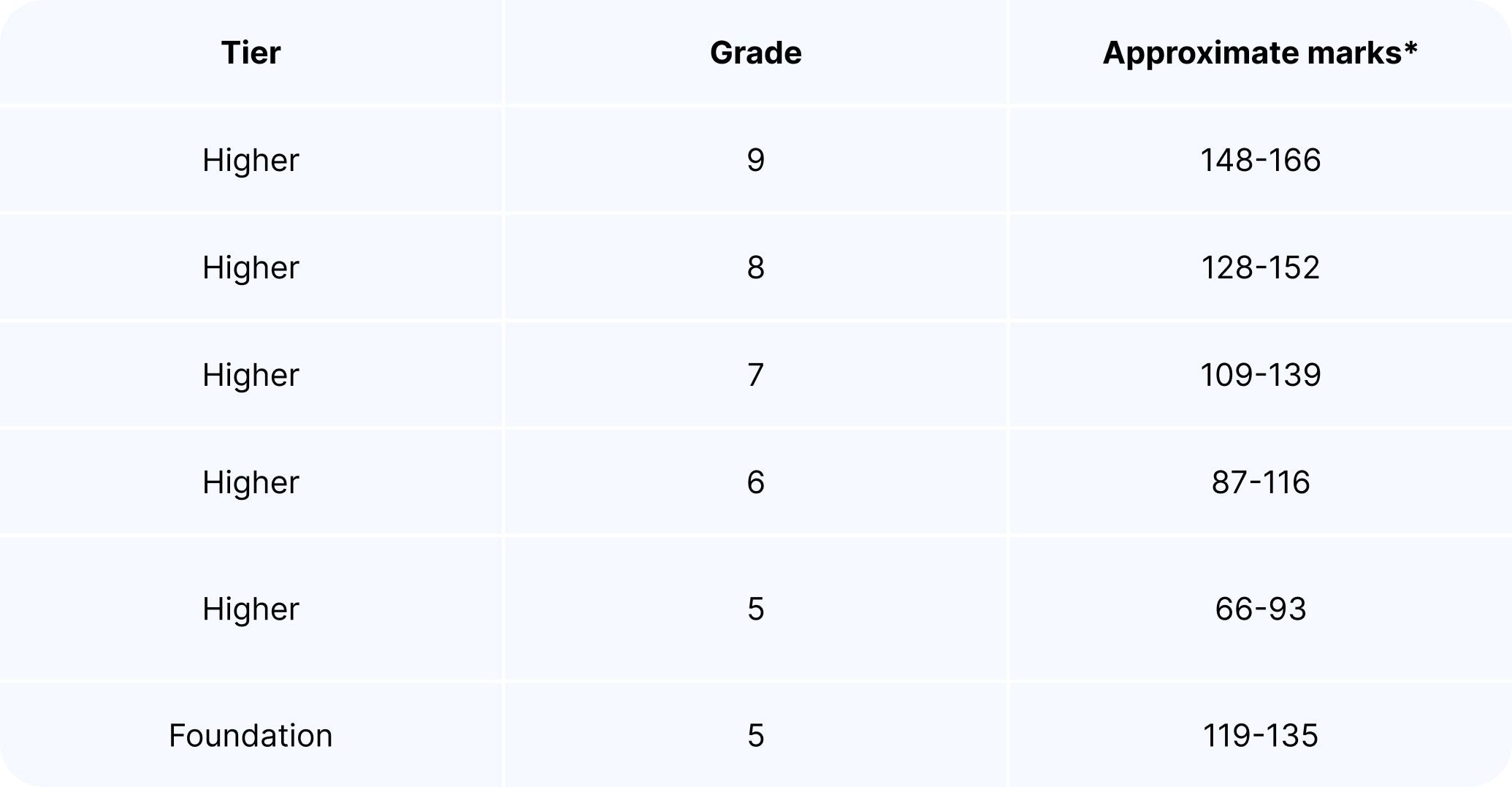
It’s important to remember that the exact grade boundaries for your GCSE exams will change every year.
Exam boards adjust the grade boundaries after an exam has happened, depending on how advanced the exam content was and how the cohort performed.
This is so students don’t have an advantage or disadvantage because of the year they took the paper. For example, if your paper were harder, grade boundaries would be lowered so that a grade 5 reflects the same level of knowledge as in previous years.
What key topics do I need to know for Edexcel Triple Science GCSE?
Edexcel Triple Science papers cover a range of topics. You’ll need a thorough understanding of each to achieve top marks, so make sure you revise any areas you find tricky ahead of the exams.
The main topics for Triple Science are:
Biology topics
Key Concepts in Biology (e.g., classification, experimental design, cells)
Cells and Control (cell structure, mitosis, cell communication)
Energy – Forces Doing Work (work, power, energy transfers)
Forces and their Effects (motion, stopping distance, momentum)
Electricity and Circuits (current, voltage, resistance, circuits)
Static Electricity
Magnetism and the Motor Effect
Electromagnetic Induction
Particle Model (particles, pressure, density)
Forces and Matter (elasticity, stress‑strain, material properties)
What are examiners looking for?
The assessment objectives for GCSE Triple Science are set by Ofqual, the exams regulator, and are consistent across exam boards.
Examiners are looking for the following in your exam papers:
AO1: Demonstrate knowledge and understanding of scientific ideas; scientific techniques and procedures
AO2: Apply knowledge and understanding of scientific ideas; scientific enquiry, techniques and procedures
AO3: Analyse information and ideas to interpret and evaluate; make judgments and draw conclusions; develop and improve experimental procedures
How can I prepare for Edexcel Triple Science GCSE?
To prepare for Triple Science exams, you’ll need to start revising early to make sure you’re confident covering all the key topics.
5 top tips to prepare for GCSE Triple Science:
1. Understand key vocabulary, definitions and units
Don’t miss out on marks for questions asking you to state or define terms. Make sure you get your head around the key vocab, definitions and units. You can use flashcards to help you memorise key terms and quiz yourself.
2. Use practice papers and mark schemes
The best way to prepare? Practise like it’s test day. Practising exam questions from past papers and checking your answers will help you get used to the question format and understand how to get top marks. You can also take a whole test and practise under timed conditions too, to build confidence for the real thing.
3. Mix up your revision techniques
It’s a good idea to try a mix of revision tactics. From flashcards to teaching others, a mix will help learning to stick. Studying little and often will also help you avoid fatigue and burnout.
4. Practise applying and analysing knowledge and ideas
Assessment objectives 2 and 3 are asking you to apply what you know to analyse and draw conclusions. When you learn a new concept, try asking yourself: how can I apply this in a different scenario? Or what assumptions or errors might affect this conclusion?
5. Plan, review, and adapt your revision
After each mock or practice paper you take, identify the topics or question types you struggle with, then prioritise those in your next revision cycle. Over time, your weak areas will shrink and your confidence will grow!
If you’re taking GCSE Triple Science, understanding what’s on the exam will help you prepare. With solid revision and preparation, you’re sure to feel calm and confident when exam day comes around. Don’t forget to bookmark this blog to refer back to. Good luck!