

How are GCSEs marked and graded?
After students sit their exams in the summer, each paper is marked by trained examiners from the relevant exam board. Marks are then totalled for each paper, and grade boundaries are applied to convert raw marks into final grades.
Grade boundaries can change each year. They’re set based on a combination of:
- Statistical evidence (to ensure year-on-year fairness)
- Expert judgement (on question difficulty)
- Performance data from a representative sample of students
This means that while papers might vary slightly in difficulty from year to year, the grading process is designed to keep outcomes fair and consistent.
Why were GCSE grades changed to numbers?
The move to numerical grades was part of a wider reform of GCSEs in England to make qualifications more rigorous and meaningful. The changes aimed to:
- Reflect higher expectations of student knowledge and skills
- Reduce grade inflation seen under the A*–G system
- Give universities and employers better information about student ability
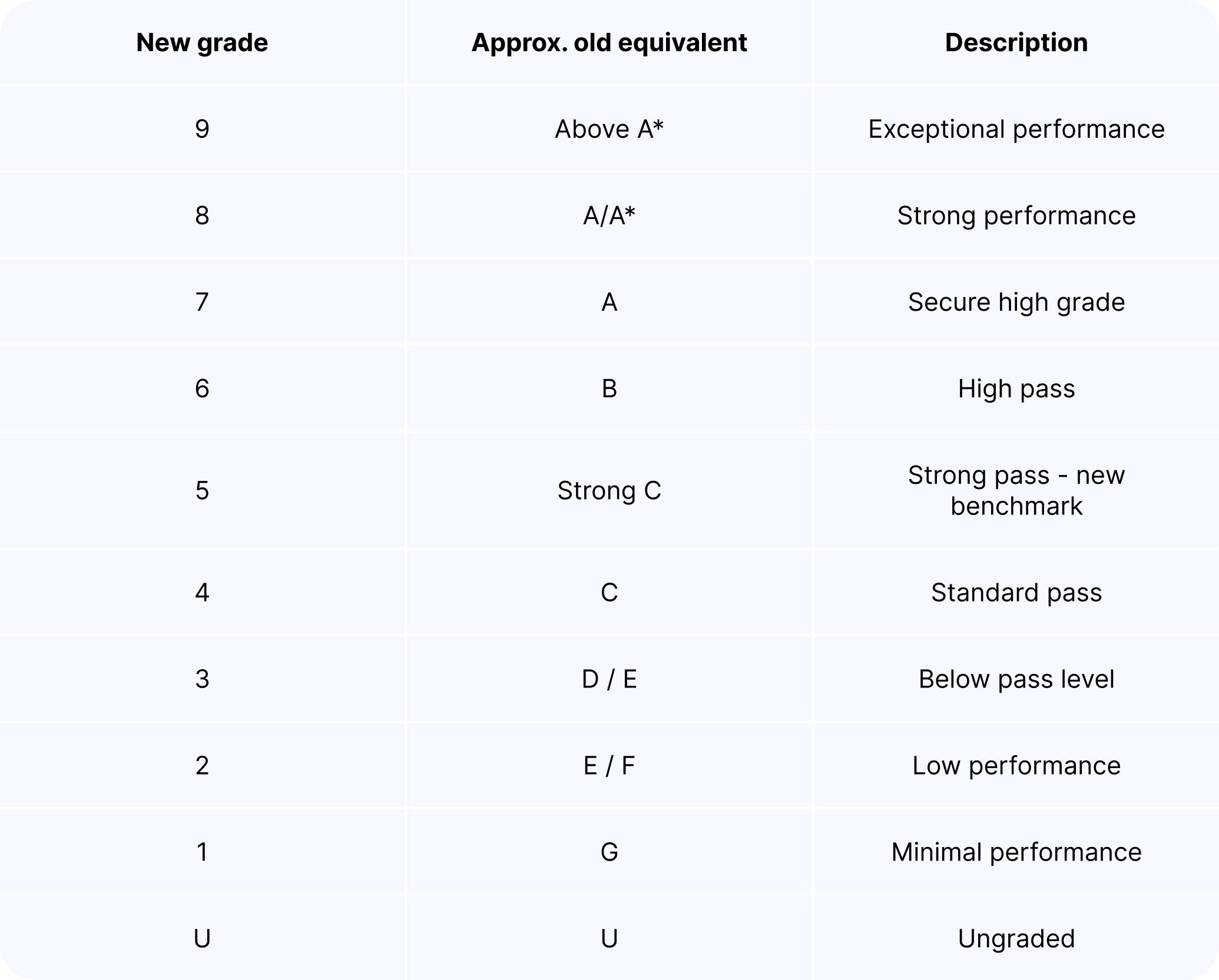
In particular, the top end of the scale was stretched to allow greater differentiation. For example, under the old system, A and A* covered a wide range of ability. Now, grades 7, 8 and 9 separate those students into clearer categories.
What impact do GCSE grades have?
GCSE grades can influence a range of next steps, including:
- Sixth form or college entry: Many require at least five GCSEs at grade 4 or above, including English and maths.
- A level subject choices: Some subjects require a grade 6 or above in the same subject at GCSE.
- University admissions: Competitive universities look at GCSEs in addition to A levels.
- Apprenticeships: Employers often expect minimum passes in English and maths.
- Future careers: GCSEs can be important indicators of academic strength, especially in core subjects.
Summary
The 9–1 GCSE grading system may look unfamiliar, but it plays a crucial role in helping students, schools and employers measure academic progress more clearly. Grade 9 rewards the very top performers, while grade 4 remains the baseline for a standard pass.
Understanding how the system works can help students set clear goals, track progress and feel more confident going into exam season.