

Which cohorts are affected?
These changes apply to students taking their GCSE exams in 2026 or 2027. That includes most students currently in Year 10 or Year 11 in the 2025-26 academic year.
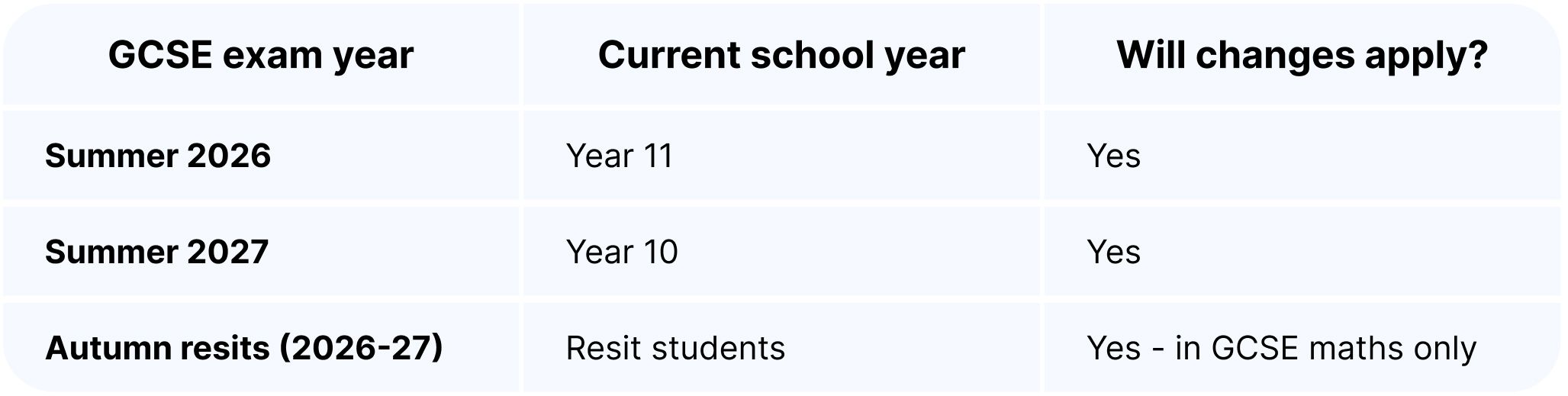
So, whether you’re teaching, supporting, or preparing for GCSEs in these years, you can expect these changes to be part of the exam experience.
How to prepare (and revise) effectively
Get familiar with the support sheets early
- Download and review the 2022–24 formula & equation sheets as soon as possible, as early exposure will help to embed understanding and familiarity.
- Practice applying, rearranging, and manipulating the formulas.
Adjust revision resources
- Schools will teach with the knowledge that students will use support materials in exams.
- Choose revision materials reflecting this: focus on problem-solving, not memory drills.
- Once the 2026 sheets are released in September 2025, download them and integrate them into practice papers.
Work on comprehension and reasoning
- As Ofqual emphasised, the goal is to test understanding, application, and rearrangement skills, not recall.
- Use question banks and past papers to practise identifying the correct formula or equation based on context and then using it.
Final thoughts
These updates, continuing formulae/equation sheets for GCSE maths, physics, and combined science through to 2027, bring clarity and fairness. Students can now devote more energy to a deeper understanding and less to memorisation. Students can concentrate on mastering core skills vital for GCSE success and beyond.