How to apply to grammar school in Enfield
1. Register for the 11 plus test
Before you register you should speak to your child’s teacher to see if the 11 plus and grammar school is right for them.
Register with The Latymer School on their website. Registration opens on 3rd May and closes on 16th June 2023. You will get an email invitation at least seven days before the test takes place. Tests in 2023 take place on 1st, 2nd and 3rd September.
If you are considering grammar schools outside Enfield, remember to register for their 11 plus exams too.
2. Apply for school places
Once you have the results of your child's 11 plus test (and any other 11 plus exams outside Enfield), you can decide which schools to include on your local authority application form.
Before listing a school on your form, check its admissions policy and make sure your child is eligible. In particular, make sure you live in the catchment area.
The application form must be submitted to your home local council by 31st October 2023.
5. National school offer day
On 1st March 2024, you will find out which school your child has been allocated a place at. They will be allocated a place at your highest-preferred school for which they meet the entry criteria and which has places available.
If no places are available at your preferred schools, they will be offered a place at another school in your area. You can appeal admissions decisions for The Latymer School here. Appeals are heard in May by an independent panel.
The Latymer School catchment area
The Latymer School only admits students who live in these postcode areas. There is no preference within this list.
- E2, E4, E5, E8, E9, E17, EN1, EN2, EN3, EN4, EN5 (Sectors 1, 2, 4, 5 only), EN8 (Sectors 7, 8, 9 only).
- N1 (not N1C), N2, N3, N4, N5, N6, N7, N8, N9, N10, N11, N12, N13, N14, N15, N16, N17, N18, N19, N20, N21, N22.
What's on the Enfield 11 plus test?
The Latymer School's 11 plus test consists of two papers:
- Maths and verbal reasoning
- English
Maths
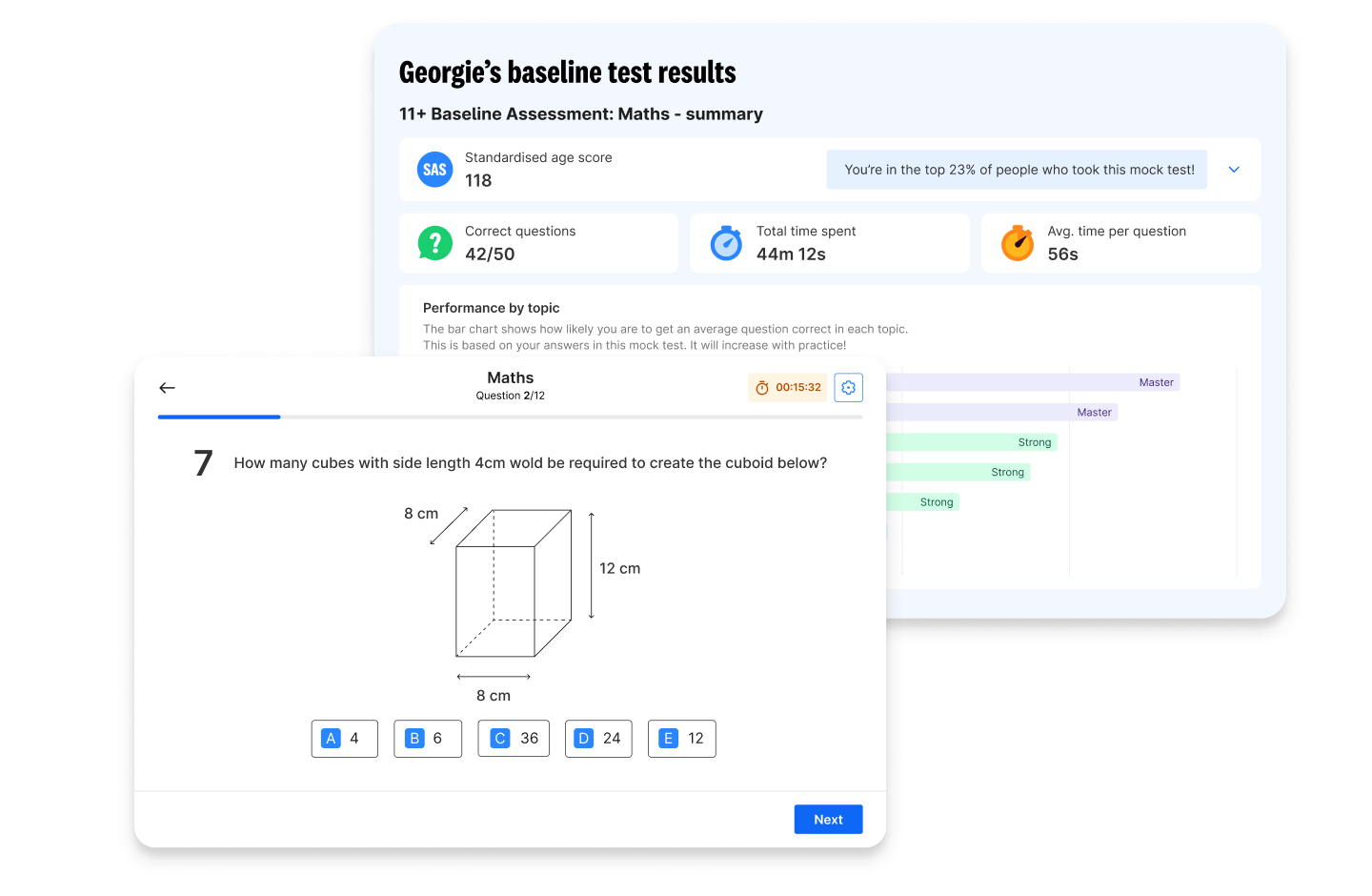
The maths section is provided by GL Assessment. It is in multiple-choice format. Children record their answers in a separate answer booklet which is marked by a computer.
The maths questions assess your child's understanding of Key Stage 2 national curriculum content, including Year 6 objectives that they will not yet have covered at primary school. The examiners don't expect children to have covered this content at school yet, but the exam tests their ability to reason and apply their knowledge accurately in these unfamiliar formats.
Topics covered:
- Number
- Measurement
- Data
- Algebra
- Geometry
Verbal reasoning
Like the maths section, the verbal reasoning section is provided by GL and is in a multiple-choice format.
The questions assess a child’s ability to connect, spot patterns with, and manipulate written information. It is not typically taught at school, so it's helpful to familiarise your child with these types of questions early on.
Verbal reasoning relies on a broad vocabulary base and understanding of word meanings both in and out of context. It can identify pupils whose strengths lie in English, history, languages and the arts.
English
The English paper is set by the school and marked by school staff. It is a written exam consisting of:
- Reading (30 minutes)
- Writing (30 minutes)
In the reading section, your child will be given an extract of about one side of A4 in length. In a separate question-and-answer booklet, there are about 12 questions asking your child to analyse and interpret the text. The questions assess your child's comprehension skills, particularly their ability to identify literary devices used and to infer and deduce information from the text.
The answer boxes are standard format for written answers. There is a total of 27 marks in this section and each question indicates the number of marks available. Children are told when it is time to move on to the writing task.
For the writing task, your child is asked to continue the passage in their own words. There are suggestions for things they might want to include, such as descriptions and dialogue. There are 25 marks available:
- 5 marks for spelling, punctuation and grammar
- 20 marks for the content (creativity and how well they have managed to imitate the tone and style of the passage)
.svg)