tom Learning is partnered with Kendrick School. You can read more about our partnership here.
Thinking about applying to Kendrick School? Find out everything you need to know about admissions and how to prepare your child for success in the 11 plus.
Key information about Kendrick School
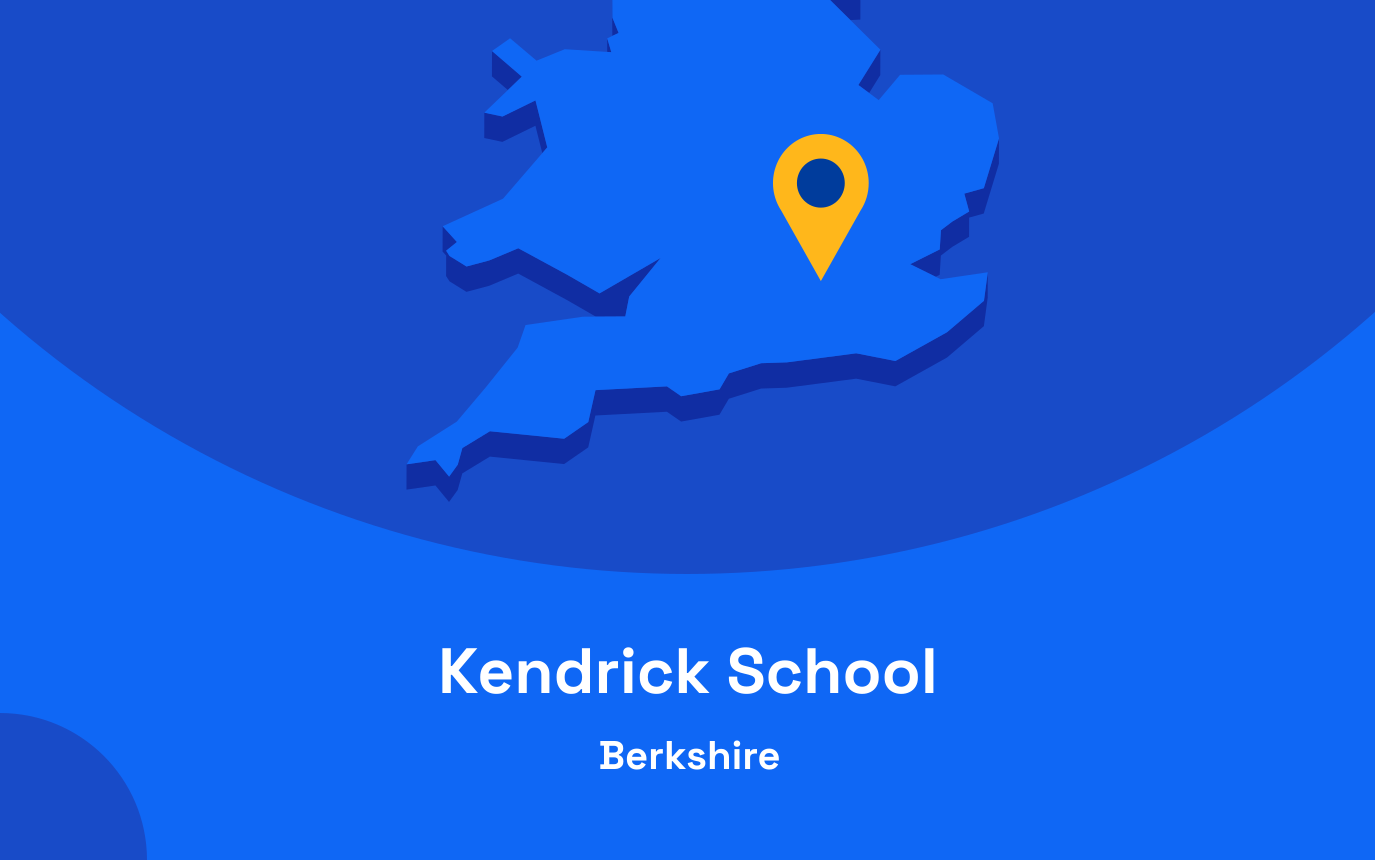
- Address: Kendrick School, London Road, Reading, Berkshire, RG1 5BN
- Number of pupils: 850+
- Admissions contact: [email protected]
- Number of places in Year 7: 128
- 11+ exam: GL Assessment 11 plus
- Catchment area: yes
Dates for your diary
- Tuesday 29th April 2025: Kendrick School open day
- Wednesday 30th April 2025: Kendrick School open day
- Thursday 1st May 2025: registration opens for the Kendrick School 11+ exam
- Tuesday 1st July 2025: registration closes for the Kendrick School 11+ exam
- Friday 19th September 2025: Kendrick School 11+ exam
- Mid-October 2025: parents receive test results
- Friday 31st October 2025: national deadline to apply for secondary school places
- Monday 2nd March 2026: national offers day
About Kendrick School
Kendrick School is a girls' grammar school founded in Reading, Berkshire. It was founded in 1877 and has an impressive record of academic achievement. Students' exam results are exceptional, placing the school among the best in the country.
Students at Kendrick School study a broad and balanced curriculum. Ofsted rates the school 'outstanding' in all areas, praising a 'first-class education'. Kendrick School is a hub school in the Science Leadership Partnership and provides science teaching support to other schools in Reading.
Beyond the classroom, girls at Kendrick School enjoy a diverse extracurricular education. Pupils are encouraged to get involved in the school's many clubs and societies. Activities include the creative arts, business and finance, dance and drama, music, and STEM.
How to apply to Kendrick School
Kendrick School is a selective school. This means that your child will need to take the 11 plus exam to be eligible for a place.
The deadline to register for the 11 plus exam at Kendrick School is Tuesday 1st July 2025. The exam will take place on Friday 19th September 2025 and you’ll receive your child’s results in mid-October. You can then use these results to decide whether to apply for a place at Kendrick School.
To apply, you’ll need to name the school as one of your preferred schools on the secondary school common application form. This will be available on your home council website from early September and must be submitted by 31st October 2025.
Remember – passing the 11 plus doesn’t guarantee that your child will be allocated a place at your preferred school. Many grammar schools are often oversubscribed with qualified children. Schools and their admissions authorities work through admissions criteria to prioritise children for places. We’ve included the admissions criteria for Kendrick School below.
What subjects are on the entrance exam?
Children applying to Kendrick School take an 11 plus exam provided by GL Assessment. This is one of the main providers of 11 plus exams in England.
The 11 plus exam for entry to Kendrick School consists of two one-hour papers. There will be a short break between the two papers.
All the questions are multiple-choice and cover four subjects:
- English: your child will be assessed on the English content they have learned in school up to the start of Year 6. Areas which are typically assessed include reading comprehension, spelling, punctuation and grammar.
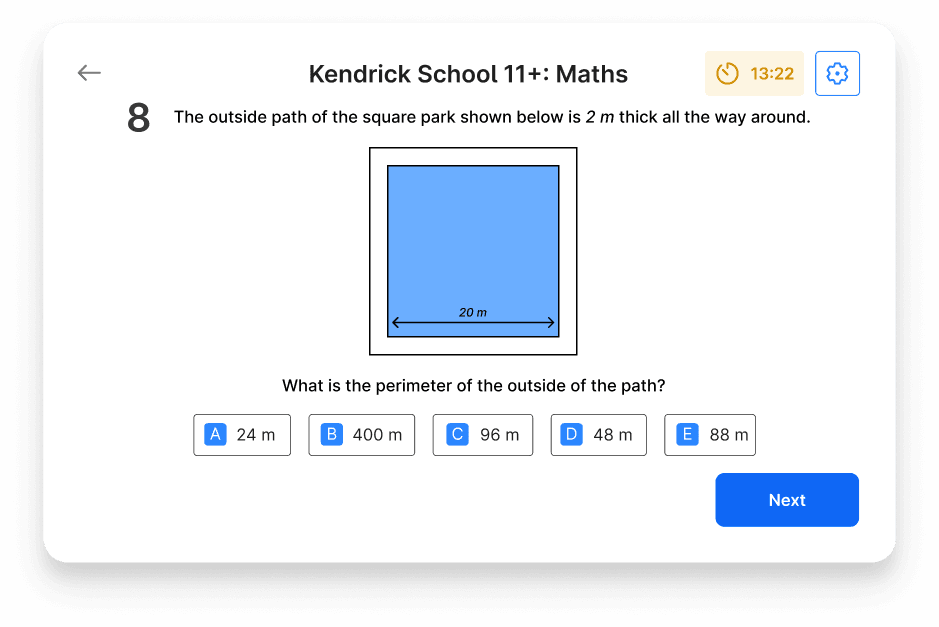
- Maths: the maths questions cover the content taught on the national curriculum up to the start of Year 6. Areas your child might be assessed on include aspects of number, measurement, geometry and statistics. They might need to apply their skills to solve unfamiliar styles of problems.
- Verbal reasoning: this is a type of problem-solving using written information – such as letters, symbols, numbers and words. Questions examine how words are produced, used, and the relationship between them. Your child might also need to use written information to solve a sequence.
- Non-verbal reasoning: this is a type of problem-solving using abstract information, such as shapes and diagrams. Your child will need to look at the relationships between shapes and sequences of shapes by identifying common features. Some non-verbal reasoning questions also involve codes, where your child will need to match features of a shape with letters.