Back to blog

KS2 factors: guide for parents

By
Atom
|
November 28, 2025

As your child moves up through Key Stage 2, they’ll start to learn about factors and prime numbers in maths lessons. If you’re looking to help your child learn at home but not sure where to start, we’re here to help!

Keep reading to:

  • Learn about factors and prime numbers
  • Understand what your child will be taught at school
  • Plus, download free factors worksheets for Years 5 and 6!

What is a factor?

A factor of a number defines the integers (whole numbers) which divide exactly into that number with no remainder. 5 is a factor of 35 because 35 ÷ 5 = 7.

Every number can be represented as a product of 2 of its factors. For example, we can represent the number 12 in 6 different ways:

  • 1 group of 12
  • 2 groups of 6
  • 3 groups of 4
  • 4 groups of 3
  • 6 groups of 2
  • 12 groups of 1

The reason for this is that the number 12 has 6 different factors: 1, 2, 3, 4, 6 and 12.

What are common factors?

Common factors describe the factors which two different numbers can both be divided by. For example, take the factors of 16 and 18:

  • Factors of 16: 1, 2, 4, 8, 16
  • Factors of 18: 1, 2, 3, 6, 9, 18

The only common factor (other than 1) between these two numbers is the number 2. Since 16 isn't a factor of 18, both numbers also have factors which are unique to them. 12 and 16 do not share all their factors, but still have 3 common factors: 4, 2 and 1.

In Key Stage 2 maths tests, your child might see factor questions involving a Venn diagram. Here’s an example of one of these types of questions on Atom.
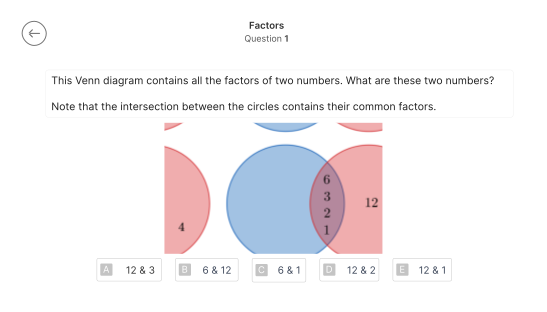
A question about factors involving a Venn diagram on Atom

In the right (red) circle, we see all the factors of 12. These are 1, 2, 3, 4, 6 and 12.

All the numbers in the left (blue) circle are in the intersection, meaning there are no factors of the left number that are not factors of 12. This means that all the factors of the left number are also factors of 12 – so the number itself must be a factor of 12.

The factors in the intersection are all the factors of 6, so the left number is 6. The correct answer is 6 & 12.

Your child might also come across longer worded questions. Take a look at this example from Atom:
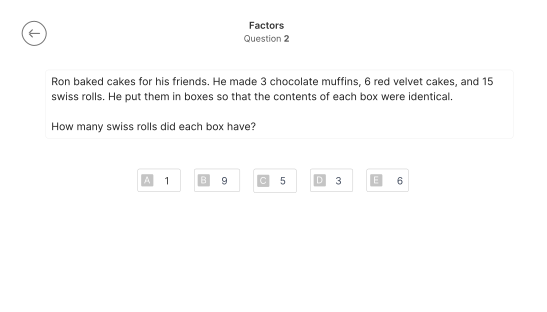
A worded question about factors on Atom

To solve this problem, we need to find a common factor of 3, 6 and 15. This will give us the number of boxes.

  • The factors of 3 are 1 and 3
  • The factors of 6 are 1, 2, 3 and 6
  • The factors of 15 are 1, 3, 5 and 15

The only common factor of 3, 6 and 15 is 3. Ron can pack 3 identical boxes. To find out how many pastries are in each identical box, we divide their total by 3. Each box will have 1 chocolate muffin (3÷3), 2 red velvet cakes (6÷3), and 5 swiss rolls (15÷3).

So the answer is C – 5 swiss rolls.

Join Atom’s free parent newsletter

Stay one step ahead of your child’s learning journey. Get expert advice on 11+ prep, Key Stage 2 support, and school admissions, plus practical tips and free resources, sent straight to your inbox.

Sign me up

What is a prime number?

A prime number is a whole number that has exactly two factors: 1 and itself. When a prime number is divided by 1 or itself, the result is a whole number with no remainders, decimals or fractions.

1 is not a prime number because it can only be divided by one number: itself.

The first prime number is 2, because it can be divided by two numbers: 1 and itself. 2 is also the only even prime number, as all even numbers can be divided by 2.

The opposite to a prime number is a composite number. A composite number has more factors than 1 and itself. For example, 6 is a composite number because it can also be divided by 2 and 3.

Prime numbers 1 to 100

  • 2
  • 3
  • 5
  • 7
  • 11
  • 13
  • 17
  • 19
  • 23
  • 29
  • 31
  • 37
  • 41
  • 43
  • 47
  • 53
  • 59
  • 61
  • 67
  • 71
  • 73
  • 79
  • 83
  • 89
  • 97

Prime factor trees

All integers (whole numbers) can be expressed as a product of their prime factors. A prime factor is a prime number that is a factor of a number.

All integers can be broken down into prime factors. We do this by repeatedly dividing the number by integers until it becomes a series of prime numbers. A prime factor tree can help us find them.

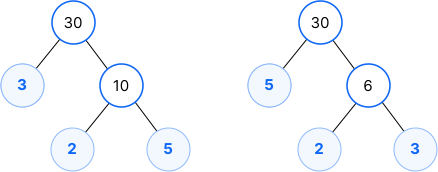
Below are two prime factor trees for 30. The prime factors are shown in light blue, at the end of the branches.

It doesn't matter which way you split up the number – the prime factors will always be the same.

Prime factor trees for the number 30

What will my child learn about factors in Key Stage 2?

Factors and prime numbers are generally not taught until Year 5 – the start of Upper Key Stage 2. Your child will learn:

  • How to find all the factor pairs of a number, and common factors of two numbers
  • The vocabulary of prime numbers, prime factors and composite numbers
  • How to work out whether a number up to 100 is prime
  • To recall prime numbers up to 19
  • How to use factors to solve problems involving multiplication and division

In Year 6, your child will continue to build upon their knowledge of factors and prime numbers from Year 5. They will be expected to identify common factors, common multiples and prime numbers, and use common factors to simplify fractions.

No items found.
No items found.
No items found.
No items found.

Build strong English, maths and science skills.

Want to support what your child is learning at school, or help them stretch beyond it? Atom gives them the right blend of challenge and support. Help them strengthen foundations, deepen understanding, and grow confident in the subjects that matter most for Key Stage 2 and beyond. 

  • Follow personalised weekly learning plans that adapt to your child’s level and keep them progressing in English, maths and science. 
  • Learn through interactive lessons that stretch their thinking and reinforce key skills. 
  • Track progress topic by topic. See their strengths and pinpoint where they need to improve. 
Strengthen foundations and build confidence.

Start your free trial and help your child make real school progress today.

Try Atom for free

Contents