Acing your OCR Combined Science GCSE starts with good preparation.
This guide breaks down everything you need to know about the exams, including the format, potential grade boundaries, where to find past papers, and how to prepare. So, whether you’re deciding if Combined Science is right for you or deep in revision, we’re here to help.
Combined science is a double award, so you’ll receive two final grades.
You can study either Gateway Science or 21st Century Science, with Gateway following a more traditional format separating Physics, Chemistry and Biology.
A formula sheet for Physics will be provided for Combined Science exams.
What’s the format for OCR Combined Science GCSE?
There are several different options for OCR Science so you can choose the right level and structure for you.
Combined Science is a double award, meaning you’ll receive two final grades (eg. 6-7)
There are two tiers you can study: Foundation and Higher.
There are two types of OCR Combined Science exam: Gateway Science A or 21st Century Science B.
Both types test Chemistry, Biology and Physics.
What’s the difference between Gateway Science and 21st Century Science?
There are two routes for Combined Science with OCR: Gateway Science and 21st Century Science.
The key differences between the two are:
Gateway Science OCR
Focuses on each of the three sciences individually: Chemistry, Biology and Physics.
There are six papers: two for Chemistry, two for Physics and two for Biology.
Each paper is 1 hour and 10 minutes long and worth 60 marks each.
Each science discipline is assessed separately across two papers.
21st Century Science
Learning is grouped into chapters that mix Physics, Chemistry and Biology into themed modules.
There are four papers.
Each paper is 1 hour and 45 minutes long and worth 95 marks each.
The learning is more integrated, linking topics across disciplines.
Six months. Six epic prizes. Still up for grabs: tickets to Reading Festival 2026 and the latest Apple tech, including an iPad Air, Vision Pro and more.
What’s the difference between Combined Science: Higher and Foundation?
As well as choosing Gateway Science or 21st Century Science, you can also take Higher or Foundation tier Combined Science, depending on your level.
Foundation tier Combined Science OCR:
Covers the core topics you need to know and excludes more complex or demanding areas.
In Foundation Combined Science, you can achieve a maximum grade of 5-5.
Higher tier Combined Science OCR:
The higher tier covers both core and more advanced topics across the curriculum.
For Higher tier Combined Science, you can achieve a maximum grade of 9-9 - the highest possible grade.
The lowest grade you can get is a 4-4, or a 4-3 for students who just miss a 4-4.
Your school will place you in the correct tier based on your performance in Year 9. Sometimes, students may be moved up or down a tier during Year 10 or 11.
OCR requires all Combined Science exams to be taken at the same level, so you cannot do Higher for one part and Foundation for another.
Is there an equations sheet for Combined Science OCR?
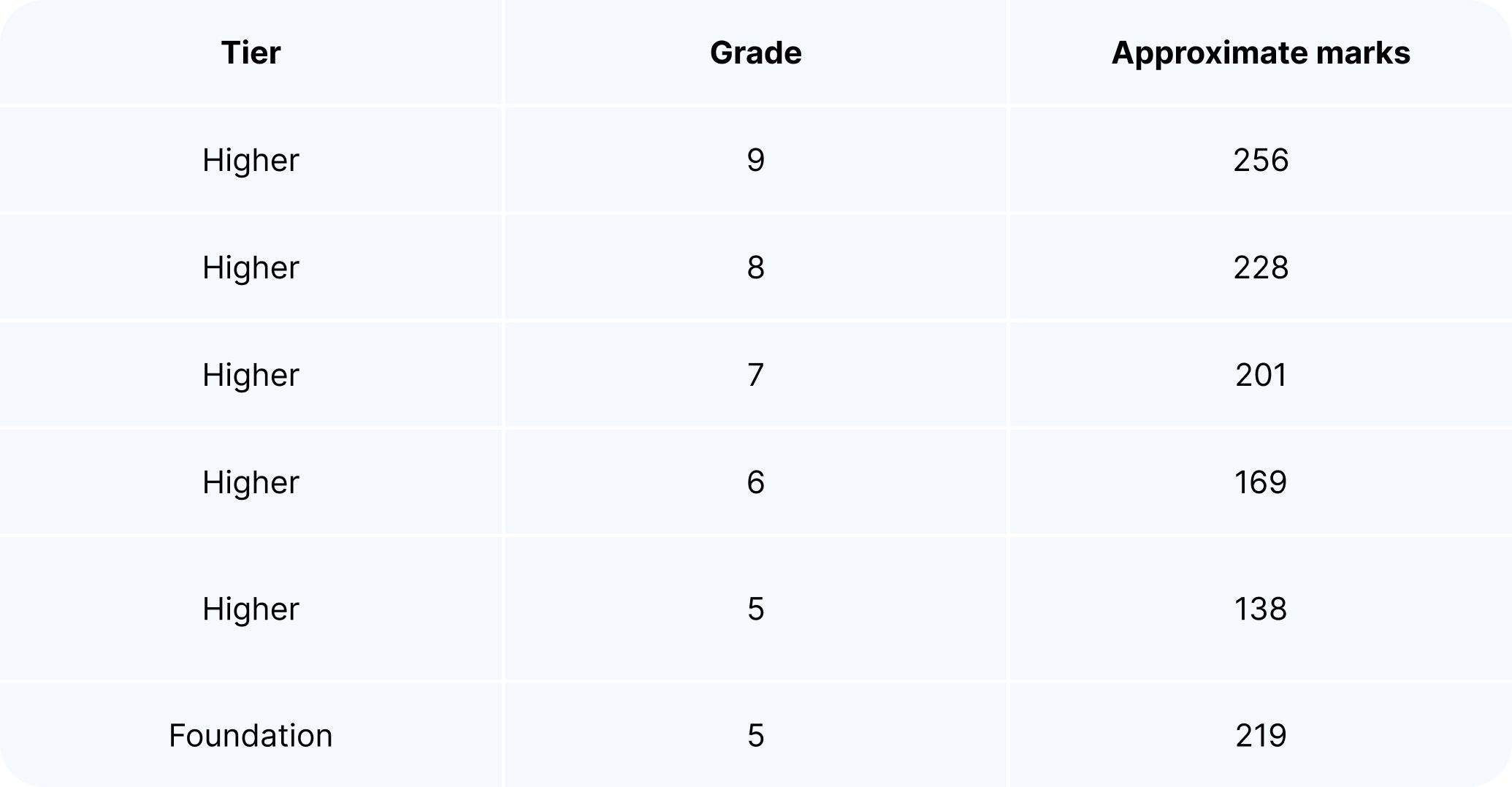
What are the grade boundaries for Combined Science GCSE?
It’s important to remember that the exact grade boundaries for your GCSE exams will change every year.
Exam boards adjust the grade boundaries after an exam has happened, depending on how advanced the exam content was and how the cohort performed.
This is so students don’t have an advantage or disadvantage because of the year they took the paper. For example, if your paper were harder, grade boundaries would be lowered so that a grade 5 reflects the same level of knowledge as in previous years.
With Combined Science giving you two grades, it can be confusing to understand whether you’ve passed or not if one of your marks is lower than a 4 or 5.
So, is a 4-3 a pass for GCSE Combined Science?
It’s important to understand that your grade is based on your overall mark across the three subjects. You can only get either the same grade (5-5) or adjacent grades (5-4) to reflect your performance across the papers.
A 4-3 would not count as a full pass. You have one pass and one fail. The best thing to do is check with your school or college to determine whether you need to resit or not to carry on with your choice of Further Education.
Where can I find past papers and mark schemes?
Practising with past papers and mark schemes is one of the most effective ways to prepare for GCSE Combined Science.
Past papers help you understand question styles, see how marks are awarded, and build confidence with real exam timing and structure.
Head to the OCR website to find past papers and mark schemes from previous GCSE Combined Science exams for Gateway and 21st Century.
What key topics do I need to know for OCR Combined Science GCSE?
Combined Science papers cover a range of topics. You’ll need a thorough understanding of each to achieve top marks, so make sure you revise any areas you find tricky ahead of the exams.
The main topics for Combined Science: Gateway are:
Biology topics
B1: Cell level systems
B2: Scaling up
B3: Organism level systems
B4: Community level systems
B5: Genes, inheritance and selection
B6: Global challenges
CS7: Practical skills
Chemistry topics
C1: Particles
C2: Elements, compounds and mixtures
C3: Chemical reactions
C4: Predicting and identifying reactions and products
C5: Monitoring and controlling chemical reactions
C6 Global challenges
CS7: Practical skills
Physics topics
P1: Matter
P2: Forces
P3: Electricity and magnetism
P4: Waves and radioactivity
P5: Energy
P6: Global challenges
CS7: Practical skills
The main topics for Combined Science: 21st Century are:
Biology topics
B1: You and your genes
B2: Keeping healthy
B3: Living together - food and ecosystems
B4: Using food and controlling growth
B5: The human body - staying alive
B6: Life on Earth - past, present, and future
Chemistry topics
C1: Air and water
C2: Chemical patterns
C3: Chemicals of the natural environment
C4: Material choices
C5: Chemical analysis
C6: Making useful chemicals
Physics topics
P1: Radiation and waves
P2: Sustainable energy
P3: Electric circuits
P4: Explaining motion
P5: Radioactive materials
P6: Matter - models and explanations
General topics
BCP7: Ideas about science
BCP8: Practical skills
Check out the OCR GCSE Combined Science specification for Gateway and 21st Century to learn more.
What are examiners looking for?
The assessment objectives for GCSE Combined Science are set by Ofqual, the exams regulator, and are consistent across exam boards.
Examiners are looking for the following in your exam papers:
AO1: Demonstrate knowledge and understanding of scientific ideas; scientific techniques and procedures
AO2: Apply knowledge and understanding of scientific ideas; scientific enquiry, techniques and procedures
AO3: Analyse information and ideas to interpret and evaluate; make judgments and draw conclusions; develop and improve experimental procedures
How can I prepare for OCR Combined Science GCSE?
To prepare for Combined Science exams, you’ll need to start revising early to make sure you’re confident covering all the key topics.
5 top tips to prepare for GCSE Combined Science:
1. Understand key vocabulary, definitions and units
Don’t miss out on marks for questions asking you to state or define terms. Make sure you get your head around the key vocab, definitions and units. You can use flashcards to help you memorise key terms and quiz yourself.
2. Use practice papers and mark schemes
The best way to prepare? Practise like it’s test day. Practising exam questions from past papers and checking your answers will help you get used to the question format and understand how to get top marks. You can also take a whole test and practise under timed conditions too, to build confidence for the real thing.
3. Mix up your revision techniques
It’s a good idea to try a mix of revision tactics. From flashcards to teaching others, a mix will help learning to stick. Studying little and often will also help you avoid fatigue and burnout.
4. Practise applying and analysing knowledge and ideas
Assessment objectives 2 and 3 are asking you to apply what you know to analyse and draw conclusions. When you learn a new concept, try asking yourself: how can I apply this in a different scenario? Or what assumptions or errors might affect this conclusion?
5. Plan, review, and adapt your revision
After each mock or practice paper you take, identify the topics or question types you struggle with, then prioritise those in your next revision cycle. Over time, your weak areas will shrink and your confidence will grow!
Preparing for OCR Combined Science, whichever route you choose, doesn’t need to feel stressful. Bookmark this blog to refer back to when you need to. Remember, with proper preparation, you’ll enter the exam hall confident. Good luck!