Standardisation is a way to remove variables from test scores to compare results fairly. Children's raw scores (their total number of marks) are converted into standardised age scores (SAS) to make sure they aren't disadvantaged based on when they were born in the year.
Why are scores age standardised?
Two children in the same school year can be almost 12 months apart in age, giving the older child a big advantage. To balance this out and even their chances, younger pupils are given extra marks.
For example, children are exposed to more than 1,000 new words a year. The children born in September will have had a much larger opportunity to develop their vocabulary than those born in August.
Concerned that your autumn-born child will have marks taken off them? Don't worry, they won’t. Younger children can gain marks, but older children will never lose marks.
No items found.
How is a standardised age score calculated?
Each child’s SAS is calculated from:
The number of questions they answered correctly
The difficulty of the questions they answered
Their age in years and months (e.g. 10 years and 9 months)
1. Attainment estimate
The first step in calculating an SAS is to work out an attainment estimate. This takes into account both the number of questions answered correctly and the difficulty of each question they answered correctly.
2. Age standardisation
Next, these scores are adjusted based on the child's age at the time they sit the exam. For example, let's say a child with a September birthday and a child with an August birthday both achieve a raw score of 100. The older child may end up with an SAS of 118, and the younger may be given an SAS of 121.
3. Stanine placement
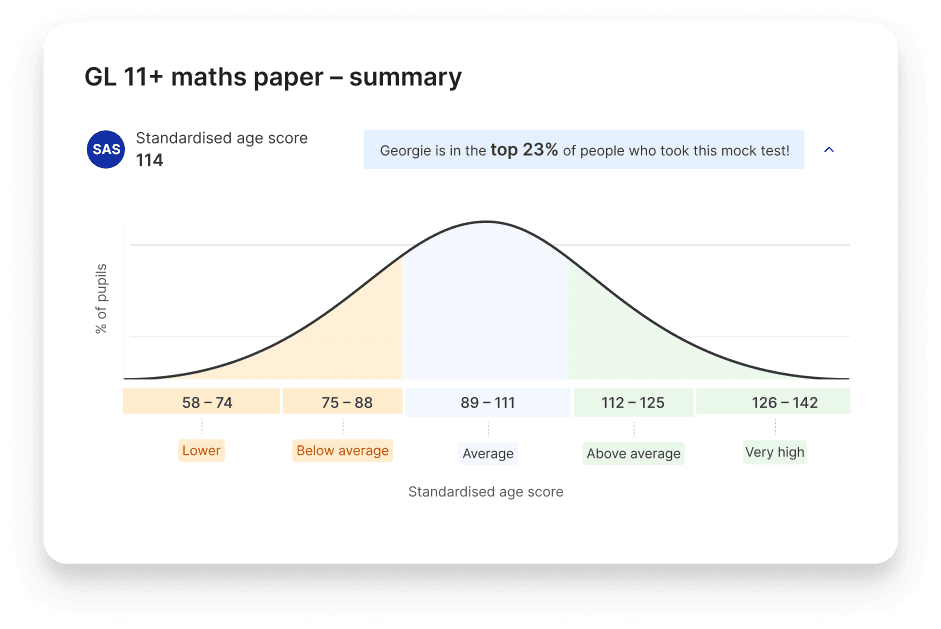
After standardising , pupils' scores are placed on a stanine curve. This represents a scale of 1 (low) to 9 (high), where 5 represents the average for that child's age. The stanine can give a broad overview of performance at an individual and year-group level.
What is a good SAS on the 11 plus?
120 or above is the top 10% of the year group
100 is average for the year group
80 or below is the lowest 10% of the year group
The highest SAS a child can achieve is usually 142. This would place them in the top 1% of children taking the test. The lowest SAS is usually 60.
Is your child ready for the 11+?
See where they stand in minutes. Atom’s free 11+ baseline tests give you an instant breakdown of their strengths and gaps. Know exactly what to focus on next and start preparing with direction, not uncertainty.
Some grammar schools and grammar school consortiums set a pass mark – or 'qualifying mark' - for their 11 plus exams, but this isn't consistent across the country. Many schools rank the SAS of every child who took the test from highest to lowest. They then offer places to a set number of the highest-scoring pupils (e.g. the 180 children with the highest scores).
Achieving the pass mark does not guarantee an offer of a place. For entry to grammar schools, it simply means that you can list the school as a preference on your common application form. Other admissions criteria is always taken into account when offering places – such as whether a child lives within a certain catchment area, if they are in public care or previously in public care, or qualify for free school meals.
Some grammar school consortiums do have set pass marks, or have provided historic qualifying marks:
Buckinghamshire Children taking the Buckinghamshire Secondary Transfer Test need a standardised score of 121 or above to be eligible for a grammar school place.
Kent The highest possible score in the Kent Test is 423.
Your child will get three standardised scores: one for English, one for maths, and one for reasoning. They will also receive a total score. Grammar schools in Kent are looking for a total score of 332 or more, with no individual test score lower than 109.
Kingston-upon-Thames In 2022, the Tiffin Schools only offered places to children who achieved the following standardised scores or higher:
Tiffin School: 103
Tiffin Girls' School: 107
Lincolnshire Lincolnshire grammar schools have a qualifying standardised score of at least 220 (out of a total of 282 available marks).
Slough The eligibility score for the Slough 11 plus is 111.
Trafford The qualifying standardised mark for Trafford grammar schools has historically been 334. This is the combined mark from both test papers.
Wirral Children taking the Wirral Admissions Test need a combined standardised score of 236 or above to be considered for a place.
Medway The pass mark for the Medway Test varies each year. However, the lowest total weighted score hasn't dipped below 483 in the past four years.
The total weighted score is calculated using this formula:
(Extended writing standardised score x 2) + (maths & non-verbal reasoning standardised score x 2) + (verbal reasoning standardised score x 1)
West Midlands The West Midlands Grammar Schools partnership is new in 2023, and covers grammar schools across Birmingham, Warwickshire, Shropshire, Staffordshire, Walsall, and Wolverhampton.
In the past few years, the qualifying score for entry to Birmingham grammar schools was 205 (combined from both test papers). Children who scored 224 or above were prioritised for places.
What 11 plus score should my child aim for?
By the time your child is ready to sit the eleven plus, they should be achieving an SAS of at least 115. For more competitive grammar or independent schools, aim for an SAS of 120 and above. 11 plus practice papers are a useful way to see how your child is likely to perform on the real exam at their current level of knowledge.
Your child's SAS is a helpful indicator of their progress, as it is the same scoring system used in the real exam. Keeping an eye on how it develops will give you insights into how quickly they are improving, as well as highlighting subtopics that need more practice.
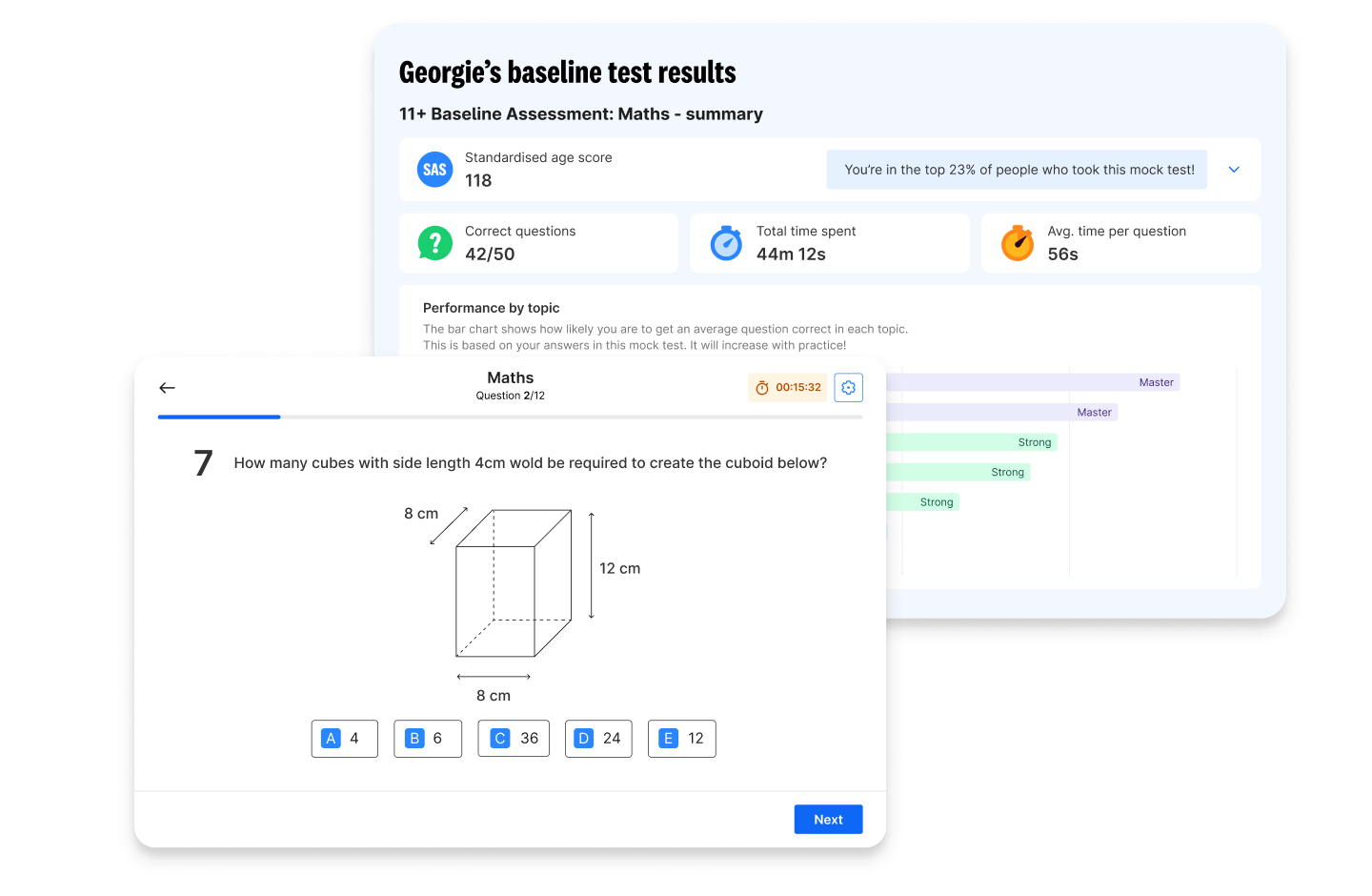
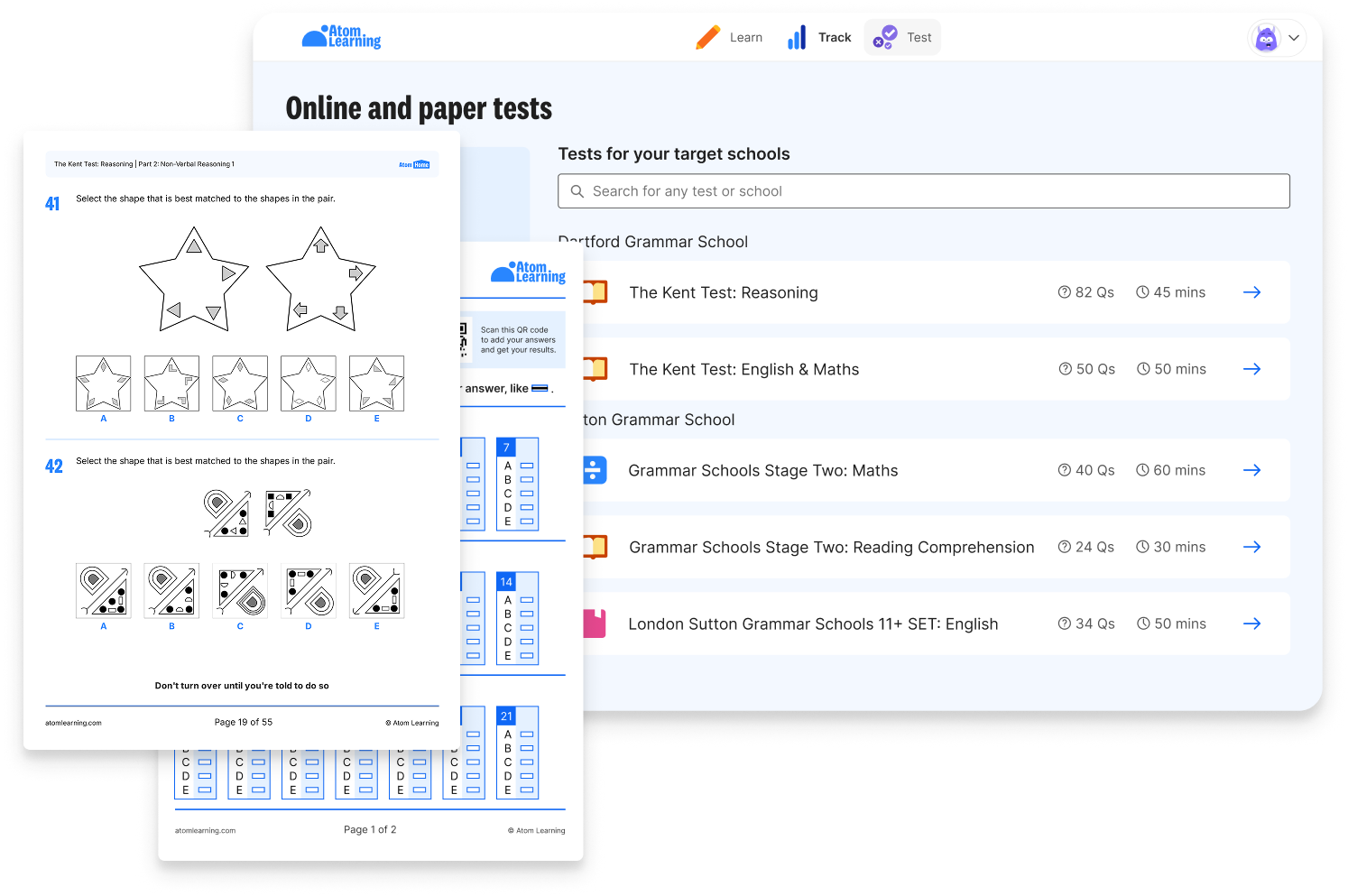
With Atom Home, you can set your child 11 plus test papers that replicate real exams used by grammar schools across the UK. Atom's online mock tests are automatically-marked, giving you instant data on your child's progress. This includes:
Your child's standardised age score
An indication of their time management (questions attempted, time taken, and average time per question)
A breakdown of their ability in all tested subtopics
Plus, use Atom's smart algorithm to quickly set your child a practice in areas they found challenging!
No items found.
No items found.
No items found.
Take control of your child’s 11+ preparation.
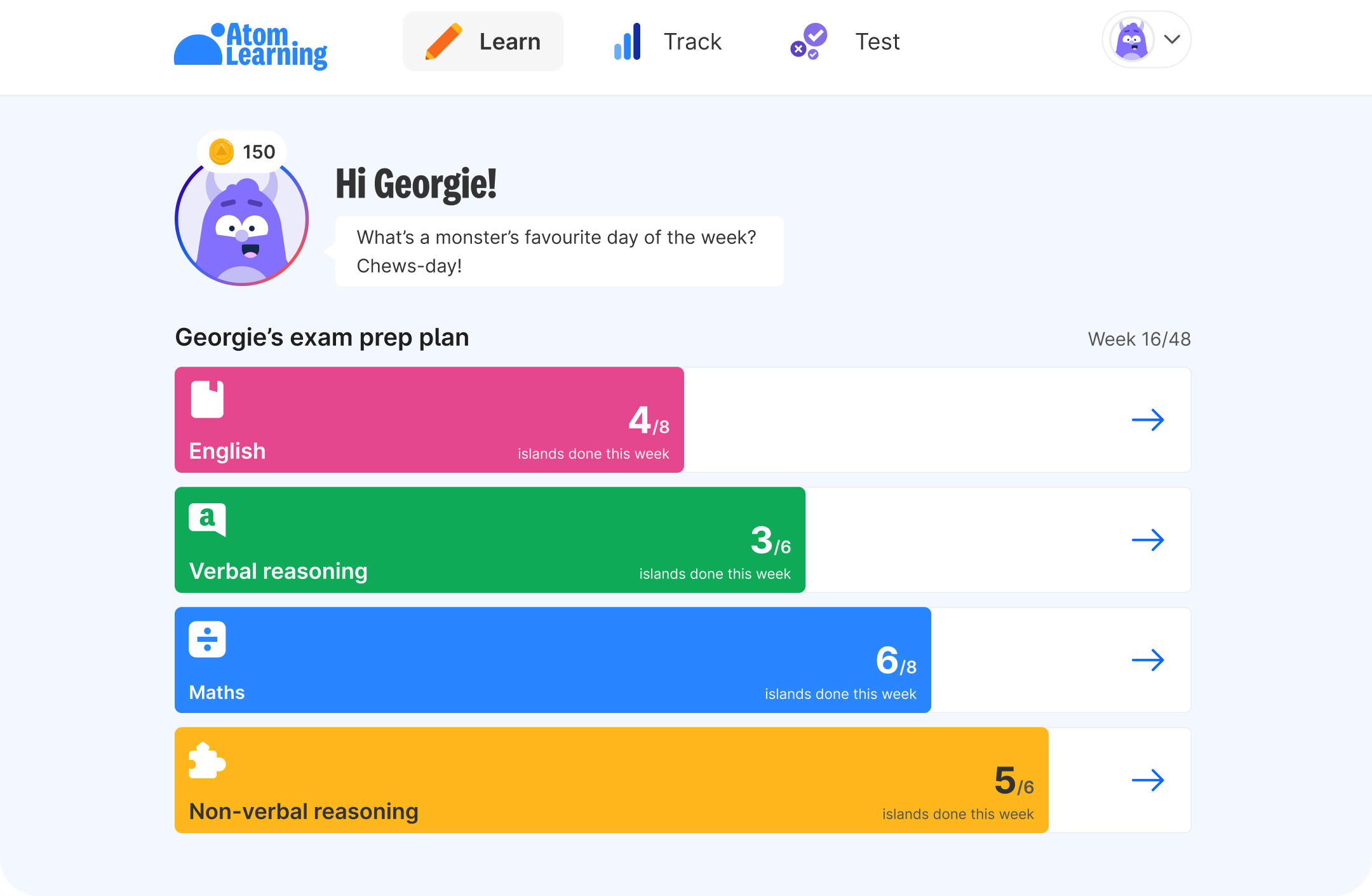
Not sure if your child is on track for the grammar school 11+? You don’t need to guess what to cover or whether they’re ready. Atom shows you exactly what to practise each week and how they’re performing, so you can stay ahead of the process without the stress.

.avif)