Key learning objectives
Exam boards assess students on:
- Knowledge and understanding of beliefs, teachings, and practices within chosen religions
- Interpretation of religious texts and sources to support points
- Analysis and evaluation of different viewpoints, including non-religious perspectives
- Application of knowledge to moral, ethical, and philosophical questions
- Clear, structured communication in both short and extended answers
Sample questions by paper
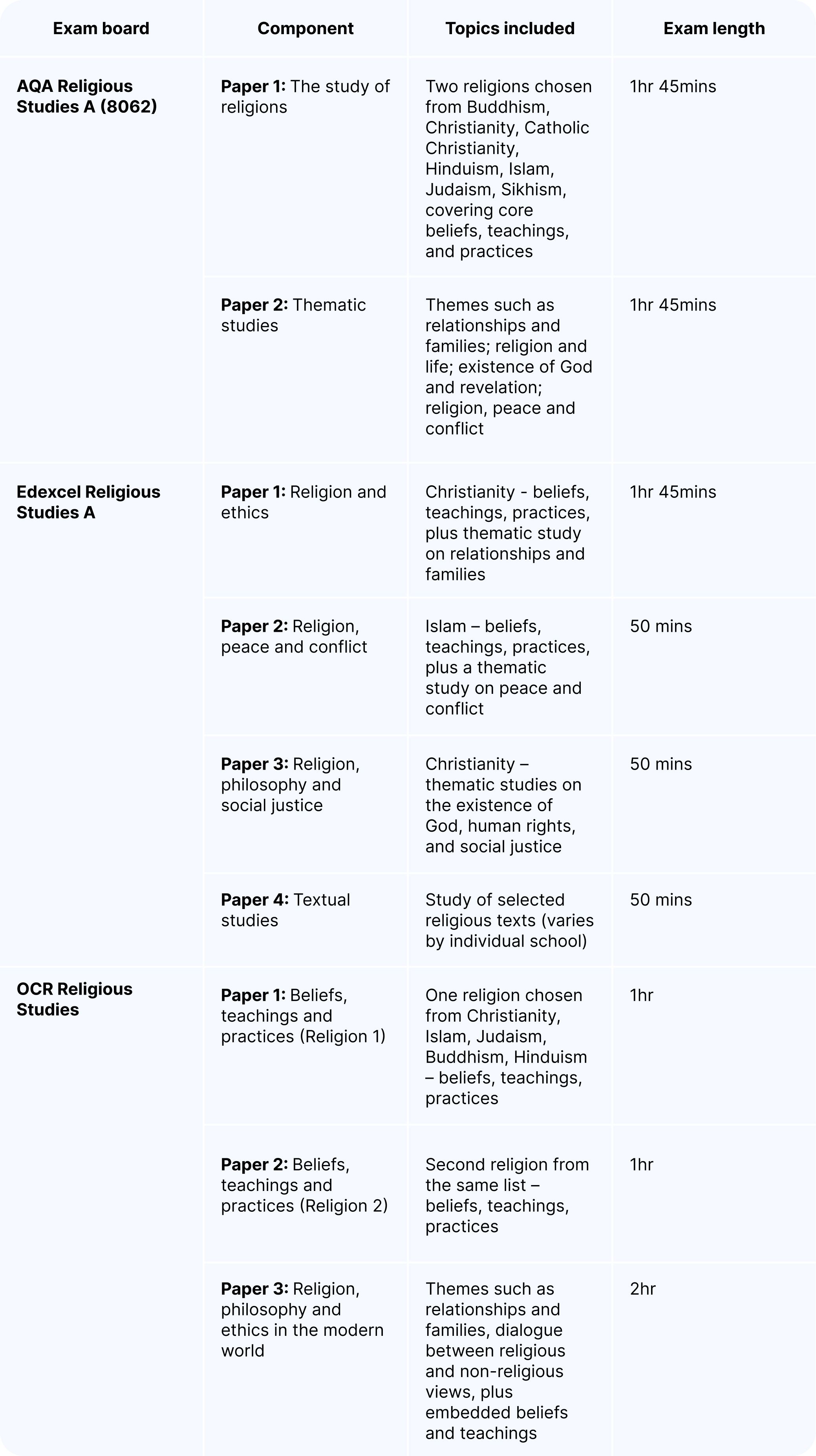
These examples give a flavour of the types of questions students will face. Parents can use them for discussion or timed practice, and teachers can adapt them for planning and assessment.
AQA Religious Studies A (8062)
Paper 1: The study of religions
Two religions chosen from Buddhism, Christianity, Catholic Christianity, Hinduism, Islam, Judaism, Sikhism – beliefs, teachings, practices
Example question: Describe two Muslim beliefs about the Imamate in Shi’a Islam. (4 marks)
How to revise at home:
Make flashcards linking each belief to a supporting religious teaching or source.
Paper 2: Thematic studies
Thematic areas like religion and life, peace and conflict, existence of God, relationships and families.
Example question: “Religion always promotes peace.” Evaluate this statement, referring to Buddhist and non-religious views. (12 marks)
How to revise at home: Practise writing short “for” and “against” points before combining them into a full answer.
Edexcel Religious Studies A (1RA0)
Paper 1: Religion and Ethics
Example question: Describe two Hindu beliefs about karma. (4 marks)
How to revise at home: Make flashcards with key terms like karma, moksha and samsara.
Paper 2: Religion, peace and conflict
Example question: Explain two Sikh teachings about equality. (5 marks)
How to revise at home: Link each belief to a story or example from Sikh history to strengthen recall.
Paper 3: Religion, philosophy and social justice
Themes: existence of God, human rights, social justice
Example question: ‘The existence of suffering proves God does not exist.’ Evaluate this statement, referring to religious and non-religious views. (12 marks)
How to revise at home: Plan quick essay outlines with one point for and one against the statement.
Paper 4: Textual studies
Religious text chosen by the school from the exam board’s approved list
Example question: Explain two teachings from St Mark’s Gospel about discipleship. (5 marks)
How to revise at home: Highlight key passages and write one-sentence summaries for each.
OCR Religious Studies (J625)
Paper 1: Beliefs, teachings and practices (Christianity example)
Example question: “Give three ways in which Christians might worship during a church service.” (3 marks)
How to revise at home: List different worship actions and quiz each other on their meanings.
Paper 2: Beliefs, teachings and practices (Islam example)
Example question: “Give three ways in which Muslims might worship during daily prayer.” (3 marks)
How to revise at home: Use flashcards to match each act of worship to its description.
Paper 3: Beliefs, teachings and practices (Judaism example)
Example question: “Describe the nature of the Talmud.” (3 marks)
How to revise at home: Write a one-sentence summary of the Talmud and why it’s important.
Tips for revision and exam preparation
A strong revision plan for GCSE Religious Studies balances learning key beliefs and practices with practising how to write well-structured answers.
Here are some strategies that make a real difference:
1. Break topics into manageable chunks
Religious Studies covers multiple faiths and a range of ethical themes.
Focus on one area at a time, for example, revising Buddhist teachings on suffering or the Christian concept of forgiveness before moving on. This avoids overload and helps build confidence step by step.
2. Use sources of authority effectively
Examiners often expect answers to be backed up with quotes or references from scriptures and religious texts.
Create a short list of key sources for each religion studied and practise weaving them into written answers. Even one well-chosen quotation can secure higher marks.
3. Practise short and extended questions
The exam includes quick-fire knowledge checks as well as longer evaluative essays. Build the habit of practising both.
For shorter questions, focus on accuracy and clarity; for longer ones, practise structuring balanced arguments with clear conclusions.
4. Test recall with flashcards and quizzes
Flashcards are a useful way to memorise key terms and definitions such as karma, atonement, or sewa.
Parents can help by testing knowledge, or students can use apps for quick daily practice to strengthen recall.
5. Discuss and debate themes
Many topics in Religious Studies involve different perspectives on moral and ethical issues.
Talking these through with friends, family, or study partners helps refine arguments and improves confidence in expressing ideas clearly under exam conditions.
Building confidence for GCSE Religious Studies success
Whether it’s understanding different beliefs, exploring big ethical questions, or practising exam technique, GCSE Religious Studies offers valuable skills that extend far beyond the classroom. A clear grasp of the topics and exam structure for the chosen exam board can make revision more focused and effective.
With regular practice, thoughtful discussion, and a balanced approach to preparing for each paper, students can confidently approach their exams and achieve their full potential.