Atom Learning is partnered with Tunbridge Wells Girls' Grammar School. You can read more about our partnership here.
Thinking about applying to Tunbridge Wells Girls' Grammar School? Find out everything you need to know about admissions and how to prepare your child for success in the Kent Test in 2025.
Key information for Tunbridge Wells Girls' Grammar School
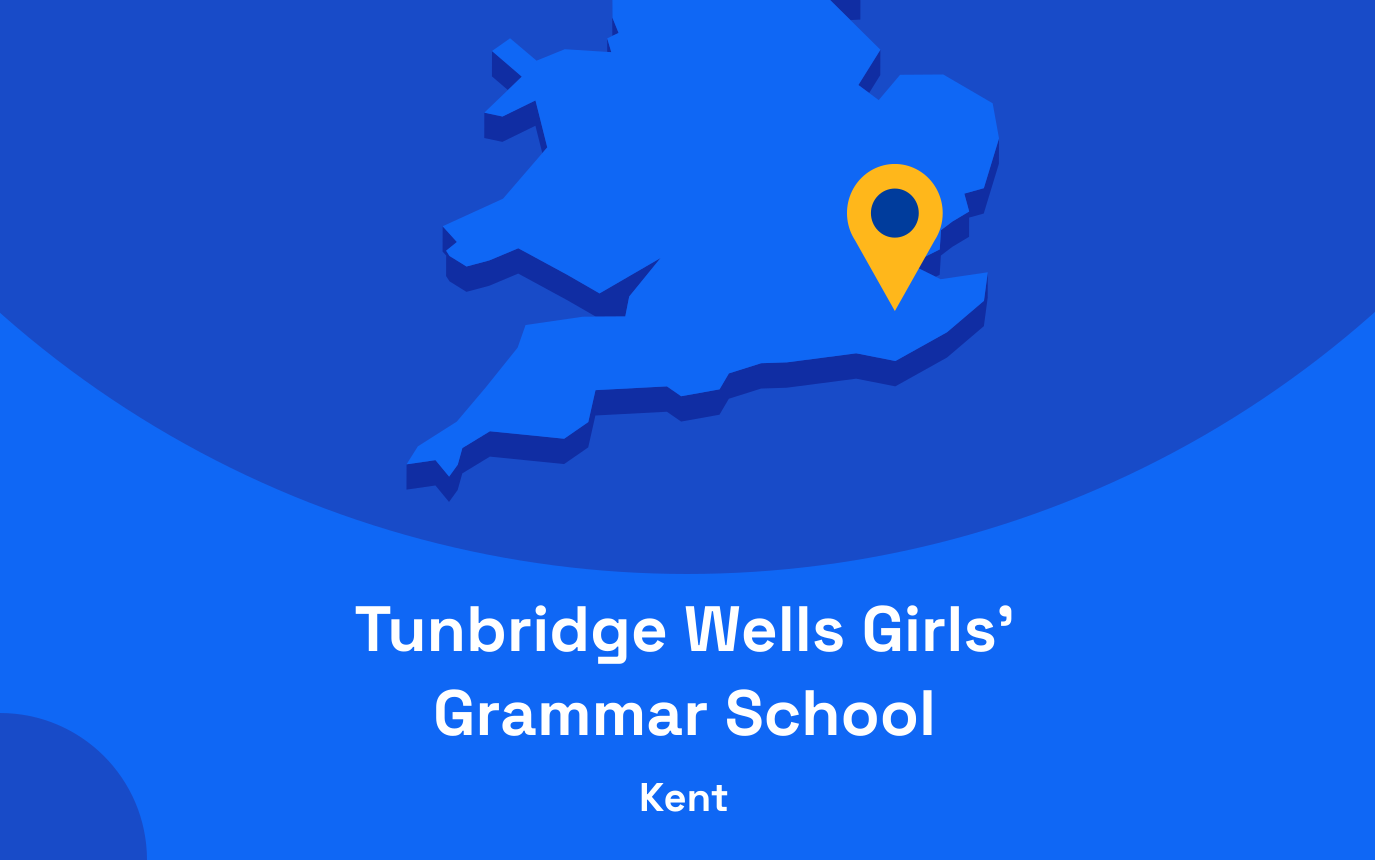
- Address: Tunbridge Wells Girls' Grammar School, Southfield Road, Tunbridge Wells, Kent, TN4 9UJ
- Number of pupils: approx 1,000
- Admissions contact: [email protected]
- Number of places in Year 7: 145
- 11+ exam: Kent Test
- Catchment area: yes
Dates for your diary
- Monday 2nd June 2025: Kent Test registration opens
- Tuesday 1st July 2025: Kent Test registration closes
- Thursday 11th September 2025: Kent Test date for children in Kent primary schools
- Saturday 13th – Sunday 14th September 2025: Kent Test date for children not in Kent primary schools
- Thursday 16th October 2025: Kent Test results sent to parents
- Friday 31st October 2025: secondary school common application deadline
- Monday 2nd March 2026: national school offers day
Dates can vary, so always check with your target schools!
About Tunbridge Wells Girls' Grammar School
Tunbridge Wells Girls' Grammar School (TWGGS) is a small selective school for girls in Tunbridge Wells, Kent. It's consistently rated 'Outstanding' by Ofsted.
Founded in 1905, the school embraces traditional values. It aims to offer students a well-rounded education within a caring environment. With high academic standards, TWGGS supports its students extensively to excel in GCSE and A level exams.
How to apply to Tunbridge Wells Girls' Grammar School
Tunbridge Wells Girls' Grammar School is a selective school. This means that your child will need to take the 11 plus exam to be eligible for a place. In Kent, the 11 plus is known as the Kent Test.
Registration for the 2025 Kent Test opens on Monday 2nd June 2025 and closes on Tuesday 1st July 2025. The exam will take place in September 2025 and you’ll receive your child’s results in mid-October. You can then use these results to decide whether to apply for a place at Tunbridge Wells Girls' Grammar School.
To apply, you’ll need to name the school as one of your preferred schools on the secondary school common application form. This will be available on your home council website from early September and must be submitted by Friday 31st October 2025.
Remember – passing the 11 plus doesn’t guarantee that your child will be allocated a place at your preferred school. Many grammar schools are often oversubscribed with qualified children. Schools and their admissions authorities work through admissions criteria to prioritise children for places. We’ve included the admissions criteria for Tunbridge Wells Girls' Grammar School below.
What's on the Kent Test?
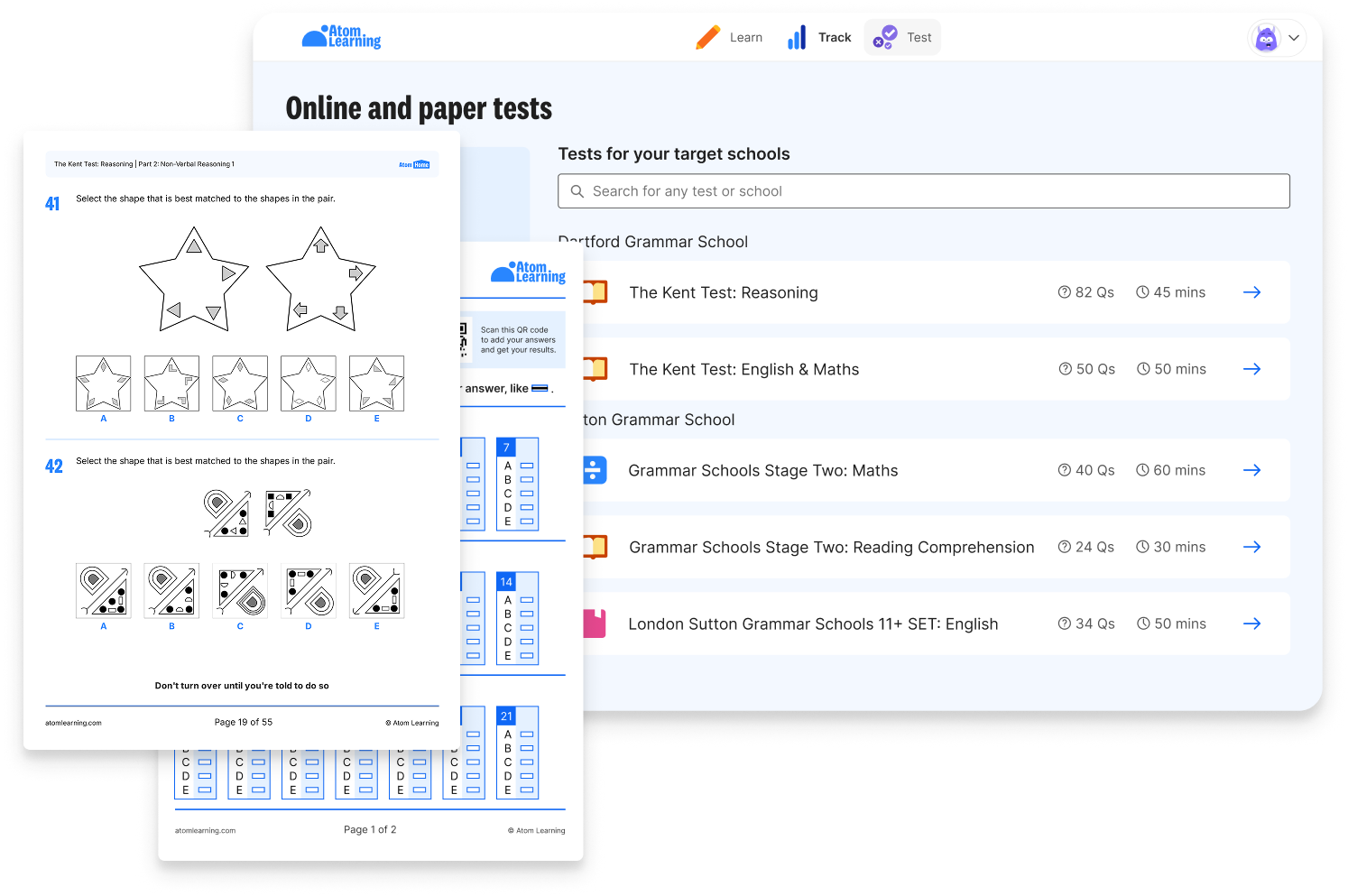
The Kent Test is made up of two multiple-choice papers and a short writing task. It’s designed to assess your child’s skills in English, maths and reasoning — and to help grammar schools identify potential.
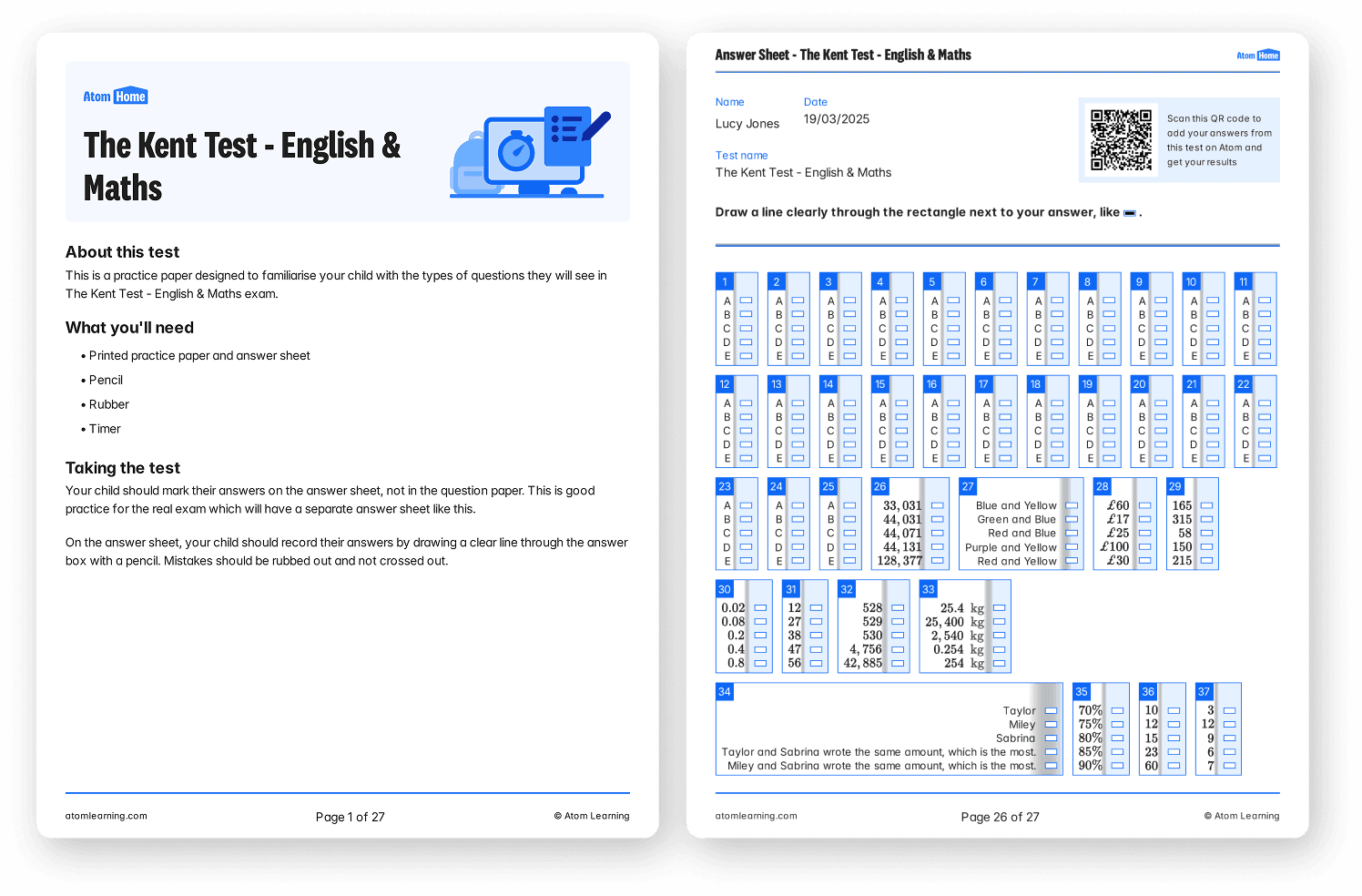
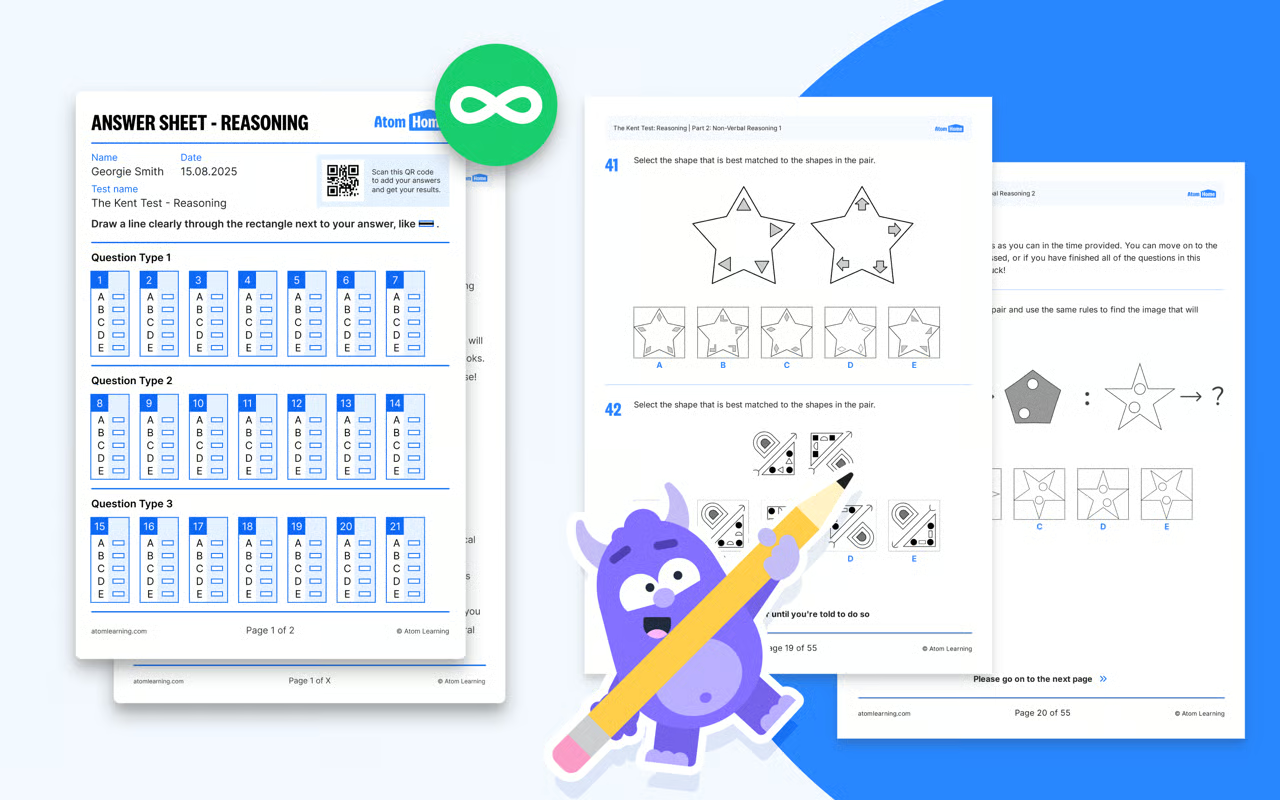
Each paper lasts around an hour, and your child will mark their answers on a separate answer sheet (this gets marked electronically).
Here’s what to expect:
Paper 1: English and maths
This paper is split into one 30-minute section that tests English, and another 30-minute section which assesses maths.
Each section includes a short 5-minute practice activity. This part isn’t marked; it just helps your child get familiar with the questions.
What’s in the English section?
The English section is mainly made up of a reading comprehension task. There are also questions that check your child’s grammar, punctuation and vocabulary. These might include:
- Choosing the best word to complete a sentence
- Spotting spelling or grammar mistakes
- Finding synonyms or antonyms
What’s in the maths section?
Your child will be tested on what they’ve learned in school in maths up to the start of Year 6. They should feel confident with:
- Times tables
- The four operations (adding, subtracting, multiplying and dividing)
- Fractions, decimals and percentages
- Ratio
- Area, perimeter and measurements
Some of the questions might feel more challenging than usual. This is so your child can show how they use their knowledge to solve new types of problems.
Paper 2: Reasoning
This paper focuses on verbal reasoning, non-verbal reasoning and spatial reasoning.
These topics aren’t usually taught in school. They’re included in the test to measure your child’s potential, not just what they’ve learned so far.
Verbal reasoning
This checks how well your child can solve problems using words, letters and numbers. For example, they might be asked to spot patterns in sequences or choose words with similar meanings.
- Time: 30 minutes
- Includes a 10-minute practice and a 20-minute test
Non-verbal & spatial reasoning
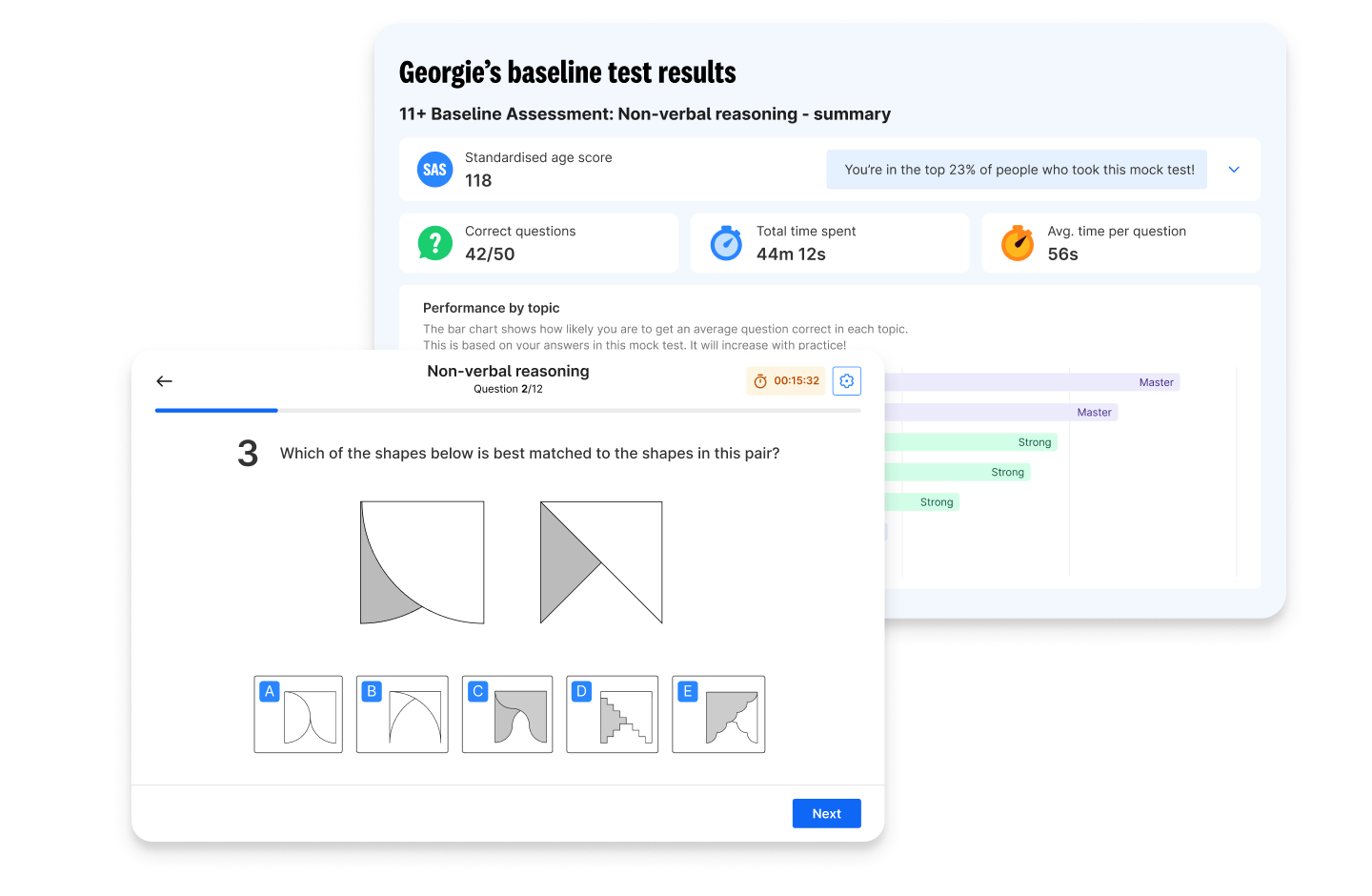
These sections use shapes, diagrams and patterns. Your child will need to spot similarities and differences, complete sequences, and mentally rotate shapes.
- Time: 30 minutes in total
- Broken into short, timed sections (each lasting around 4–5 minutes)
Each section starts with a short, guided practice session.
Creative writing task
All children also complete a short creative writing exercise. This isn’t marked as part of the main test, but it might be used if your child’s results are reviewed by a headteacher panel or at appeal stage.
The creative writing task lasts around 40 minutes, including 10 minutes for planning and 30 minutes for writing.