

The Kent Test (11+) guide
Thinking about a grammar school in Kent for your child? This guide walks you through how the system works, key dates for entry, and how to support your child through the 11+.
In this guide, you'll find:
- How the Kent grammar school system works
- Key dates and deadlines for 2027 entry
- Which schools use the Kent Test
- What your child will be tested on
- How the exam is scored and how places are allocated
- Practical ways to support your child's 11+ preparation
Kent grammar schools
There are 32 grammar schools in Kent. They all use the same 11+ test, known as the Kent Test. The test papers are provided by GL Assessment.
Which grammar schools use the Kent Test?
- Barton Court Grammar School
- Borden Grammar School
- Chatham and Clarendon Grammar School
- Cranbrook School
- Dane Court Grammar School
- Dartford Grammar School
- Dartford Grammar School for Girls
- Dover Grammar School for Boys
- Dover Grammar School for Girls
- Gravesend Grammar School
- Highsted Grammar School
- Highworth Grammar School
- Invicta Grammar School
- Maidstone Grammar School
- Maidstone Grammar School for Girls
- Mayfield Grammar School
- Oakwood Park Grammar School
- Queen Elizabeth’s Grammar School
- Simon Langton Girls’ Grammar School
- Sir Roger Manwood’s School
- The Folkestone School for Girls
- The Harvey Grammar School
- The Judd School
- The Langton Grammar School for Boys
- The Norton Knatchbull School
- The Skinner’s School
- Tonbridge Grammar School
- Tunbridge Wells Girls' Grammar School
- Tunbridge Wells Grammar School for Boys
- Weald of Kent Grammar School
- Wilmington Grammar School for Boys
- Wilmington Grammar School for Girls
Note that if your child is applying for a grammar school in Medway or the London Boroughs of Bexley and Bromley, they will take a separate exam. Find out more information about these exams:
Key dates for 2027 entry
- Monday 1st June 2026: Kent Test registration opens
- Wednesday 1st July 2026: Kent Test registration closes
- Thursday 10th September 2026: Kent Test — for pupils who attend a Kent primary school
- Weekend of 12th–13th September 2026: Kent Test — for pupils who do not attend a Kent primary school
- Thursday 15th October 2026: results day
- Saturday 31st October 2026: secondary school common application deadline
- Monday 1st March 2027: national school offers day
Dates may be subject to change. Always check with your target school for the latest information.
Worried about missing an important 11+ deadline?
Get grammar school reminders with the key dates for your target school delivered straight to your inbox.
• Registration deadlines
• Exam dates
• Revision nudges
All tailored to your child. We'll make sure you're always prepared for what's next.
.png)
What is the Kent Test?
The Kent Test is the 11+ exam used by all grammar schools within the Kent County Council area. Your child only needs to take it once, even if you're applying to multiple Kent grammar schools.
The test takes place in September of Year 6. Children born between 1st September 2015 and 31st August 2016 will sit the test in September 2026 for entry to Year 7 in September 2027.
If your child attends a Kent primary school, they will likely sit the test at their own school on a weekday. If your child attends a primary school outside Kent, they may be invited to sit the test at a Kent grammar school over the weekend of 12th–13th September 2026.
The test is designed to assess a child's academic ability. Grammar schools in Kent are competitive and frequently oversubscribed, so performance in the test plays a significant role in the admissions process.
What's in the Kent Test?
The Kent Test is made up of two multiple-choice papers and a short writing task. It's designed to assess your child's skills in English, maths and reasoning and to help grammar schools identify potential.
Each paper lasts around an hour, and your child will mark their answers on a separate answer sheet which gets marked electronically.
Here's what to expect:
Paper 1: English and maths
This paper is split into two 30-minute sections — one testing English and one testing maths. Each section includes a short 5-minute practice activity followed by a 25-minute test. The practice section isn't marked; it just helps your child get familiar with the questions.
What's in the English section?
The English section is mainly made up of a reading comprehension task. There are also questions that check your child's grammar, punctuation and vocabulary. These might include:
- Choosing the best word to complete a sentence
- Spotting spelling or grammar mistakes
- Finding synonyms or antonyms
What's in the maths section?
Your child will be tested on what they've learned in school in maths up to the start of Year 6. They should feel confident with:
- Times tables
- The four operations (adding, subtracting, multiplying and dividing)
- Fractions, decimals and percentages
- Ratio
- Area, perimeter and measurements
Some of the questions might feel more challenging than usual. This is so your child can show how they use their knowledge to solve new types of problems.
Paper 2: Reasoning
This paper focuses on verbal reasoning and non-verbal reasoning and lasts around an hour, including the practice sections.
These topics aren't usually taught in school. They're included in the test to measure your child's potential, not just what they've learned so far.
Verbal reasoning
This checks how well your child can solve problems using words, letters and numbers. For example, they might be asked to spot patterns in sequences or choose words with similar meanings.
Non-verbal reasoning
This section uses shapes, diagrams and patterns. Your child will need to spot similarities and differences, complete sequences, and identify how shapes relate to each other. The non-verbal reasoning section is split into shorter sections, each timed and administered individually.
Both the verbal and non-verbal reasoning sections are roughly the same length.
Creative writing task
All children also complete a short creative writing exercise. This isn't marked as part of the main test, but it might be used if your child's results are reviewed by a headteacher panel. 40 minutes is allowed for the writing task, including 10 minutes for planning.
Is your child ready for the Kent Test?
See where they stand in minutes. Atom’s free Kent Test practice assessment gives you an instant breakdown of their strengths and gaps. Know exactly what to focus on next and start preparing with direction, not uncertainty.

How is the Kent Test scored?
After the test, answer sheets are marked electronically. Scores are then age-standardised, which means younger children are not disadvantaged compared to their older peers.
Your child's results will be sent to you on Thursday 15 October 2026. You will receive three standardised scores, one for English, one for maths, and one for reasoning, as well as a total aggregate score. If your child meets the qualifying standard, you can list your preferred grammar school or schools on your common application form (CAF).
What's the pass mark for the Kent Test?
To be considered for a Kent grammar school, your child will need a total aggregate score of 332 or more, with no single subject score lower than 106. Individual scores range from 69 to 141, giving a highest possible total of 423.
It's important to note that achieving a qualifying score does not guarantee your child a place at a Kent grammar school. It means they can be considered for any Kent grammar school you name on your Common Application Form. Some schools, particularly those most likely to offer places to children from outside Kent, give priority to applicants with the highest scores.
Some priority groups, including Looked After Children and children eligible for Pupil Premium, may qualify with a lower score. As each school applies its own admissions criteria when allocating places, parents are encouraged to check the admissions policy for each school they are considering.
How to apply for Kent grammar schools
1. Register for the Kent Test
To be considered for a place, you must register your child to sit the Kent Test.
- Registration opens: Monday 1st June 2026
- Registration closes: Wednesday 1st July 2026
Children currently in Year 5 who were born between 1 September 2015 and 31 August 2016 are eligible to take the Kent Test in 2026.
If your child has a disability or special educational needs that may affect their access to the test, discuss this with their primary school's SENCO before registering. Access arrangement requests will not be accepted after 1 July 2026.
If you live outside Kent, you should still register your child if you intend to apply for a place at a Kent grammar school. Note that the Kent Test is only valid for Kent grammar schools — it is not accepted by Medway, Bexley or Bromley grammar schools, which run their own separate selection processes.
2. Apply for school places
Test results are sent on Thursday 15thOctober 2026.
If your child achieves a qualifying score, you can list your preferred school or schools on your secondary school common application form, which must be submitted to your local authority by Saturday 31st October 2026.
Before listing a school, check its admissions policy carefully to make sure your child meets all relevant criteria.
3. National Offer Day
On Monday 1st March 2027, you'll be informed which secondary school your child has been offered a place at.
If your preferred school is not offered, your child will be allocated another local school place and you'll receive information about how to appeal.
How can I help my child prepare for the Kent Test?
The Kent Test can feel like a big milestone, but preparation doesn't have to be stressful.
Here are some practical ways to support your child in a calm, structured way.
Stay on track with a clear Kent Test revision plan
One of the hardest parts of 11+ preparation isn't motivation – it's knowing what to work on, when, and how to stay consistent without it taking over family life.
A clear plan helps your child build skills in the right order and avoid last-minute cramming.
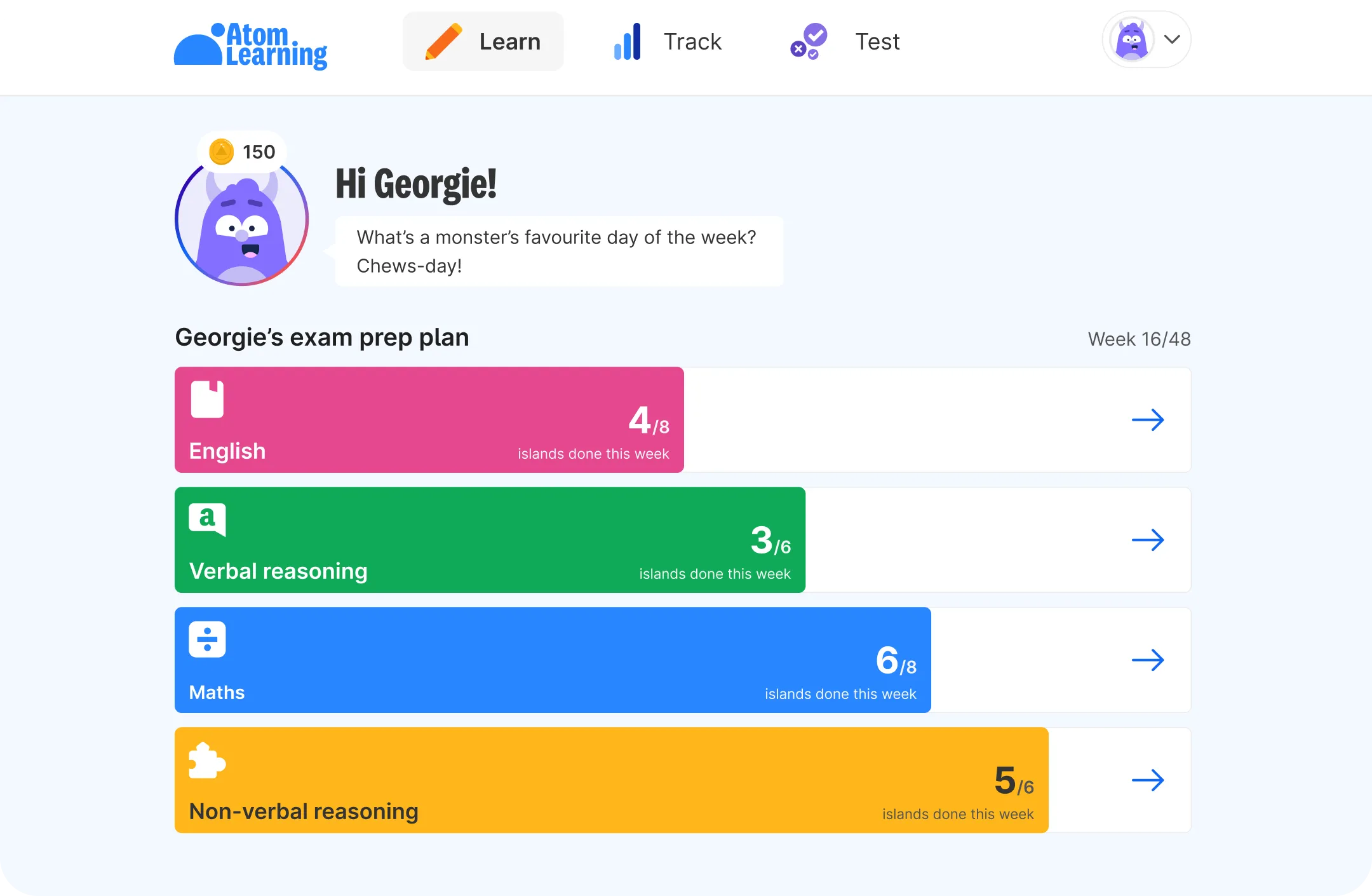
With Atom's Exam Plan, you enter your child's exam date and target schools, and Atom builds a personalised weekly plan based on the key skills they'll be tested on. It adapts as they improve and shows them exactly what to focus on each week.
That means less guesswork for you, less stress for them, and a clearer path to exam day.
Build Kent Test exam technique with realistic practice papers

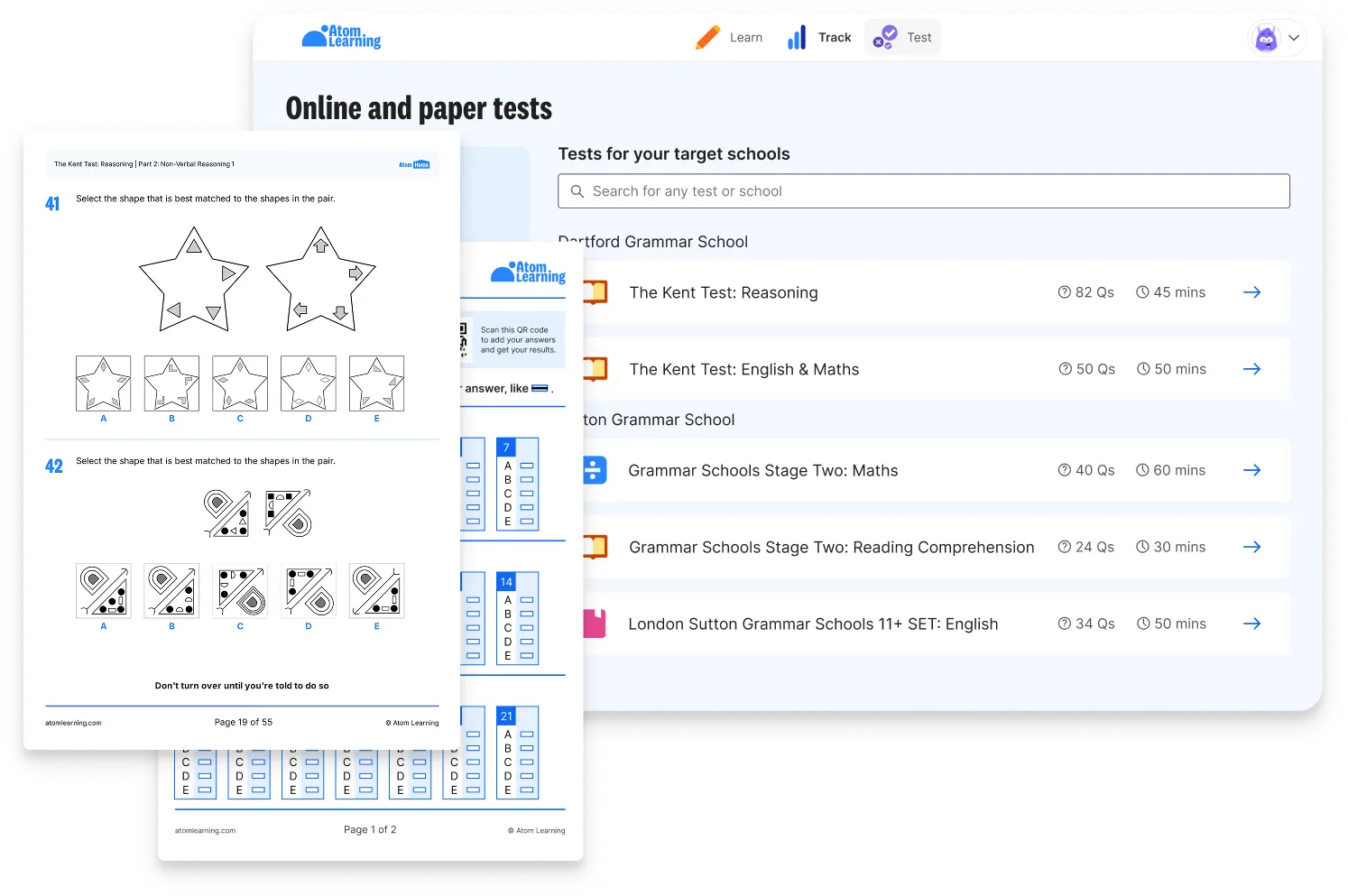
Once your child feels secure with the main topics, paper practice tests help them feel more confident with the exam format.
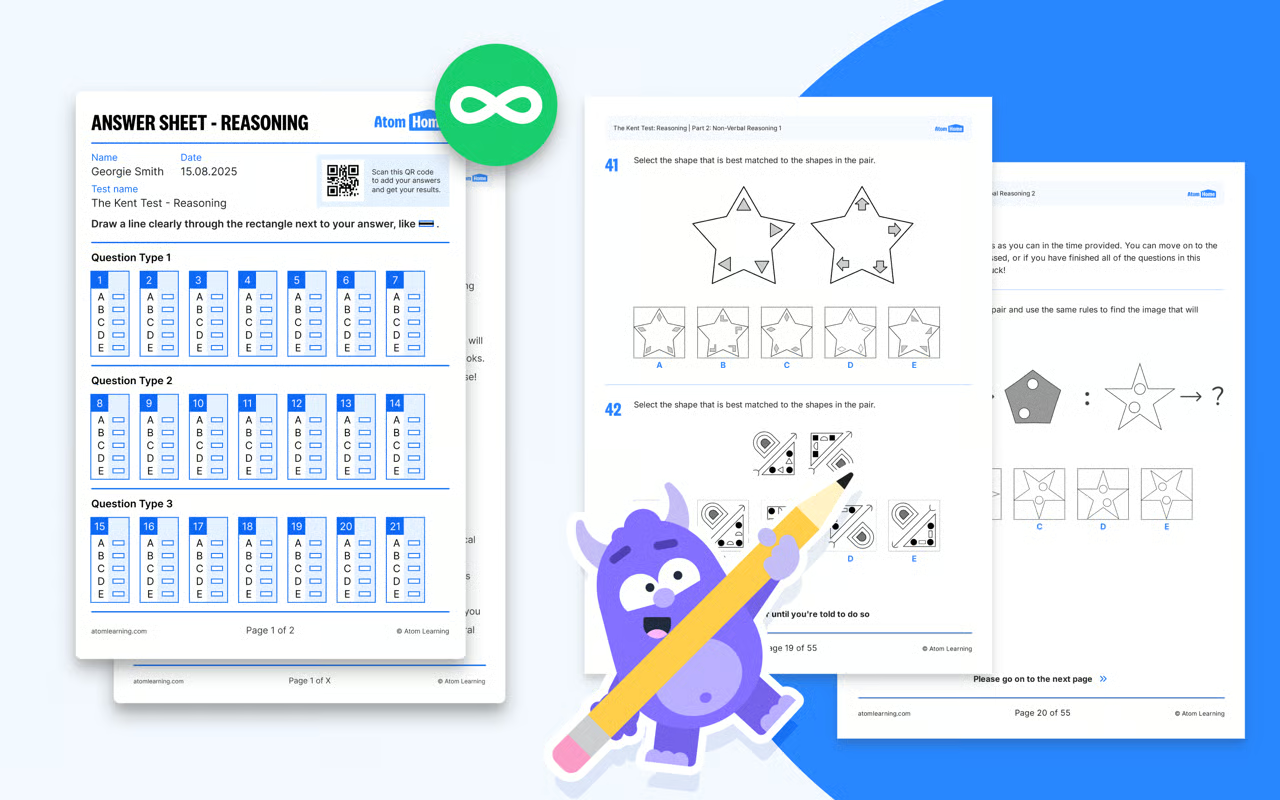
Atom's 11+ practice papers are designed to reflect real test conditions. Parents simply photograph their child's answer sheets and upload them to Atom for instant marking.
You'll get:
- a Standardised Age Score (SAS)
- clear insight into strengths and areas for improvement
- a comparison with other children applying to the same schools
The papers are unlimited, meaning your child can practise again and again with new questions each time.
Encourage regular reading for Kent Test English success
Strong reading skills underpin almost every part of the Kent Test.
Encourage your child to read for 10–15 minutes a day, focusing on variety – fiction, non-fiction, different genres and authors.
This helps build:
- vocabulary
- comprehension and inference
- confidence with unfamiliar texts
If you're looking for ideas, Atom's recommended reading lists for Years 3–6 include a wide range of age-appropriate books.
Celebrate progress, not just Kent Test scores

When you're supporting your child through Kent Test preparation, what really matters is knowing they're moving in the right direction.
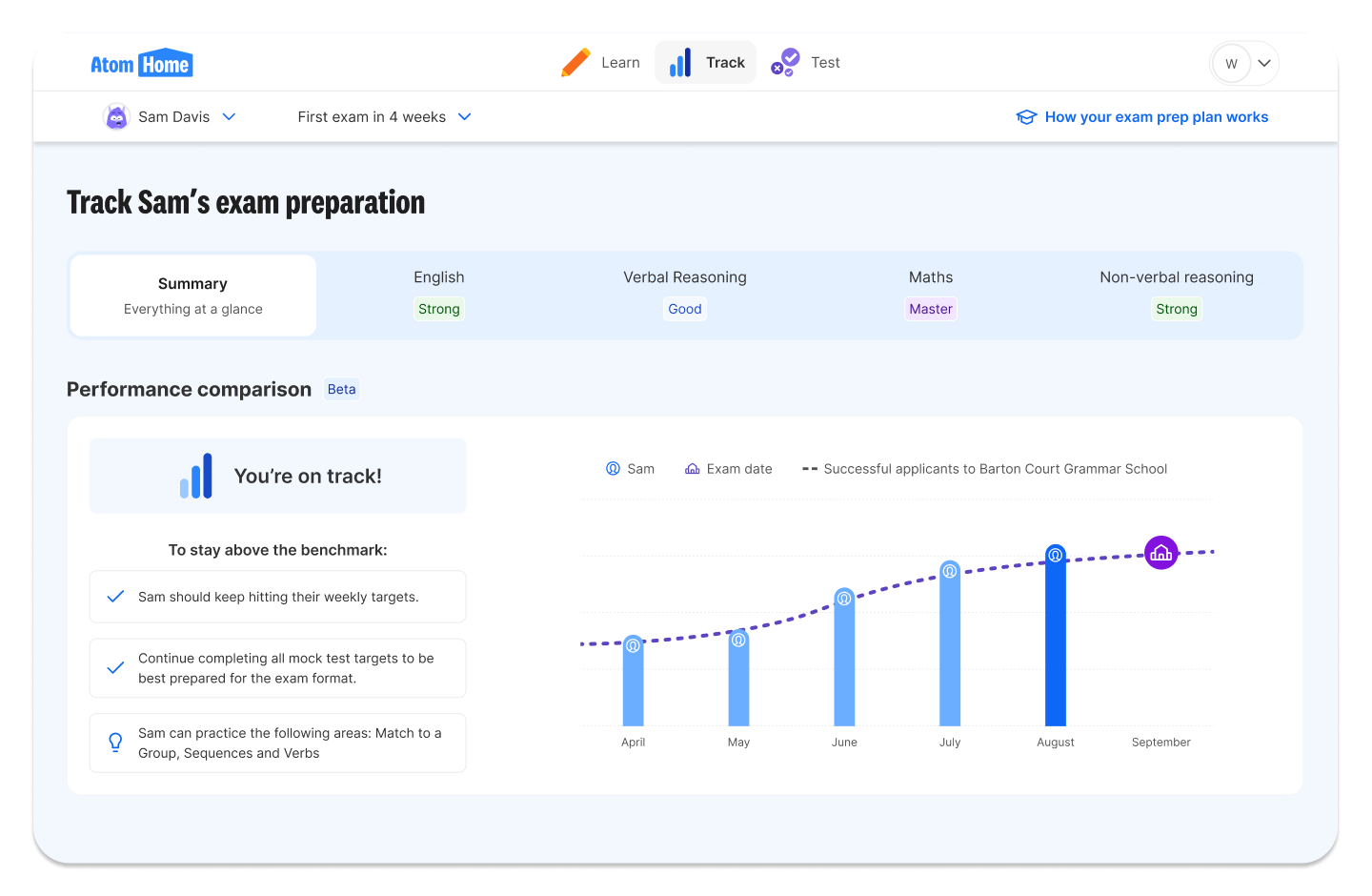
Atom's progress tracking gives you a clear, simple view of how your child is doing across topics and how their performance is developing over time.
That makes it easier to give meaningful encouragement, keep motivation steady and focus on consistent improvement – not just one-off test results.
Take control of your child’s 11+ preparation.

Not sure if your child is on track for the grammar school 11+? You don’t need to guess what to cover or whether they’re ready. Atom shows you exactly what to practise each week and how they’re performing, so you can stay ahead of the process without the stress.
- Follow personalised weekly exam plans that show them what to learn next.
- Download replica 11+ practice papers and upload a photo for instant, stress-free marking.
- Track progress and see how they compare to others applying to the same schools.
Start your free trial and help your child feel fully prepared for the 11+.