For many families, the term GCSEs can initially feel like a mystery. These exams mark a major milestone in secondary education and play an important role in shaping future opportunities. This guide breaks down what GCSEs are, how they work, and how parents can best support their child through them.
What this post covers:
- What GCSE stands for and when exams take place
- Which subjects students can study
- How GCSEs are assessed and graded
- Why GCSEs are important
- Practical tips for supporting a child through their GCSE years
What are GCSEs and when do they happen?
GCSE stands for General Certificate of Secondary Education. These are the main qualifications taken by students in Year 11 (around age 15–16) in England, Wales and Northern Ireland.
- GCSEs are studied over two years: Year 10 and Year 11.
- Exams are usually held in May and June of Year 11.
- GCSE results are released in August.
Most students take 8 to 10 GCSE subjects, although this varies depending on the school and each individual’s strengths.
For more information, read How many GCSEs do you need? A guide for students and parents.
Which GCSE subjects do students study
Students follow a mix of core subjects and optional subjects.
Core (compulsory) subjects
- English Language and English Literature
- Mathematics
- Science (either Combined Science or the three separate sciences: Biology, Chemistry and Physics)
Optional subjects
Chosen by the student in Year 9 (around age 13–14). These might include:
- Humanities such as History, Geography or Religious Studies
- Modern foreign languages such as French, Spanish or German
- Creative subjects such as Art, Drama or Music
- Other options such as Computer Science, Business Studies or Physical Education
This balance allows students to gain essential knowledge while exploring areas they enjoy or may want to pursue further.
How are GCSEs assessed?
Most GCSEs are assessed through final exams taken at the end of Year 11. In some subjects, coursework or practical assessments also contribute to the final grade. Examples include:
- Speaking and listening tests in Modern Languages
- Scientific experiments in Science subjects
- Portfolios or performances in Art, Music or Drama
The grading system
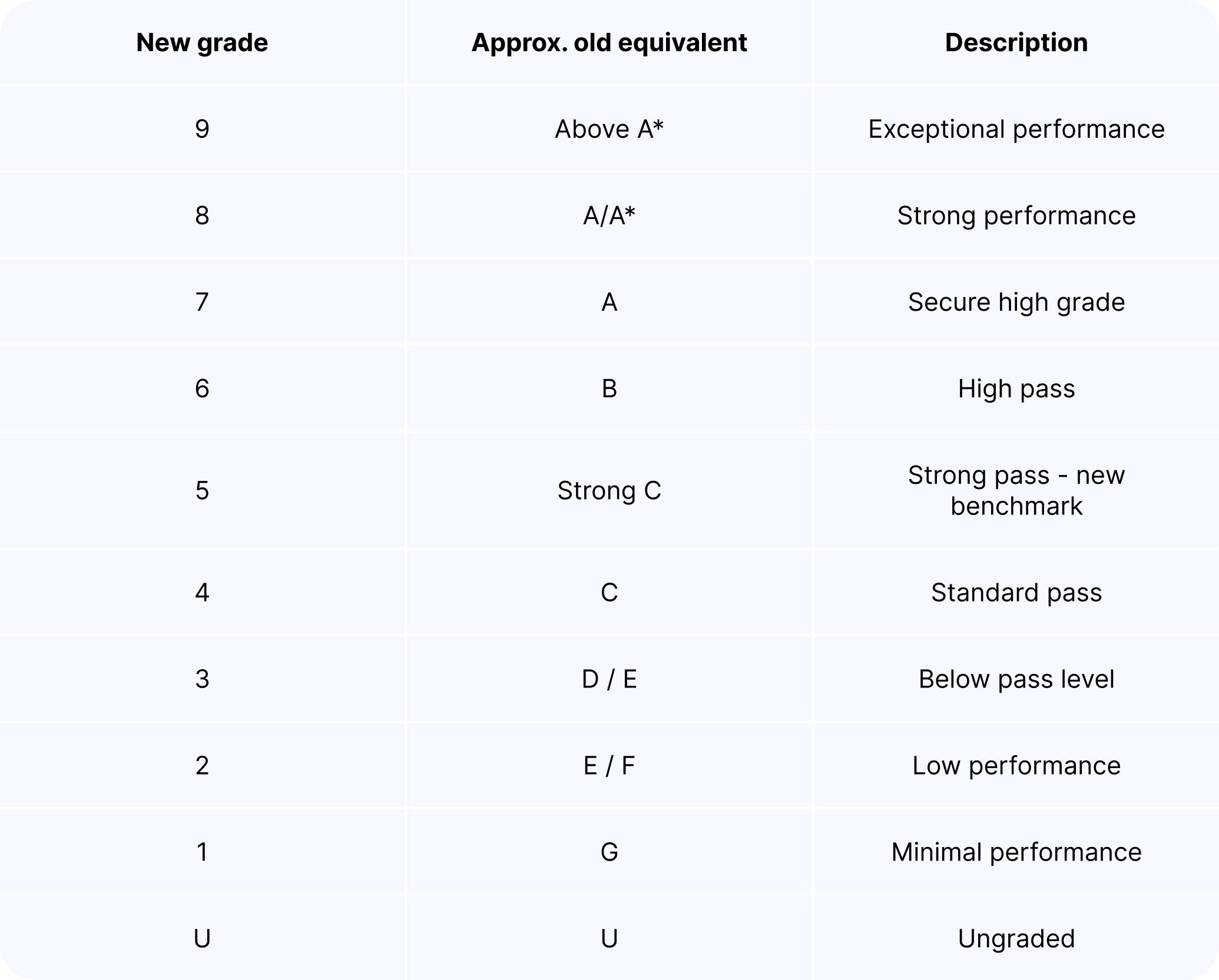
GCSE results are given on a numerical scale from 9 to 1:
- 9 is the highest grade, showing exceptional performance.
- 4 is a standard pass, similar to a C grade in the old system.
- 1 is the lowest grade.
Here’s a simple comparison: