

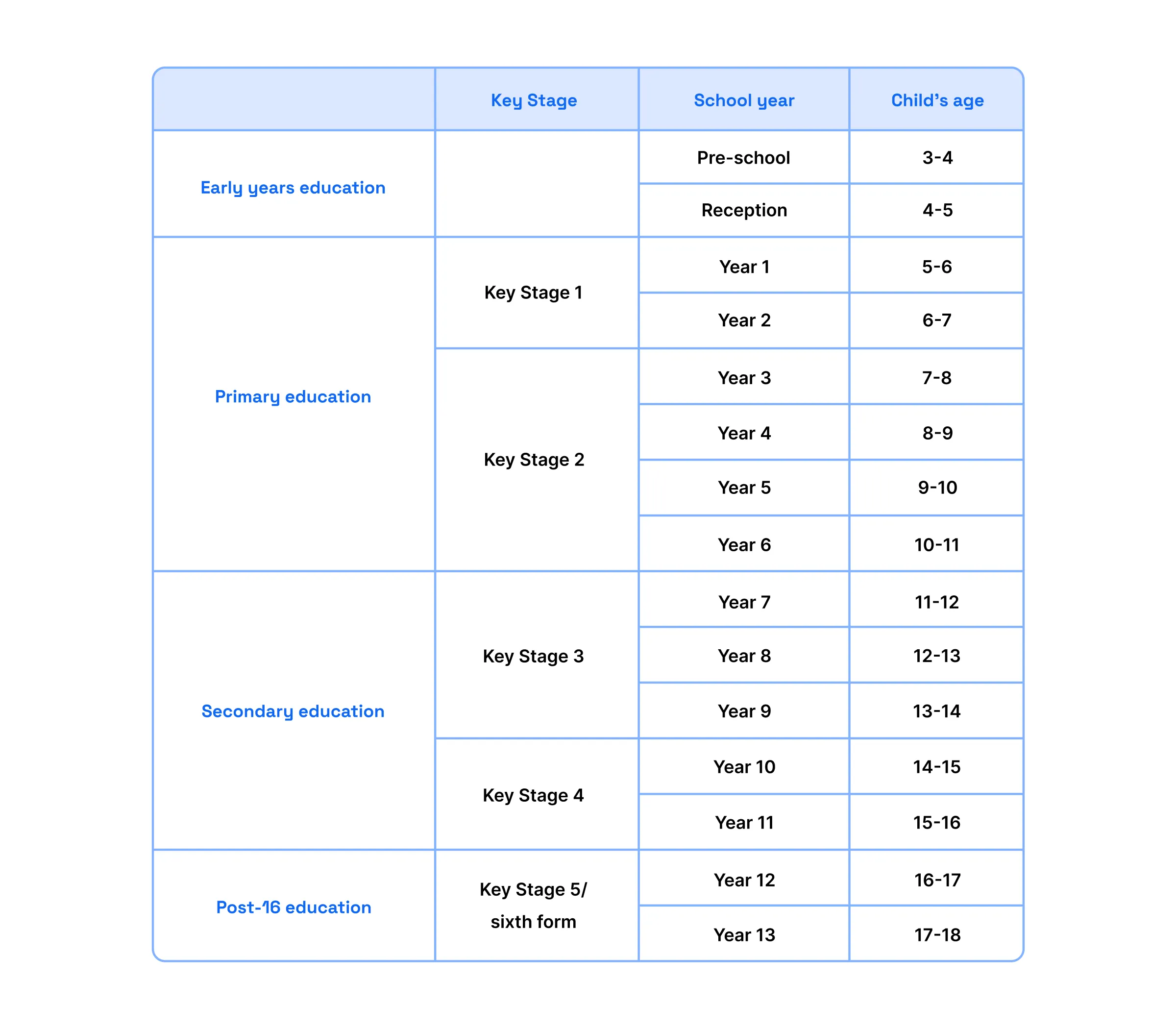

The national curriculum in England
The national curriculum is used by schools to make sure that children learn the same things. It includes a list of subjects and standards children should reach in each subject at each Key Stage.
All state schools funded by local authorities in England must follow the national curriculum. Academies and free schools have more independence to follow their own curriculum, but it must be broad and balanced and include the same key subjects. Private schools do not have to follow the national curriculum, but they must be registered with the government and inspected regularly.
Primary curriculum (Key Stage 1 & 2)
Compulsory national curriculum subjects at primary school:
- English
- Maths
- Science
- Design and technology
- History
- Geography
- Art and design
- Music
- Physical education (PE), including swimming
- Computing
- Ancient and modern foreign languages (at Key Stage 2)
Primary schools must also provide:
- Relationships and health education
- Religious education (RE) (parents can ask for their child to be taken out of the whole lesson or part of it)
Schools often also teach:
- Personal, social and health education (PSHE)
- Citizenship
- Modern foreign languages (at Key Stage 1)
- Sex education (parents can ask for their child to be taken out of the lesson)
Online learning for Key Stage 2
Atom is a fun and convenient way for your child to get up-to-date with the Key Stage 2 national curriculum, to give them a smooth academic transition to UK senior school.
Schools in Northern Ireland, Scotland and Wales use their own curriculum structures which are similar to the one in England.
UK qualification levels
- GCSEs – national exams taken at age 16.
- A levels – national exams taken at age 18, for getting a place at university.
- IB/International Baccalaureate – an equivalent qualification to A levels, more often offered by independent schools than by state schools.
You can learn about and compare the different qualification levels in the UK here.
The UK school year
In Britain, the academic year starts in September and ends in July. It is split into three terms of roughly twelve weeks:
- Autumn term (September–December)
- Spring term (January–March/April)
- Summer term (April–July)
Each term is usually divided into two halves. There is a week’s break in the middle, half-term holidays. Between the terms, there are three major breaks:
- Christmas holidays (December)
- Easter holidays (March or April)
- Summer holidays (July–August)
The exact dates of school terms and holidays vary depending on the school and region. Independent schools tend to have longer holidays than state schools.
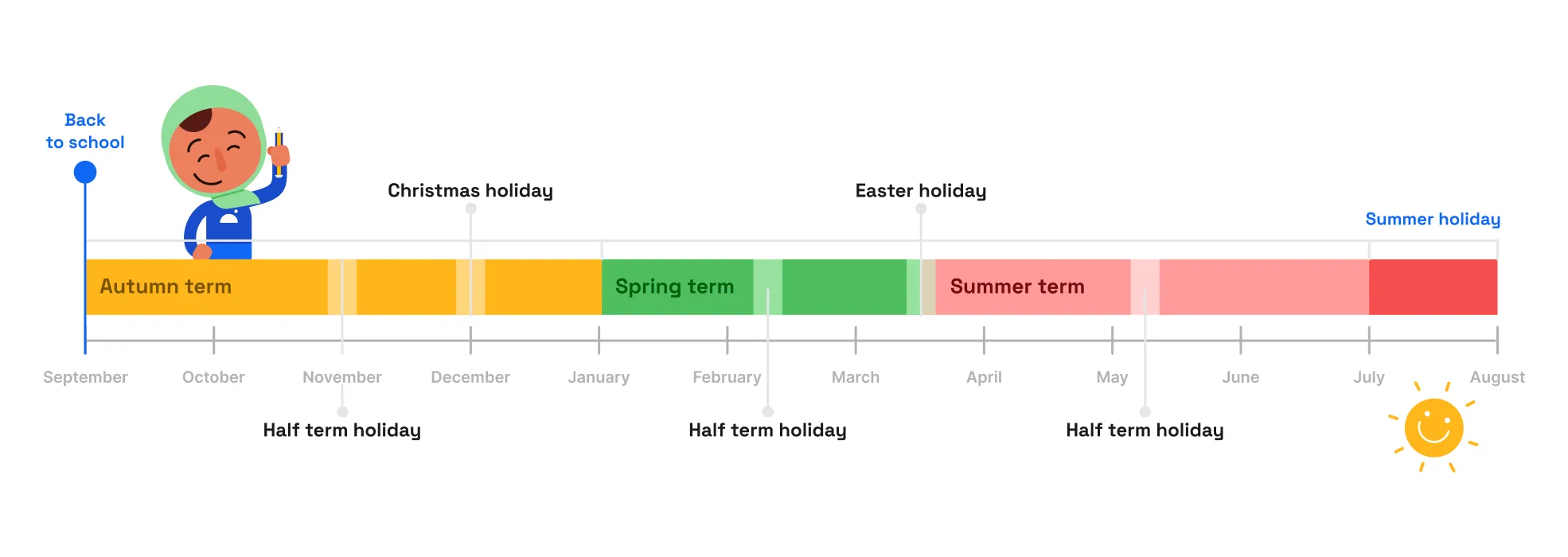
A timeline of the UK school year (click for larger version)
The UK school day
Children at state schools attend school from Monday to Friday. At independent schools, children often attend school on Saturday mornings too.
A typical state school day in the UK starts between 8.45am and 9am, and ends between 3pm and 4pm. At independent schools, hours are usually longer, with classroom lessons taking place from 8.30am to 4.30pm followed by activities until 7pm.
Children are usually given a short break mid-morning and mid-afternoon, and a 30–60 minute break for lunch at 12pm or 1pm. Some children attend extracurricular activities such as sports clubs or music lessons during their lunch break.
Breakfast clubs are available to provide childcare before school, typically an hour before school starts. Children have breakfast together then do activities or homework. After-school clubs also offer extracurricular activities at both state and private schools.
During the primary years, it’s common for a class of children to stay in one classroom, where they are taught all subjects by one teacher. At secondary school, children are more likely to have timetabled lessons. They will need to move between classrooms and teachers for different subjects.
How to choose a UK school
When choosing a UK school for your child, there are lots of decisions to make. Every child is unique, and will need different qualities in a school at different stages of their life. The most important consideration is what is right for your family. What kind of environment will your child thrive in at this stage of their development?
Visits and open days
If possible, visit the school or at least attend a virtual open day to get a feel for their ethos. Take every opportunity to learn more about the school community and assess whether it's a good fit for your child.
Some questions you might wish to ask school staff:
- How do you support international children to transition into the school, academically and socially?
- How do you balance student wellbeing with academic excellence?
- What support do you have for students speaking English as a foreign language?
- What is the timetable like? How much downtime do students have?
- What’s your philosophy on homework – how much is there on a nightly basis?
- How do you incorporate digital skills into the curriculum? What’s your approach to online learning if this becomes necessary again?