


Confidence takes time to build.
Year 3 is where it starts.
Atom meets your child where they are today and builds from there - covering every subject, with no gaps and no guesswork.
Try Atom free for 5 days
No commitment. Cancel any time.
✓ Trusted by 350,000+ families
✓ 89% of Atom students get into their first-choice school
✓ Recommended by primary school teachers
Year 3 starters achieve more.
7x
more likely to get into their first-choice school

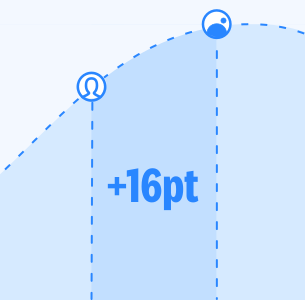
16
SAS points higher on average than peers
How Atom supports Year 3 learners
What parents are saying

“
Bitesize, tailored to the child, and genuinely enjoyable. I'd tell any Year 3 or 4 parent: building the daily habit alone pays for itself.
- Atom parent, Year 3 starter
“
I don't have to sit next to him. He's on it, he's engaged, and I can see exactly how he's doing from my dashboard. Year 5 felt manageable because we started in Year 3.
- Atom parent, Year 3 starter
“
We started in Year 3 because a friend recommended it. I didn't expect the difference it would make to his confidence at school - that was the real surprise.
- Atom parent, Year 3 starter
Partnered with 1,000+ schools

















What the 11+ actually tests
The 11+ tests English, maths, verbal reasoning and non-verbal reasoning. Verbal and non-verbal reasoning aren't taught in school. Most children encounter them for the first time during exam preparation. Starting early means your child can learn every subject properly, so there are no gaps by exam day.
Start with no commitment.
Free for 5 days
Then from £39.99/month · cancel any time
✓ Personalised learning that meets your child exactly where they are
✓ Parent dashboard - see exactly how your child is progressing
✓ Short daily sessions designed to build habits, not dread
✓ Full 11+ and independent school exam coverage
✓ Parent dashboard - see exactly how your child is progressing
✓ Short daily sessions designed to build habits, not dread
✓ Full 11+ and independent school exam coverage
Start your free trial
No commitment required. Cancel anytime.
Frequently Asked Questions
Is Year 3 too early to start 11+ preparation?
What should a Year 3 child be doing to prepare for the 11+?
How long should my Year 3 child practise each day?
How is the 11+ different from what my child learns at school?
Will starting early put too much pressure on my child?
What subjects does the 11+ test?
What's the difference between grammar schools and independent schools?
Which grammar schools can my child apply to?
When should I start preparing my child for the 11+?
My child is in Year 3. Do I need to register for grammar schools yet?
Not sure where to start?
Have a question about the 11+, school admissions, or your child's learning?
Our education experts have supported 110,000+ families through this journey - and we're here to help yours.
Our education experts have supported 110,000+ families through this journey - and we're here to help yours.