Verbal reasoning tests our ability to understand and engage with written information. The skills used in verbal reasoning have some overlap with reading comprehension and vocabulary.
Verbal reasoning is not part of the national curriculum. This means that many children do not have much experience of verbal reasoning questions before taking the 11+ exam.
In this article, learn which 11+ verbal reasoning questions children tend to struggle with the most, and get tips and techniques to help your child work through tricky questions.
No items found.
Types of verbal reasoning questions
Verbal reasoning questions tend to fall into different categories: words and wordplay, logic, patterns and functions, and numbers.
Here are the three types of verbal reasoning questions which children using Atom find the most difficult.
Morph the word
Stolen words
Find the calculation
Morph the word
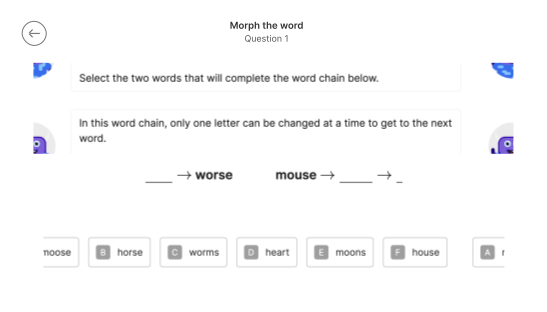
In 'morph the word' questions, children are given two words and need to get from the first word to the last word by changing one letter at a time to create a new word.
Here's an example of a 'morph the word' verbal reasoning question from Atom.
In this example, the two words missing from the chain are horse and house:
Replace the m in mouse with h
Replace the u in house with r
Replace the h in horse with w
The word 'moose' could be used to make a word chain here along with the word 'morse', but as 'morse' isn't an option, it can't be a correct answer!
Incorrect answers can often be caused by spelling mistakes. Children should double check that the word they have selected is correctly spelled.
Stolen words
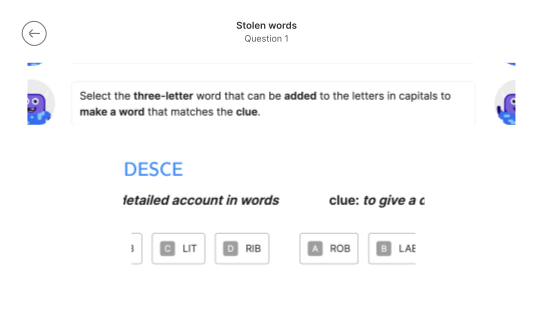
In 'stolen words' questions, your child will be asked to work out the three- or four-letter word that is missing from the incomplete word. They might have a clue or a sentence to help find the stolen word.
Take a look at this example 'stolen words' verbal reasoning question on Atom.
Students can often lose marks here by suggesting a complete word that does not make sense in the context of the clue, or stolen letters that do not form a word in their own right.
So, to solve these types of questions, your child should:
First read through the clue (if one is given) to get a sense of what the complete word might be.
Once they think they have found the stolen letters, check that they make a real word when combined with the letters.
Double check that the completed word is spelled correctly.
Check that the stolen letters create a word in its own right, and that it is spelled correctly.
Reread the clue to check that the completed word fits.
In this example, the correct answer is RIB. RIB can be added to the letters DESCE to form the word describe.
Find the calculation
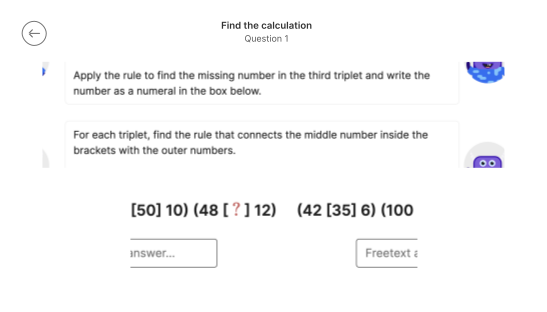
In 'find the calculation' questions, your child will be given a set of numbers. The numbers within the set will be linked by a rule.
There are three types of find the calculation questions:
In this example, there are two steps connecting the middle number to the outer numbers:
We must divide the left number by the right number
We must then multiply the result by 5 to find the middle number
By applying this rule to the third triplet, we get:
48 ÷ 12 = 4
4 x 5 = 20
So the correct answer is 20: (48 [20] 12)
No items found.
No items found.
Take control of your child’s 11+ preparation.
Not sure if your child is on track for the grammar school 11+? You don’t need to guess what to cover or whether they’re ready. Atom shows you exactly what to practise each week and how they’re performing, so you can stay ahead of the process without the stress.