
Back to blog

Reading grammar schools 11+ (11 plus) guide

By
Atom
|
March 16, 2026

Thinking about a grammar school in Reading for your child? This guide walks you through how the system works, key dates for entry, and how to support your child through the 11+.

In this guide, you'll find:

  • How the Reading grammar school system works
  • Key 11+ dates and deadlines for 2027 entry
  • Which schools use selective entrance exams in Reading
  • What your child will be tested on
  • How the exam is scored and how places are allocated
  • Practical ways to support your child's 11+ preparation

Reading grammar schools

There are two grammar schools in Reading, plus one partially selective school, that use entrance exams for 11+ entry:

Reading School and Kendrick School are fully selective grammar schools. Reading Girls' School is a partially selective state school; most places are not academically selective, but children can take an entrance exam to apply for a place in the school's selective stream.

Each school runs its own separate entrance exam. If you are applying to more than one school, your child will need to register and sit each exam individually.

Key dates for 2027 entry

  • Wednesday 25th March 2026: Reading School open day (booking required) and test registration opens
  • Tuesday 28th April 2026: Kendrick School open day
  • Wednesday 29th April 2026: Kendrick School open day
  • Thursday 1st May 2026: Kendrick School test registration opens
  • Sunday 17th May 2026: Reading School test registration closes
  • Tuesday 1st July 2026: Kendrick School test registration closes
  • Sunday 12th July 2026: Reading School Sporting Aptitude Assessment
  • Wednesday 15th July 2026: Reading School test date for SEN applicants
  • Thursday 16th July 2026: Reading School test date for Day and Boarding applicants
  • Friday 19th September 2026: Kendrick School 11+ entrance exam
  • Friday 25th September 2026: Reading School test date for Day applicants living outside the catchment area
  • Mid-October 2026: results available for Reading School and Kendrick School
  • Saturday 31st October 2026: deadline to apply for secondary school places
  • Monday 1st March 2027: secondary school national offers day

Please note: Reading Girls' School key dates for 2027 entry have not yet been released. We will update this page as soon as they are published. In the meantime, check the school's website for the latest information.

Dates may be subject to change. Always check with your target school for the latest information.

What is the 11+ in Reading?

The 11+ is an academic entrance test used by grammar schools to assess children for Year 7 entry. Children who pass the test or meet a qualifying standard are eligible to apply for a place.

The test is taken in the summer and autumn terms of Year 6. Children born between 1 September 2015 and 31 August 2016 will sit the Reading School entrance exam in July 2026 and the Kendrick School 11+ in September 2026, for entry to Year 7 in September 2027.

The three selective state schools in Reading each use a different entrance exam. It is important to check the specific requirements of each school you are applying to.

What's on the 11+ in Reading?

Each school uses a different exam. Here is a breakdown of what your child will be tested on at each school.

Reading School

Boys applying to Reading School sit an entrance exam provided by Future Stories Community Enterprise (FSCE), an exam board that is a subsidiary of Reading School itself.

The exam tests the application of knowledge and skills from KS2 subjects taught up to and including the Year 5 programme of study. Subjects tested may include any of the following:

  • Art & Design
  • Computing
  • Design & Technology
  • English
  • Geography
  • History
  • Languages
  • Mathematics
  • Music
  • Physical Education
  • Science

The test includes both multiple-choice and written-response questions. The type of questions, subjects, content, and format can change from year to year.

Sporting Aptitude Assessment

Reading School also offers up to 15 places on its Kenwrick Sports Pathway (KSP). Children applying for a sporting aptitude place must sit a separate Sporting Aptitude Assessment on Sunday 12th July 2026.

Children are only eligible for a sporting aptitude place if they have achieved eligible scores in the FSCE entrance tests, surpassed the threshold for the sporting aptitude assessment, and live within the catchment area (for day places).

Kendrick School

Kendrick School uses 11+ papers provided by GL Assessment. There are two one-hour papers with a short break in between. All questions are multiple-choice and the papers cover four subjects:

  • English: reading comprehension, spelling, punctuation and grammar, based on the national curriculum up to the start of Year 6
  • Maths: number, measurement, geometry and statistics, based on Key Stage 2 content up to the start of Year 6
  • Verbal reasoning: problem-solving using written information such as letters, symbols, numbers and words
  • Non-verbal reasoning: problem-solving using abstract information such as shapes and diagrams

Reading Girls' School

Girls applying for one of the 42 selective stream places at Reading Girls' School take an online entrance assessment known as Cambridge Select Insight (formerly CEM Select).

The test takes approximately one hour to complete and assesses verbal, non-verbal and numerical ability across five or six sections, including comprehension, missing words, numerical ability and pictures.

Is your child ready for the 11+?

See where they stand in minutes. Atom’s free 11+ baseline tests give you an instant breakdown of their strengths and gaps. Know exactly what to focus on next and start preparing with direction, not uncertainty. 

Take the free test

How is the 11+ scored in Reading?

Each school handles marking and scoring differently.

Reading School uses a combination of marking methods depending on the paper. Multiple-choice papers are marked using Optical Mark Recognition (OMR). Written-response papers are marked by school staff. Results are shared in mid-October.

Kendrick School uses OMR marking for its GL Assessment papers, with scores then age-standardised to ensure younger children are not disadvantaged. Age standardisation means a child's raw score is adjusted based on their age in years and months at the time of the test.

Reading Girls' School has historically used an online assessment that is marked automatically, with scores then age-standardised.

What's the pass mark?

There is no single fixed pass mark across the Reading schools. Each school sets its own qualifying standard and allocates places using its own admissions criteria. All three schools are competitive, and passing the test or reaching the qualifying standard does not guarantee a place. Where a school receives more applications than places available, it will allocate places using its oversubscription criteria.

We always recommend reviewing your target school's admissions policy carefully before applying.

How to apply for Reading grammar schools

1. Register for each school's entrance exam

Each school has its own registration process and deadline. Registration forms are available on each school's website.

Key registration dates for 2027 entry:

  • Reading School: registration opens Wednesday 25th March 2026 and closes Sunday 17th May 2026
  • Kendrick School: registration opens Thursday 1st May 2026 and closes Tuesday 1st July 2026
  • Reading Girls' School: registration dates to be confirmed — check the school's website for updates

2. Apply for school places

Test results are sent in mid-October 2026.

If your child meets the qualifying standard for a school, you can list it on your secondary school common application form (CAF), which must be submitted to your local authority by Saturday 31st October 2026.

Before listing a school, check the admissions policy to make sure your child meets all criteria.

3. National Offer Day

On Monday 1st March 2027, you'll be informed which secondary school your child has been allocated.

If your preferred school isn't offered, your child will receive another local school place, and you'll be given information about how to appeal.

How can I help my child prepare for the Reading 11+?

The Reading 11+ exams can feel like a big milestone, but preparation doesn't have to be stressful. Here are some practical ways to support your child in a calm, structured way.

Stay on track with a clear Reading 11+ revision plan

One of the hardest parts of 11+ preparation isn't motivation – it's knowing what to work on, when, and how to stay consistent without it taking over family life.

A clear plan helps your child build skills in the right order and avoid last-minute cramming.

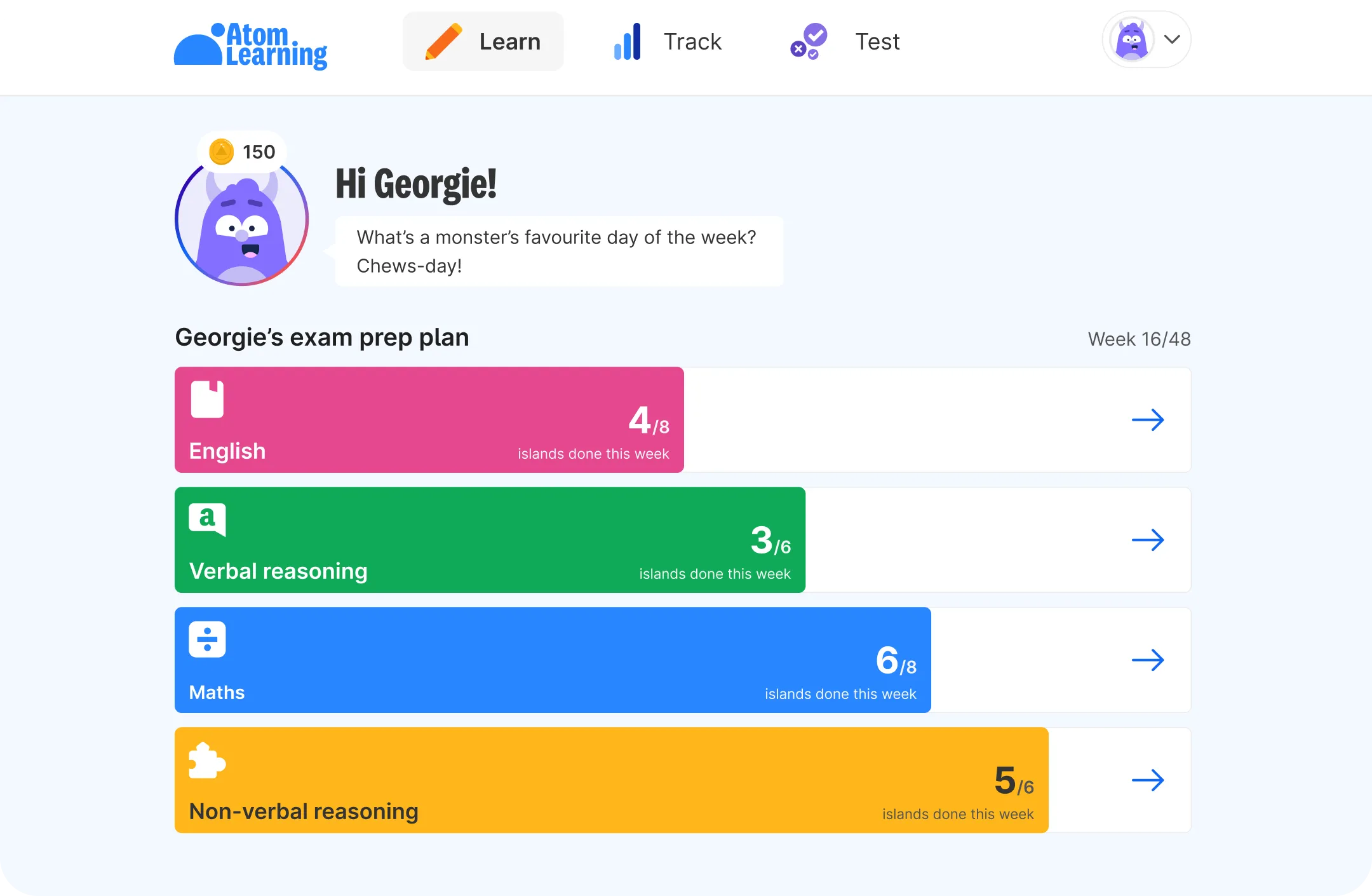
With Atom's Exam Plan, you enter your child's exam date and target schools, and Atom builds a personalised weekly plan based on the key skills they'll be tested on. It adapts as they improve and shows them exactly what to focus on each week.

That means less guesswork for you, less stress for them, and a clearer path to exam day.

Build 11+ exam technique with realistic practice papers
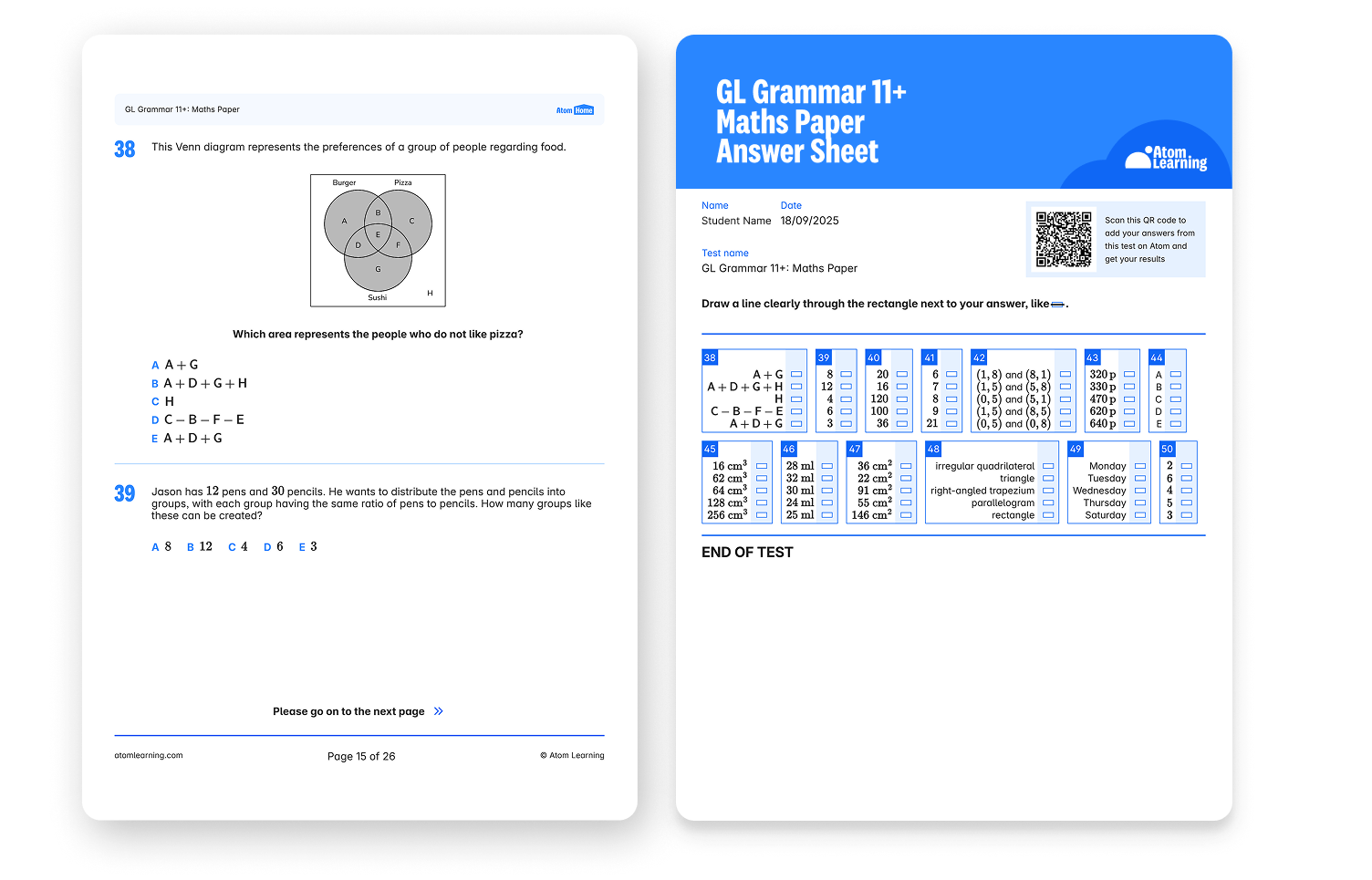
Once your child feels secure with the main topics, paper practice tests help them feel more confident with the exam format.

Atom's 11+ practice papers are designed to reflect real test conditions. Parents simply photograph their child's answer sheets and upload them to Atom for instant marking.

You'll get:

  • a Standardised Age Score (SAS)
  • clear insight into strengths and areas for improvement
  • a comparison with other children applying to the same schools

The papers are unlimited, meaning your child can practise again and again with new questions each time.

Encourage regular reading for 11+ English success

Strong reading skills underpin almost every part of the 11+.

Encourage your child to read for 10–15 minutes a day, focusing on variety – fiction, non-fiction, different genres and authors.

This helps build:

  • vocabulary
  • comprehension and inference
  • confidence with unfamiliar texts

If you're looking for ideas, Atom's recommended reading lists for Years 3–6 include a wide range of age-appropriate books.

Celebrate progress, not just 11+ scores
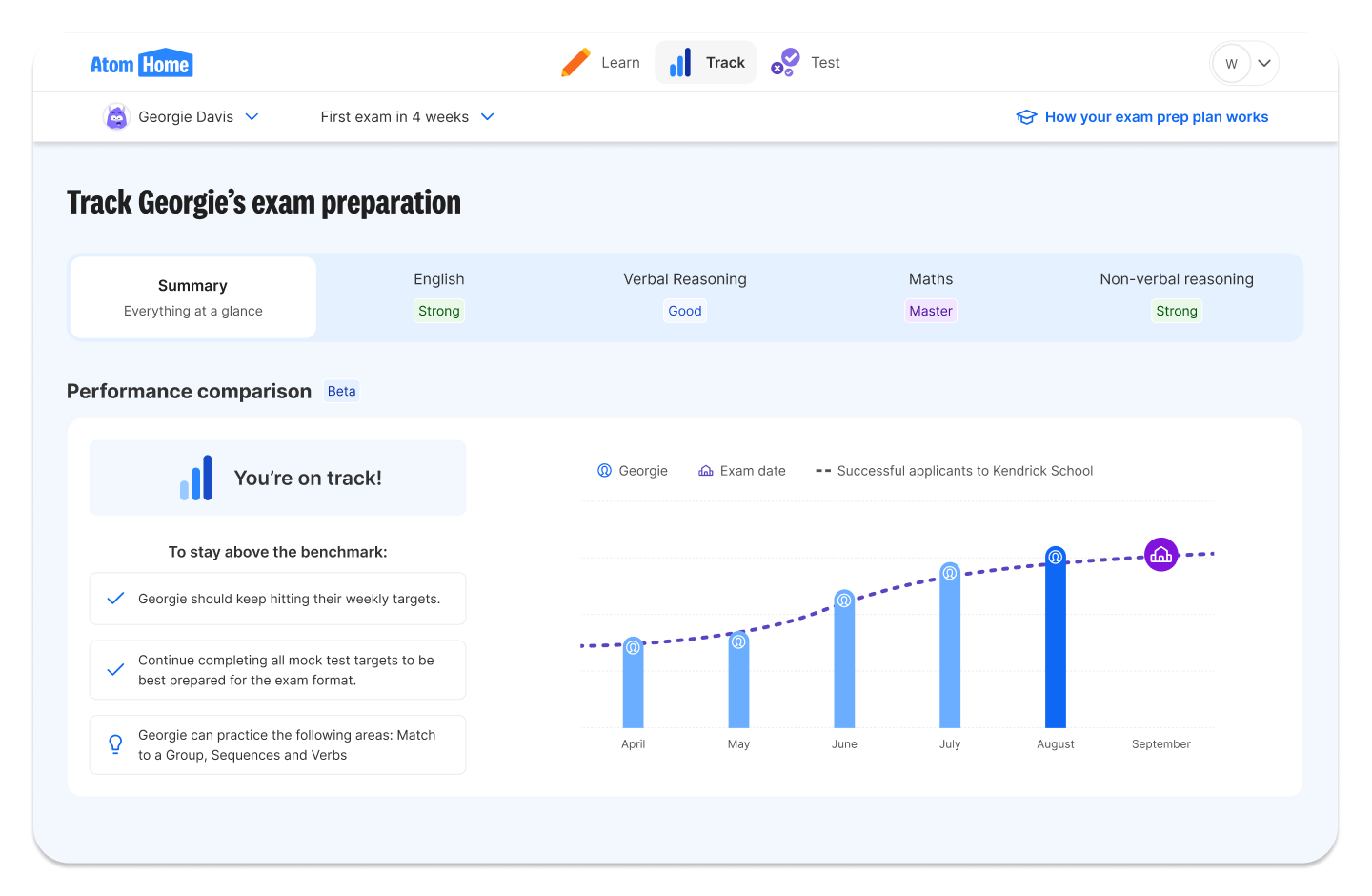
When you're supporting your child through 11+ preparation, what really matters is knowing they're moving in the right direction.

Atom's progress tracking gives you a clear, simple view of how your child is doing across topics and how their performance is developing over time.

That makes it easier to give meaningful encouragement, keep motivation steady and focus on consistent improvement – not just one-off test results.
No items found.
No items found.
No items found.
No items found.

Take control of your child’s 11+ preparation.

Not sure if your child is on track for the grammar school 11+? You don’t need to guess what to cover or whether they’re ready. Atom shows you exactly what to practise each week and how they’re performing, so you can stay ahead of the process without the stress.

Endorsed by grammar schools, trusted by families.

Start your free trial and help your child feel fully prepared for the 11+.

Try Atom for free