Bursaries: Which Schools Spend the Most Per Pupil?

Bursaries: which schools spend the most per pupil?
How much a school spends on bursaries varies hugely from one independent school to the next. We've gone through 200 independent schools' latest annual accounts, as compiled by The Times, to see which ones put the most money into bursaries and scholarships, on average, for every pupil on their roll. Here's what the figures show, and what they don't.
What does "average bursary spend per pupil" actually mean?
It isn't what any individual bursary is worth. It's a school's total annual spend on bursaries and scholarships (not counting fee discounts for staff's own children), divided by every pupil at the school, including those paying full fees. So it's a measure of how much of a school's overall budget goes towards financial help, not what your family would be offered if you applied. Some children at a school receive a full, 100% bursary. Many receive nothing at all. The school-wide average sits somewhere in between.
Schools' published figures also lump bursaries and scholarships together, even though the two work differently: a bursary is awarded on financial need, and a scholarship on talent or achievement. Our guide to independent school scholarships sets out how scholarships are assessed and what they're usually worth.
Which schools spend the most on bursaries?
The top 20, out of the 200 schools covered in the data, are below. If the school you're interested in isn't here, you'll find it in the full 200-school list in our free scholarships and bursaries guide.
Christ's Hospital, in Horsham, is a long way ahead of everywhere else. It spent £24.7m on bursaries and scholarships in the year covered, across 874 pupils, working out at £28,310 per pupil on average, almost three times the amount spent by Downside School in Bath, which comes second at £9,668. Christ's Hospital is a longstanding charitable foundation built specifically around widening access, which shows in how much of its budget goes towards bursaries compared with most other schools.
Across all 200 schools in the data, the average spend per pupil is a good deal lower, at £2,649, so every school in the top 20 is spending considerably more than a typical independent school.
Does a high average mean my family would get a large bursary?
Not directly. A school's average spend per pupil is a reasonable signal that it has a well-established bursary programme, but it doesn't tell you what your own family would be assessed as eligible for. That depends on your household's financial circumstances and the specific school's own bursary policy. For the full picture on how eligibility is assessed, what documents are involved, and the usual application timeline, see our Bursaries: a parents' guide.
Where can I see all 200 schools?
The full list, with every school's average bursary and scholarship spend per pupil, is in our free parents' guide to scholarships and bursaries at private schools. It also explains how bursaries and scholarships work and how to approach an application. Download it for free below.
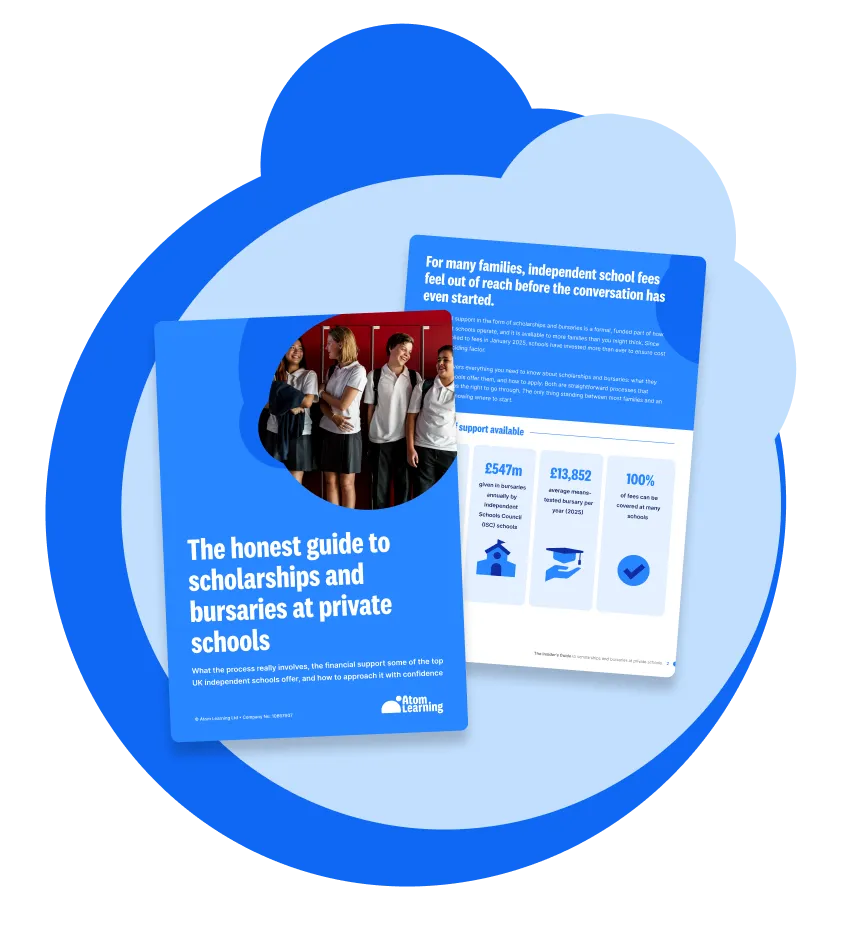
Your guide to scholarships & bursaries
Financial support for independent school fees is more available than most families realise.
This free guide is an honest look at how scholarships and bursaries work in practice: what they cover, how the timeline unfolds from Year 4 to Year 6 and how to approach admissions with confidence.

How was this data worked out?
Independent schools registered as charities have to publish annual accounts with the Charity Commission each year, and those accounts disclose how much they spent on bursaries and scholarships. The Times took that spend, left out discounts given on staff's own children's fees, and divided it by the number of pupils at each school to reach the average-per-pupil figure used here. As with any single year's accounts, the figures will move from one year to the next as spending and pupil numbers change.
If you already have a school in mind
A number of schools families often shortlist appear further down the full 200-school list rather than in the top 20. Harrow School, in London, is the highest-placed London school on the list, 27th overall at £4,065 per pupil. Further down are Sherborne School (34th, £3,806), Cheltenham College (41st, £3,690), Haileybury (56th, £3,081), Ardingly College (90th, £2,337) and Mill Hill School (188th, £925). If you're already looking at one of these, or one of the schools in the table above, we've put together a dedicated entry guide for each. For any school not mentioned here, you'll find its figure in the full 200-school list in our free scholarships and bursaries guide.
What to do next if bursaries matter to your family
Averages are a useful starting point, but the real detail sits with each school's own bursary policy: who can apply, how income is assessed, and when the deadline falls. Bursary deadlines often come earlier than the entrance test itself, so it's worth checking each school's dates early rather than close to application season. Our bursaries guide walks through the full application process, what's assessed, and the usual timeline for 11+ and 13+ entry.
Take control of your child’s independent school prep.

Worried about keeping pace with the competition? Independent school exams can feel unpredictable, but your child’s preparation doesn’t have to be. Atom shows you exactly what to practise and how they’re performing, so you can stay ahead throughout the admissions process.
- Follow personalised weekly exam plans that show them what to learn next.
- Practise with mock tests that replicate their exam and generate new questions every time, so they build real exam skills.
- Track progress and see how they compare to others preparing for the same schools.
Start your free trial and help your child get ready for senior school entry.