
Back to blog

FSCE 11 plus: what you need to know

By
Atom
|
September 17, 2026

If your child is aiming for a grammar school that uses the Future Stories Community Enterprise (FSCE) 11+ entrance exam, this guide explains what the exam is, how it works, and how to help them prepare. Atom Learning is not an official or authorised source of information about FSCE assessments. This guide is based on publicly available information and provides general background for families. FSCE assessments are tailored to each school and can change from year to year. For definitive information about your child's assessment, always rely on the official familiarisation materials published by the school you are applying to. Updated 17 September 2026: the descriptions of the individual papers and the exam delivery format have been amended.

Key takeaways:

  • FSCE assessments are individually tailored to each school and are available in both paper and online formats.
  • There are four papers. Each school chooses which papers to use and in what combination, so there is no single format that applies to every school.
  • Papers differ by how children answer — multiple-choice options, short written answers, or an extended creative response — rather than by subject.
  • Questions may draw on any Key Stage 2 subject taught up to the end of Year 5, including English, maths, science, geography, history, computing, art & design, design & technology, languages, music and physical education.
  • The pass mark, or qualifying standard, is decided by individual schools.
  • The number of schools using FSCE is growing. Ermysted's Grammar School, Queen Elizabeth Grammar School, Penrith and Clitheroe Royal Grammar School are using FSCE for their entrance exams for 2027 entry.

What is the FSCE 11 plus?

The FSCE 11 plus is a Year 7 entrance test. It was created by Future Stories Community Enterprise, linked to Reading School, in 2022. The test helps grammar schools identify which students might thrive there.

The FSCE was designed to be a fairer, more accessible alternative to traditional 11+ exam formats. The exam focuses on how well children can apply knowledge they have already covered in school up to the end of Year 5.

Which grammar schools use the FSCE 11 plus?

Here are the schools using the FSCE 11+ for 2027 entry:

Always check your target school's website to confirm the latest exam arrangements.

What is the format of the FSCE 11 plus?

FSCE assessments are available in both paper and online formats, and each school chooses which it uses. Your school's familiarisation materials will confirm which format your child will sit.

Where the exam is taken on paper, your child will write their answers in the spaces provided on the answer sheet; any work done elsewhere will not be seen or marked.

Arrangements vary between schools. Where instructions are read aloud via a pre-recorded voice recording, the recording will typically tell children at the start of each section:

  • which page number to turn to
  • the section number and name
  • how to answer the questions, with an example (also printed in the question booklet)
  • how much time they have to complete the section
  • when to start and when they have a short time left

An invigilator will be present throughout. Where answer sheets are pre-printed with your child's details, they can raise their hand and an invigilator will help if anything is incorrect.

The FSCE papers

There are four FSCE papers. Schools can use any combination of them, and they may be sat in any order, so there is no single paper structure that applies to every school.

What separates the papers is how children are asked to answer, not the subject being tested. Each of the first three may include questions from any of the subjects listed below.

  • Adventure Paper — questions with multiple-choice answer options
  • Beacon Paper — questions with short written answers
  • Compass Paper — questions with multiple-choice answer options
  • Discovery Paper — a paper requiring an extended creative response

Because assessments are commissioned individually by each school, the papers used, the subjects covered and the question formats can change from year to year. Always check your target school's official familiarisation materials to confirm what your child will sit.

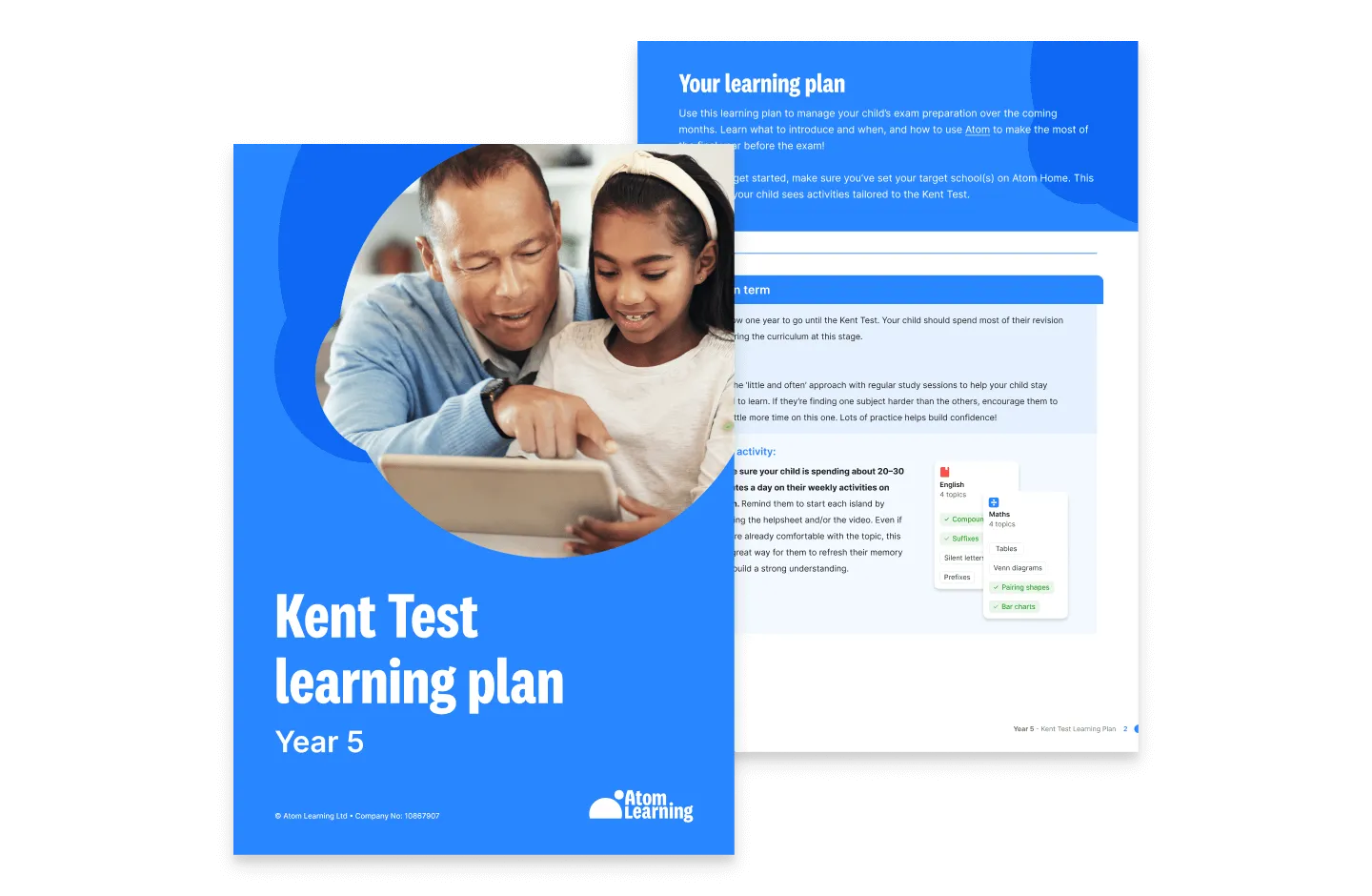
Get your free 11+ learning plan and topic list

Find out exactly what your child needs to study for their target grammar school. Simply enter the school, and Atom will generate a personalised 11+ learning plan and topic list aligned to that school’s exams – so you can focus on what really matters.

Get my plan

What subjects are tested on the FSCE 11 plus?

An FSCE assessment may include questions from any of the following subjects your child is taught at school, up to the end of Year 5:

  • Art & Design
  • Computing
  • Design & Technology
  • English
  • Geography
  • History
  • Languages
  • Maths
  • Music
  • Physical Education
  • Science

Which of these appear depends on the assessment an individual school has commissioned. None of the subjects go beyond what children will have covered in primary school by the end of Year 5, so the content will not be unfamiliar.

The aim is to assess how children apply what they already know, rather than testing for facts crammed outside the classroom.

The sections below cover question types that families commonly meet in Key Stage 2 and that are useful to practise. They are not a guide to what will appear in any particular school's assessment — question types and content can change from year to year, and your school's official familiarisation materials are the only definitive source.

1. English

Where an assessment includes English, question types can include reading comprehension, vocabulary and spelling.

Reading comprehension

Questions assess how well children understand a short passage of text, and their ability to analyse and interpret it. The passage could be fiction or non-fiction.

Take a look at an example comprehension question.
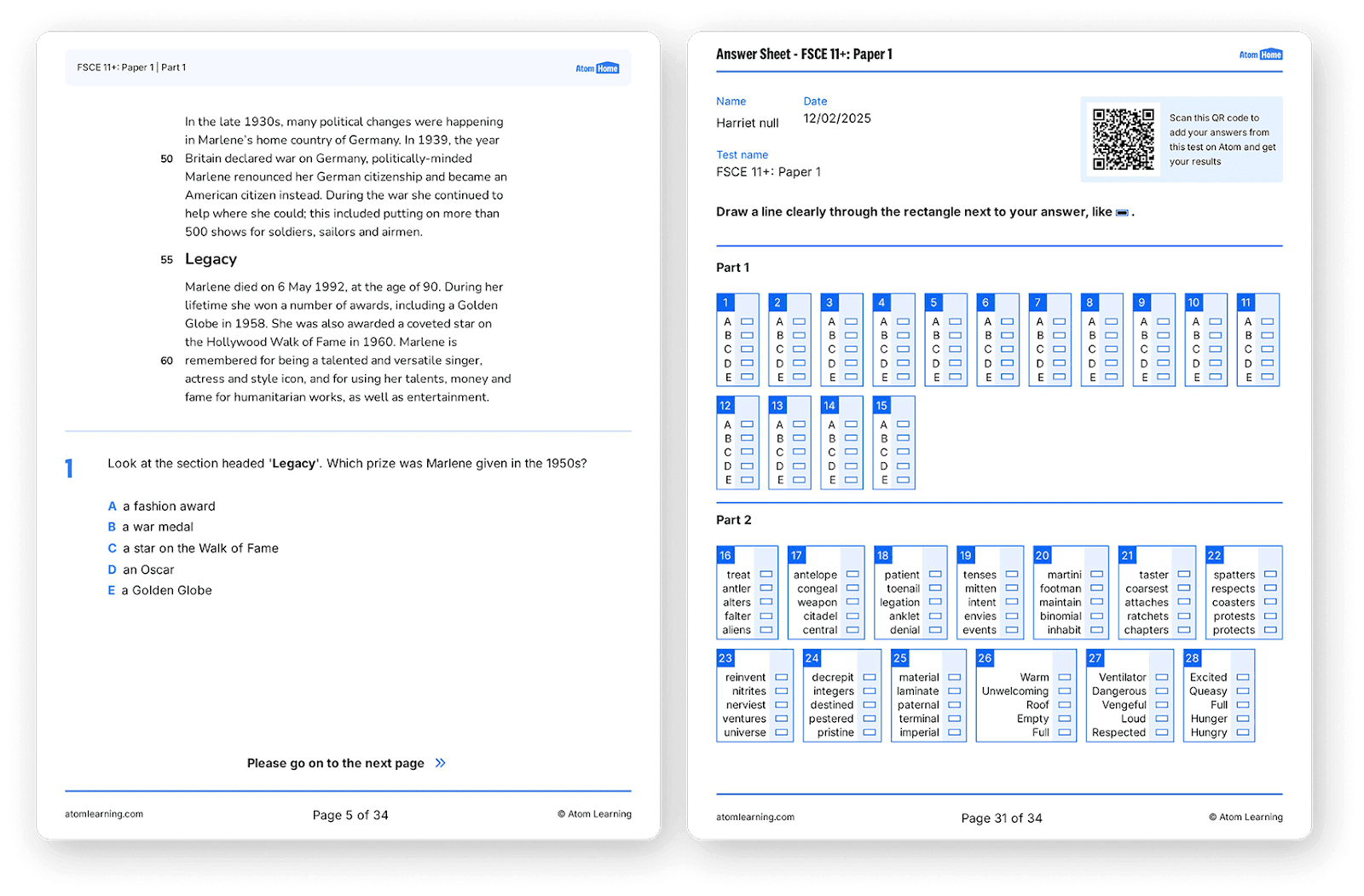
FSCE English comprehension exam question and answer sheet

Vocabulary

Vocabulary questions test word knowledge and understanding. For example, children may be asked to identify the word that is a close match (synonym) for a given word from a set of options.

Take a look at an example below.
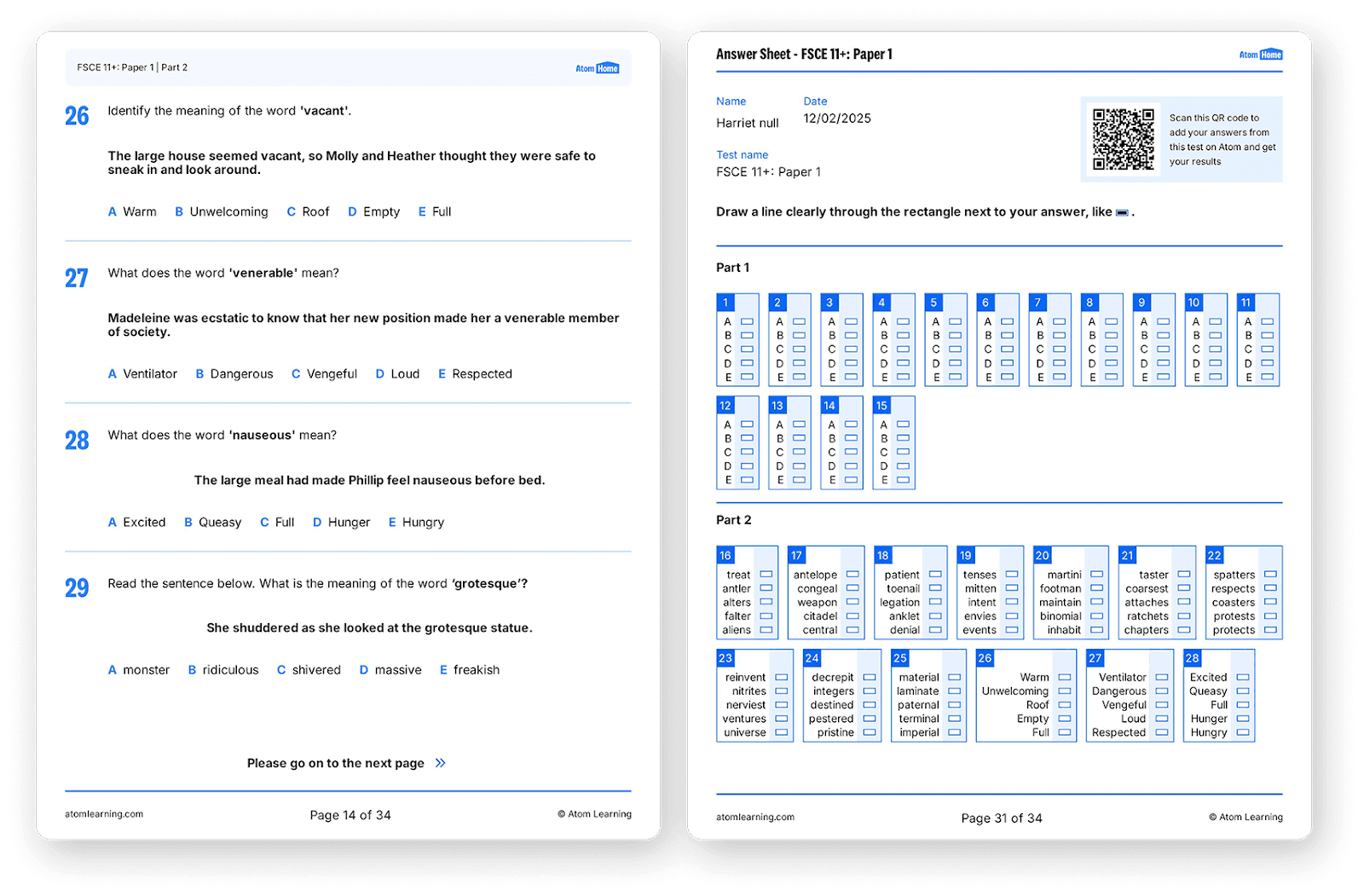
FSCE English vocabulary exam questions and answer sheet

Missing letters (spelling)

Spelling is assessed through missing letters questions. Children see a word with some letters removed and must identify the full, correctly-spelt word in context.

Here is an example of a ‘missing letters’ question.
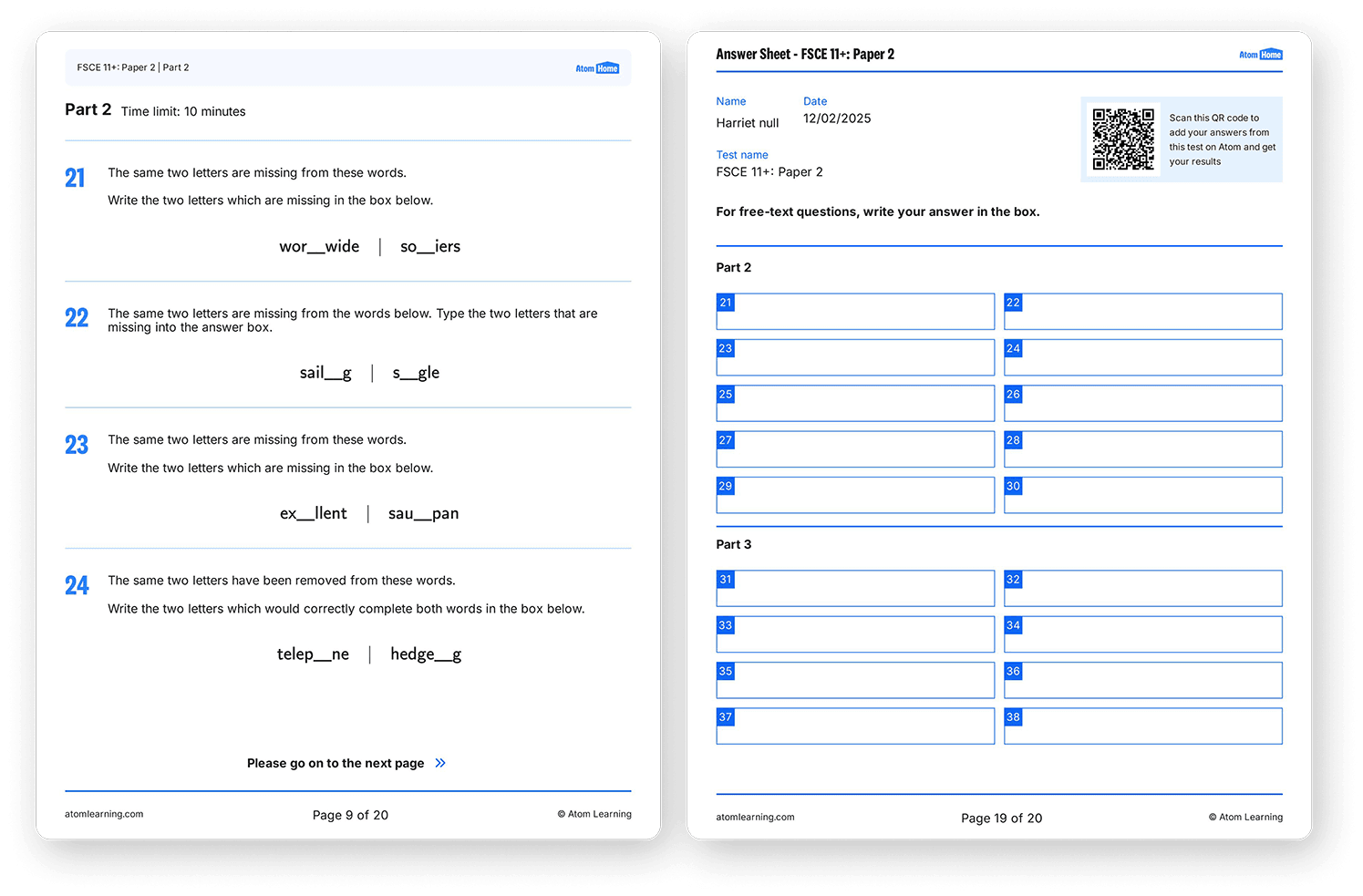
FSCE Missing letters exam questions and answer sheet

2. Maths

Where an assessment includes maths, questions draw on the Key Stage 2 curriculum up to the end of Year 5. Topics your child may meet include:

  • Number and place value: round numbers, negative numbers, and Roman numerals
  • Calculations: addition, subtraction, multiplication and division, factors, and prime, square and cube numbers
  • Fractions, decimals and percentages: comparing and ordering, adding and subtracting, multiplying and rounding, and an introduction to percentages
  • Measurement: units, perimeter, area and volume
  • Geometry: 2D shapes, 3D shapes, angles, reflection and translation
  • Statistics: tables and line graphs

Here is an example maths question.
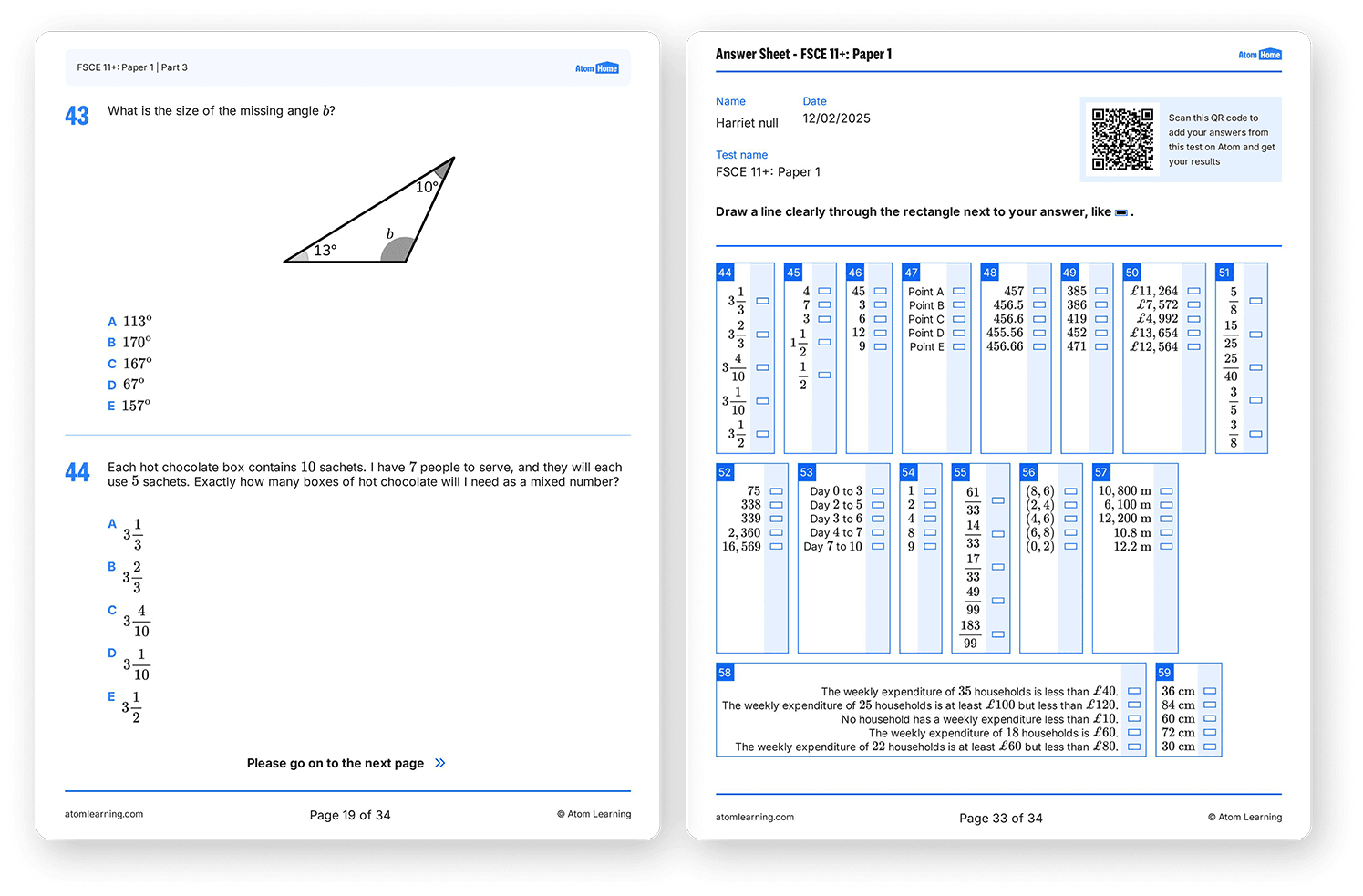
FSCE Maths questions and answer sheet example

3. Creative writing

Where a school includes the Discovery Paper, your child will see a prompt to use as the basis for an extended piece of original writing.

Planning

  • Planning space is typically provided in the question booklet.
  • Planning is not marked, but your child should use the time to structure their ideas.
  • Children are usually asked not to write on the answer sheet during planning time.

Writing

Your child will be told when the planning time has finished, and when to start writing on the answer sheet. Any work written in the question booklet will not be marked.

Marking criteria are set by individual schools, but strong creative writing generally shows:

  • creativity and imagination
  • good structure and pace
  • correct and effective use of spelling, punctuation and grammar
  • an extensive and interesting vocabulary
  • varied sentence structures

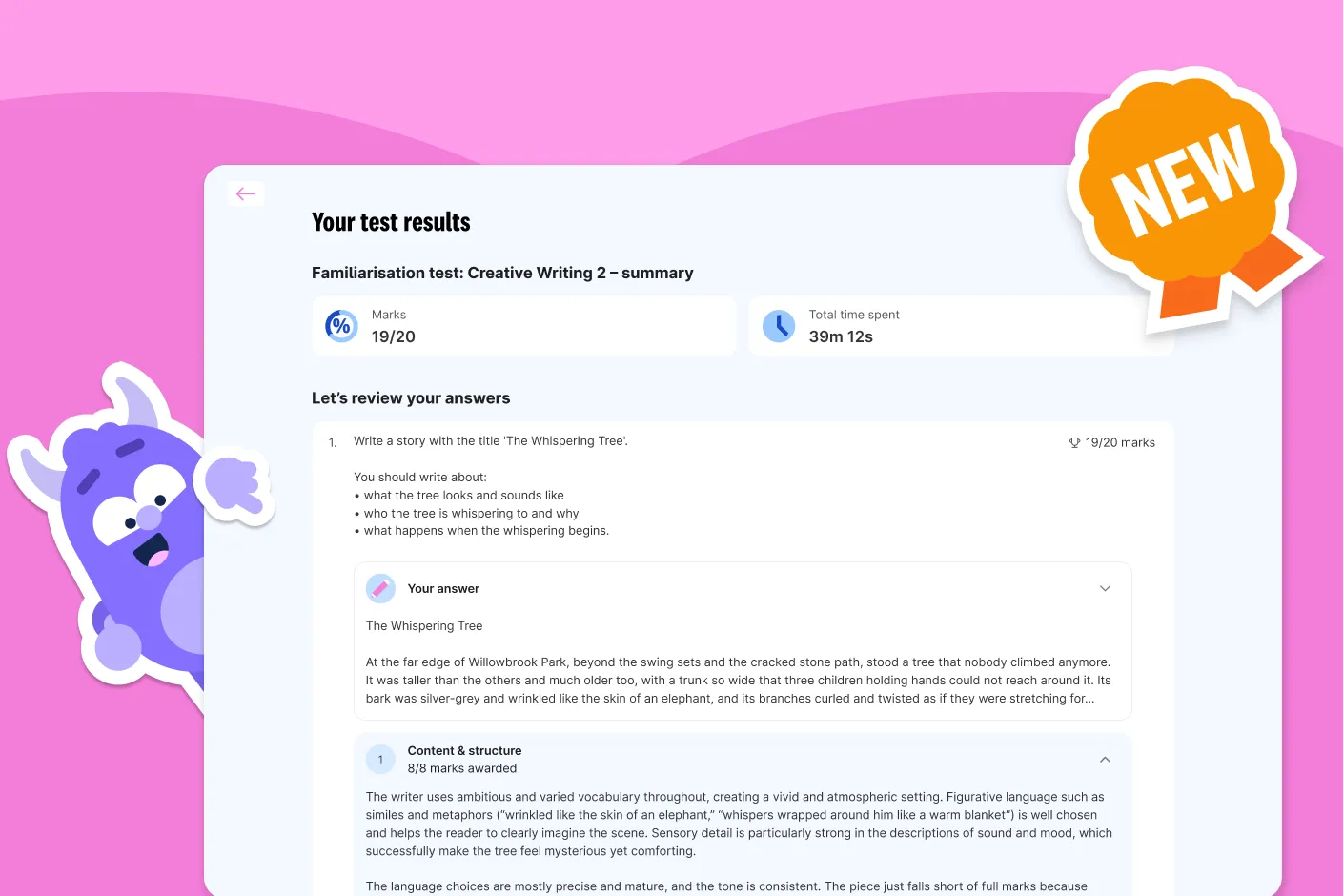
Instantly marked creative writing for ages 7–11

Creative writing is one of the hardest parts of 11+ prep to get right, with vague expectations, unclear marking, and no easy way to know how your child’s doing.

Atom’s new writing tests change that. They’re modelled on real grammar and independent school exams, marked instantly, and come with clear, expert feedback, so you can support your child with confidence.

Explore creative writing tests

How is the FSCE 11 plus exam marked?

Each school sets their own "eligible score" or qualifying standard.

Multiple-choice answer sheets are typically marked electronically using Optical Mark Readers (OMR). Raw scores are then age-standardised (SAS), which takes your child's age at the time of the test into account.

Some schools operate a two-stage process, in which a creative response paper is only marked for children who have first reached an eligible score on the other papers. Check your school's admissions information to confirm how it marks and ranks candidates.

How to prepare for the FSCE 11 plus

Here are our top tips for helping your child prepare effectively for the FSCE 11 plus exam.

Build solid KS2 knowledge

FSCE assessments draw on the Key Stage 2 curriculum up to the end of Year 5, so the strongest foundation your child can have is a confident understanding of what they've already been taught at school.

Using a 'little and often' approach works best as our brains learn new information more effectively in smaller chunks. Experts recommend study sessions of 20–30 minutes for 10-year-olds.

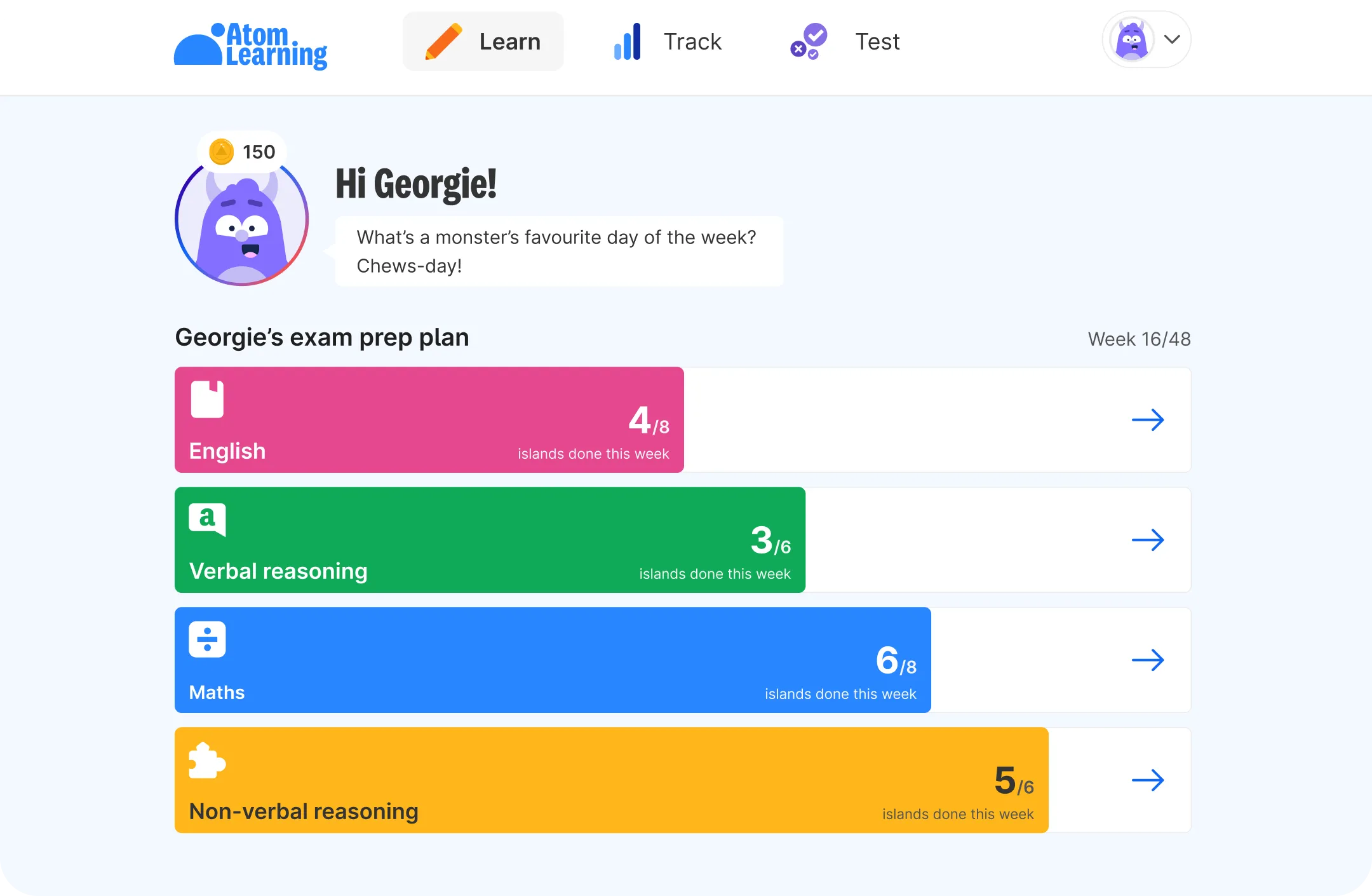
With Atom Home, your child gets:

  • a personalised weekly learning plan tied to their target schools
  • adaptive questions that meet them at the right level of difficulty
  • coverage of KS2 topics across the curriculum

Enter your target schools on Atom Home and get started with a free trial today.

Encourage regular reading

Strong reading skills support almost every area of Key Stage 2 learning.

Encourage your child to read for 10–15 minutes a day, focusing on variety – fiction, non-fiction, different genres and authors.

This helps build:

  • vocabulary
  • comprehension and inference skills
  • confidence with unfamiliar texts

Looking for inspiration? Explore Atom’s free reading and writing starter kit for helpful suggestions of age-appropriate books your child can read!

Build 11+ exam technique with realistic practice papers

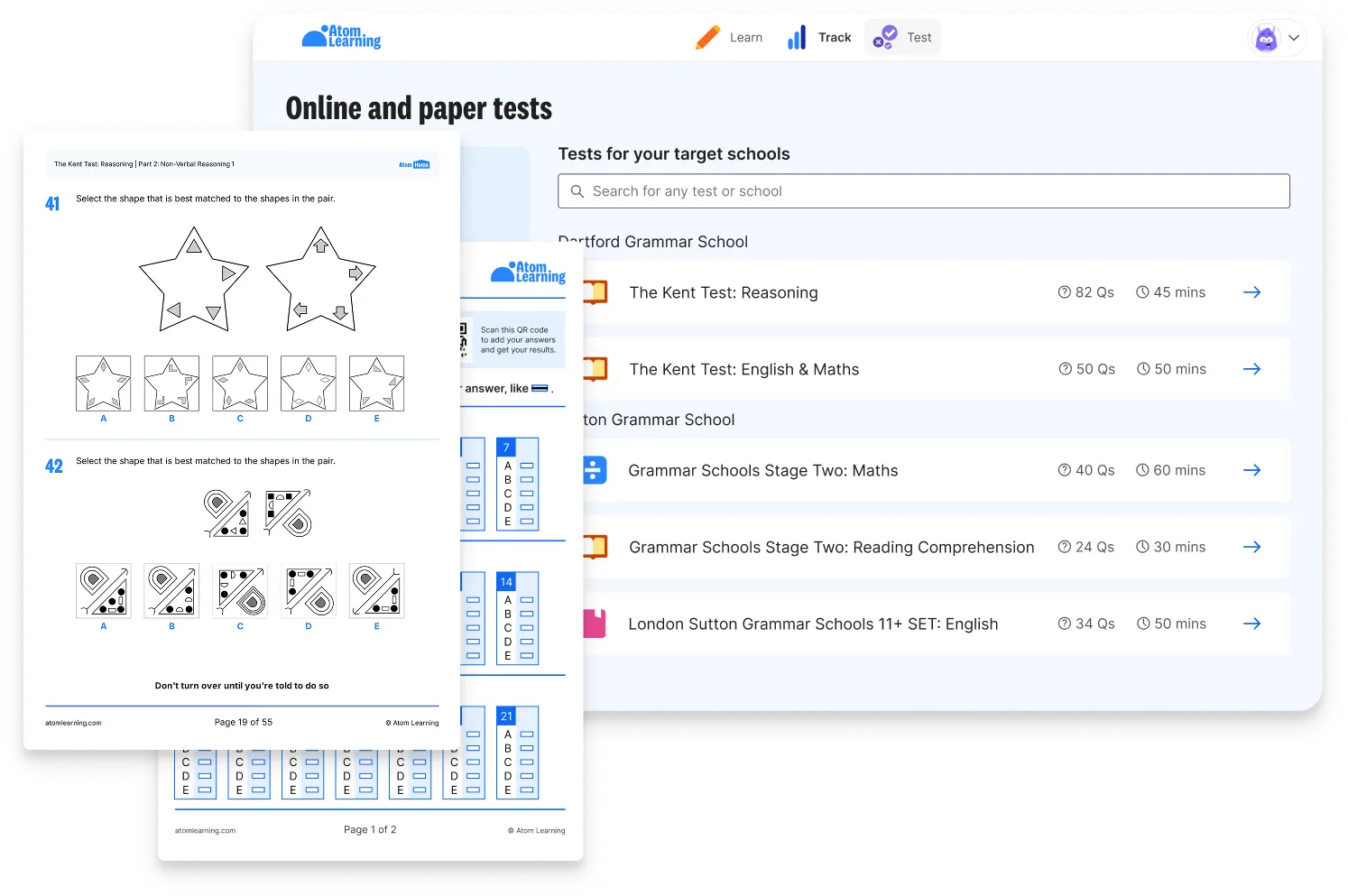
Once your child feels secure with the main topics, paper practice tests help them feel more confident with the exam format.

Atom’s practice papers are designed to reflect real test conditions. Parents simply photograph their child’s answer sheets and upload them to Atom for instant marking.

You’ll get:

  • a Standardised Age Score (SAS)
  • clear insight into strengths and areas for improvement
  • a comparison with other children applying to the same schools

The papers are unlimited, meaning your child can practise again and again with new questions each time.

Ready to start preparing? Try 11+ entrance exam practice on Atom.

Celebrate progress, not just scores

When you’re supporting your child through exam preparation, what really matters is knowing they’re moving in the right direction.

Atom’s progress tracking gives you a clear, simple view of how your child is doing across topics and how their performance is developing over time.

That makes it easier to give meaningful encouragement, keep motivation steady and focus on consistent improvement – not just one-off test results.

No items found.
No items found.

Take control of your child’s 11+ preparation.

Not sure if your child is on track for the grammar school 11+? You don’t need to guess what to cover or whether they’re ready. Atom shows you exactly what to practise each week and how they’re performing, so you can stay ahead of the process without the stress.

Endorsed by grammar schools, trusted by families.

Start your free trial and help your child feel fully prepared for the 11+.

Try Atom for free

Contents