
Back to blog

Everything you need to know about AQA Maths GCSE

By
Atom
|
October 22, 2026

Are you taking GCSE Maths with AQA? If you’ve got questions on what to expect, take a look at this guide.

Exam boards assess knowledge differently, so it’s important to get accurate information on what to expect in the exam and how it will be marked. This guide will help you understand what the Maths GCSE will look like with AQA and give top tips on how to prepare.

Unsure which exam board your school has selected? ‍

Key takeaways:

  • There are three papers in the AQA GCSE Maths exam, and each one counts for a third of your overall Maths grade.
  • The grade boundaries for Maths AQA are set after exams take place to make sure grades are fair.
  • A formula sheet will be included for AQA Maths GCSEs in 2025, 2026, and 2027.
  • AQA GCSE Maths past papers can be found on the AQA website.

What’s the format for AQA Maths?

To make the GCSE journey less mysterious, here’s a rundown on the format of the AQA Maths exams, including how many papers there are, how long each paper lasts, their structure, and the kinds of questions and marks you will face.

How many papers are there?

There are three exam papers for AQA GCSE Maths, for both the Foundation and Higher tiers.

All content from the AQA GCSE Maths course can be tested in any of the three exam papers, with questions often combining topics from across the curriculum.

The three papers are:

Paper 1: Non-calculator

  • Written exam: 1 hour 30 minutes
  • 80 marks
  • Non-calculator
  • Counts for one-third (33%) of the total GCSE AQA Maths grade.

Paper 2: Calculator

  • Written exam: 1 hour 30 minutes
  • 80 marks
  • A calculator is allowed in the exam
  • Counts for one-third (33%) of the total GCSE AQA Maths grade.

Paper 3: Calculator

  • Written exam: 1 hour 30 minutes
  • 80 marks
  • A calculator is allowed in the exam
  • Counts for one-third (33%) of the total GCSE AQA Maths grade.

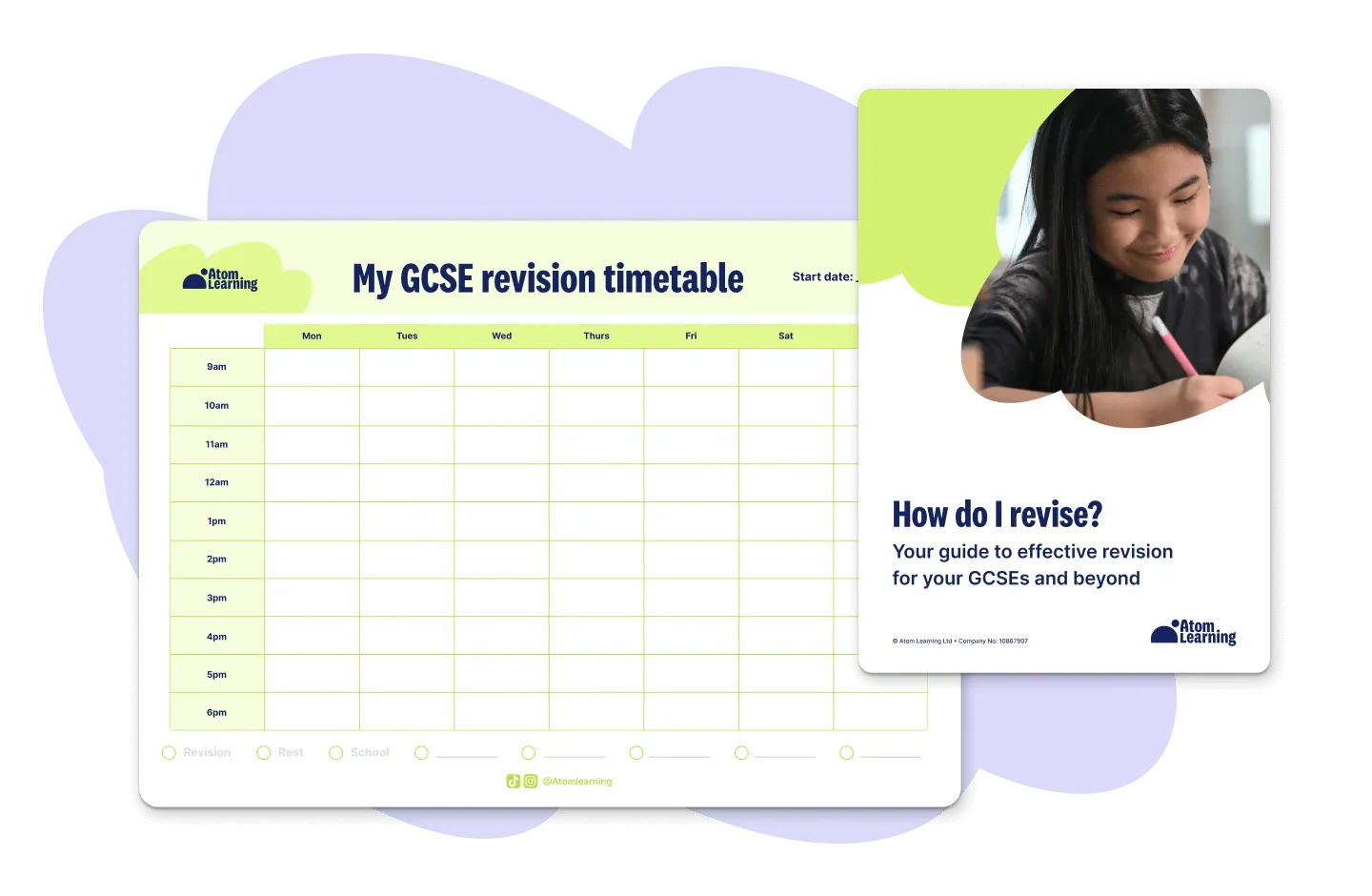
Download your free GCSE revision planner

Less stress, more success! Get your free GCSE revision planner and our handy guide to effective revision today.

Download now

What’s the difference between Higher and Foundation?

As you can see, the format of the two Maths tier papers is the same. The key difference between the two is how challenging the questions are and the grades available.

Foundation tier Maths AQA:

  • Covers the essential topics students need to know that will prepare them for further study, work and everyday life.
  • In Foundation Maths, students can achieve grades 1,2,3,4, and 5, but no higher.

Higher tier Maths AQA:

  • The higher tier covers more advanced topics such as: more complex Algebra, higher-level Geometry, and deeper Functions.
  • For Higher tier Maths, students can achieve grades 3-9, but no lower.

Your school will place you in the correct tier based on your performance in Year 9. Sometimes, students may be moved up or down a tier during Year 10 or 11.

AQA requires all exams to be taken at the same level, so you cannot do Higher for one part and Foundation for another.

How long is the exam?

  • Each paper is 1 hour and 30 minutes (90 minutes) long.
  • If you're entitled to 25% extra time, you'll have 1 hour 53 minutes per paper.
  • All papers are set on separate days, usually spread across the exam period in May and June.

What does the exam paper look like?

Each paper will include:

  • An instructions page: This is where students will need to fill in their personal details and where they can read through the materials, instructions, information and advice for each AQA Maths paper.
  • The question booklet: This will include all the questions and where students will write their answers and show their working out.
  • Additional pages: These are for extra space to include working out, if needed. Students must write the question number in the left-hand margin to ensure they don’t lose marks.

What kinds of questions are there?

For each of the papers, a mix of question styles will appear. The difficulty increases as you progress through the paper.

Towards the start of the paper, short, one or two-mark questions will appear:
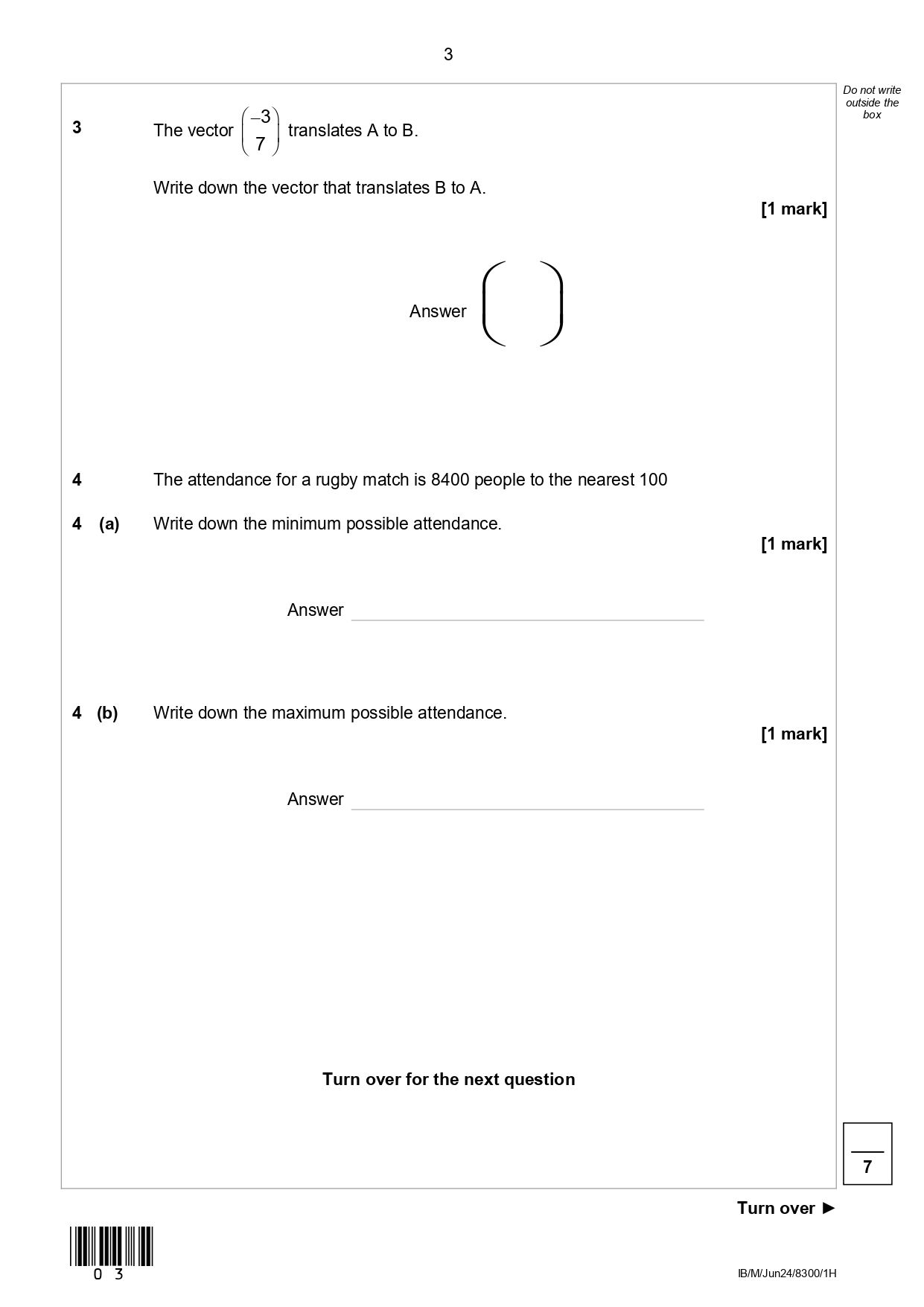
AQA-Maths-JUN24-3.jpg

Pictured: The first page from Higher Tier, Paper 1 AQA GCSE Maths June 2024.

As you progress through the paper, multi-step problems with more marks will be included, requiring deeper thinking:
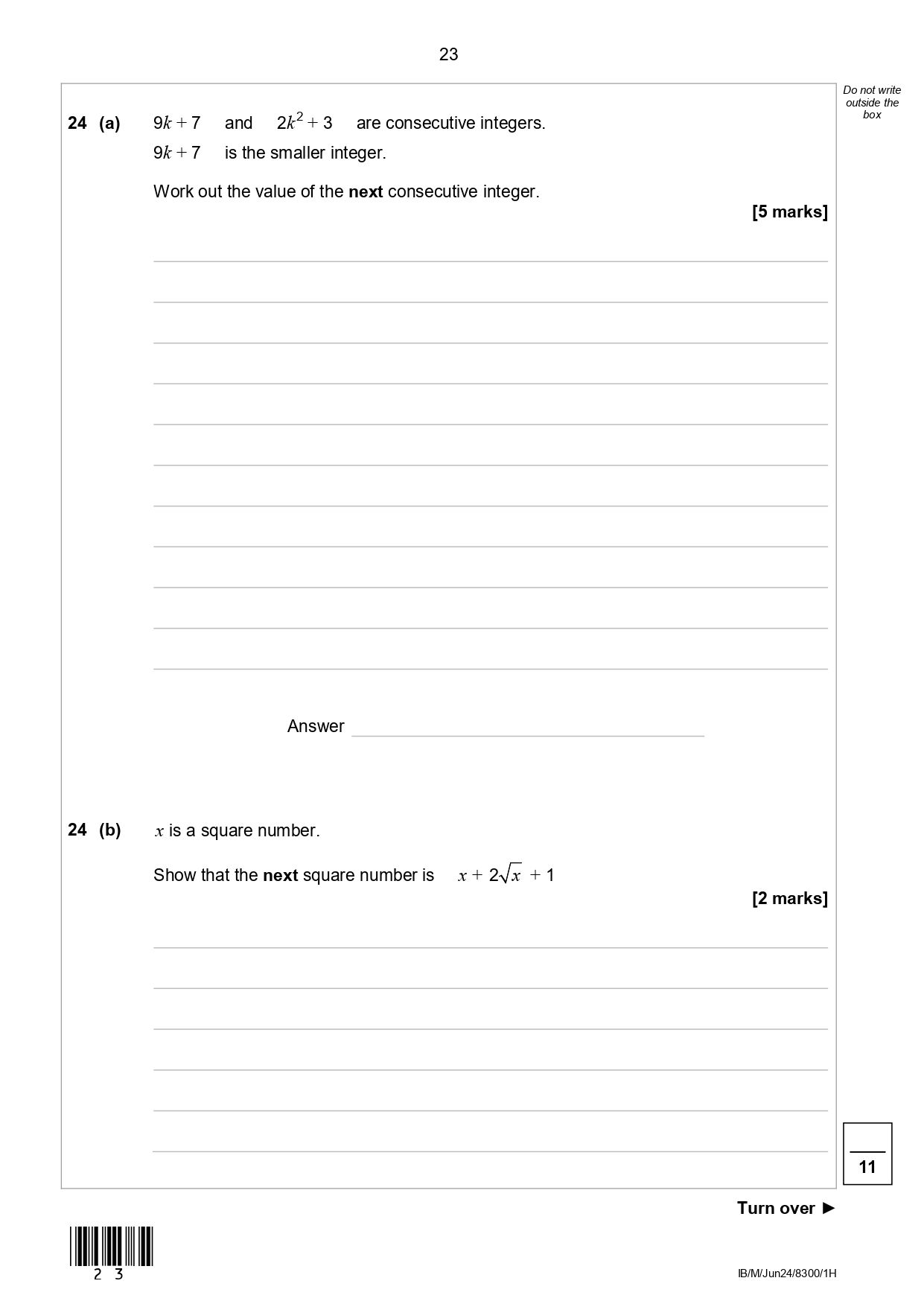
AQA-Maths-JUN24-23.jpg

Pictured: Higher Foundation Tier, Paper 1 AQA GCSE Maths June 2024.

Each AQA GCSE Maths paper is worth 80 marks in total. The number of marks for a question shows how much detail or working is needed.

Short, 1–2 mark questions are simpler, while the later questions can be worth up to 8 marks and usually require more steps and reasoning.

Here's a breakdown of the types of questions you'll find by number of marks:

1-mark questions:

  • These are often simple recall, single-step arithmetic, or quick fact questions.
  • They test basic skills: e.g. “Write ⅗ as a decimal,” “What is 7 × 8?”, “Calculate 15% of 80.”
  • They don’t require extended working. One line or even just the answer is enough (though working is beneficial in case of slips).
  • They’re designed to build confidence early in the paper.

Medium-mark questions (2–5 marks):

  • These questions require a few more steps to solve, and ask students to demonstrate more thought and understanding.
  • You may need to show intermediate workings or justify a step.
  • The mark scheme will award method marks (for correct setup or steps) as well as final answer marks.

Higher-mark, multi-step / reasoning questions (6, 7, 8+ marks):

  • These ask you to combine multiple areas of Maths: Algebra, Geometry, Statistics or Ratio, in context.
  • They often include “show that”, “explain why”, “prove”, or “justify” wording.
  • You must lay out a clear method, break down steps, and sometimes consider alternative approaches or show reasoning.
  • Marks are split into different types. You can earn method marks for showing the correct steps and working, and accuracy marks for getting the right answers. Some questions also award extra marks for giving a clear explanation or justification at the end.
  • Even if the final answer is wrong, partial marks can be earned for correct working.
  • For the higher mark questions, students must show their working out.

What are the grade boundaries for AQA Maths GCSE?

Grade boundaries are set after every exam series, so they shift a little each year, and they differ between the two tiers. In the June 2026 series — the most recent — a grade 4 standard pass in AQA Mathematics (8300) took 154 out of 240 (64%) at Foundation tier and 63 out of 240 (26%) at Higher tier. A grade 5 took 187 out of 240 (78%) at Foundation and 97 out of 240 (40%) at Higher. The top grade 9, available only at Higher tier, took 219 out of 240 (91%).

The full June 2026 boundaries for both tiers are below. AQA publishes the boundaries for every series on its grade boundaries page.
AQA GCSE Mathematics (8300) grade boundaries for the June 2026 exams, showing the raw marks needed for each grade.
Grade Foundation tier Higher tier
Grade 9Not available at this tier219 out of 240 (91%)
Grade 8Not available at this tier192 out of 240 (80%)
Grade 7Not available at this tier166 out of 240 (69%)
Grade 6Not available at this tier131 out of 240 (55%)
Grade 5 (strong pass)187 out of 240 (78%)97 out of 240 (40%)
Grade 4 (standard pass)154 out of 240 (64%)63 out of 240 (26%)
Grade 3115 out of 240 (48%)46 out of 240 (19%)
Grade 276 out of 240 (32%)Not available at this tier
Grade 138 out of 240 (16%)Not available at this tier
No items found.

Where can I find past papers and mark schemes?

Practising with past papers and mark schemes is one of the most effective ways to prepare for GCSE AQA Maths. Past papers help you understand the question style, see how marks are awarded, and build confidence with real exam timing and structure.

Head to the AQA website to find past papers and mark schemes from previous GCSE AQA Maths exams. Once you've worked through those, Atom gives you a fresh set of practice papers based on our team's predictions for the next GCSE year, plus instant, examiner-style feedback so you always know exactly where marks were gained or lost.

Read the examiner's report, not just the mark scheme

After every series the board publishes an examiner's report on what candidates actually did — the questions that were misread, the answers that stopped half way, the marks lost to command words. It is the closest thing to being told in advance what to avoid, and almost nobody reads it.

Start with the AQA Maths 8300/1H Paper 1 Higher, non-calculator examiner's report (June 2025), then work through the rest on AQA Maths assessment resources.

A recent AQA Maths past paper to start with

If you want to sit one now rather than browse, use the June 2025 paper (8300/1H Paper 1 Higher, non-calculator): the question paper and the mark scheme. Give yourself the real time limit, mark it against the scheme, then read the examiner's report on the same paper to see where other candidates lost the marks you lost.

Are there predicted papers for AQA Maths?

Yes. Once you have worked through the real past papers, there is nothing left that you have not already seen — and the most recent papers are the ones every other candidate has done too. Predicted papers are fresh papers written to match the style, balance and difficulty of the real thing for the year ahead.

Atom writes a set of predicted papers for AQA Maths based on our team's predictions for the next GCSE series, marked instantly with examiner-style feedback so you can see exactly where marks were gained or lost — so you can keep sitting full papers under real conditions right up to the exam.

What key topics do I need to know for the AQA Maths GCSE?

AQA Maths tests several key topics at GCSE. You’ll need a thorough understanding of each topic, and it’s important to make sure you revise the areas you find most difficult ahead of the exam.

The topics are:

  • Number: This topic tests your understanding of things like units of measure, fractions and prime numbers.
  • Algebra: For this topic, you’ll be tested on expanding and simplifying algebraic equations, plotting and understanding graphs, and more.
  • Ratio, Proportion and Rates of Change: This topic involves understanding concepts such as compound units, scale diagrams, and direct and inverse proportion.
  • Geometry and Measure: Here you’ll need to understand properties of angles, coordinate axes, rotation, reflection, translation and enlargement, among other things.
  • Probability: This involves calculating the likelihood of outcomes in future experiments, understanding the probability scale, using tree diagrams, and more.
  • Statistics: For Statistics, you’ll need to interpret and construct charts, graphs and diagrams, understand population data, understand correlation and more.

If you’re taking Further Maths, you’ll also be tested on topics like Functions, Coordinate Geometry, Calculus and Matrix Transformations.

What are examiners looking for?

When marking AQA GCSE Maths papers, examiners aren’t just checking for the right answers; they want to see how you think. They’re looking for clear working, sensible explanations and answers that show genuine understanding of the questions.

Every question on the paper is written to show examiners what a student can really do. Each question tests one or more of the three Assessment Objectives (AOs), which helps examiners assess how well a student can apply Maths to solve problems.

The three assessment objectives are:

1. AO1 – Applying standard techniques

This is about using mathematical skills and methods correctly. Examiners look for accuracy in calculations, correct use of formulae, and clear working.

Questions that assess AO1 often involve number work, algebraic manipulation, or Geometry. Students are rewarded for demonstrating the correct method, even if they make a mistake in their calculations.

2. AO2 – Reasoning, interpreting and communicating

Here, examiners want to see a student’s ability to think logically and explain their process. AO2 is about showing why something works, not just how to do it.

Students might need to compare results, interpret graphs, or explain relationships between numbers. Clear reasoning and well-presented answers are key; examiners are looking for clear, logical thinking just as much as the correct final answer.

3. AO3 – Solving problems in context

This objective focuses on applying Maths to real-life or unfamiliar situations. Examiners are assessing how well students can choose the right method, link different areas of Maths, and make sense of their answers.

AO3 questions often require several steps and reward logical reasoning and a clear understanding of the problem, not just the final answer.

Every AQA Maths paper provides you with the opportunity to demonstrate what they truly understand. The best way to impress examiners is to approach each question step by step, show the working clearly, and check that your answers make sense.

By practising this approach regularly, you build the habits examiners look for: clear working, logical thinking, and confidence in tackling unfamiliar problems. It’s these skills, developed over time, that help turn preparation into strong, well-earned marks on exam day.

How can I prepare for AQA Maths?

To prepare for AQA Maths exams, you’ll need to start revising early to make sure you’re confident covering all the key topics. For exam revision tips for Maths, take a look at our Maths breakdown here.

What do I need to bring to the exam?

Feeling calm and prepared on exam day starts with having everything you need ready to go. For AQA GCSE Maths, what you’ll need for exam day depends slightly on which paper you’re sitting.

For Paper 1, you’ll need:

  • A black pen (bring a few spares!)
  • Pencil, ruler, rubber, and sharpener.
  • Protractor and compass for geometry questions.

For Papers 2 and 3, you’ll need everything above, plus a scientific calculator that meets exam board regulations. Make sure it’s in good condition with fresh batteries and that you’re confident using all its functions.

Finally, beyond Maths equipment, there are a few other essentials you’ll need for exam day:

  • Make sure to have a clear pencil case.
  • A bottle of water with no label.
  • If you’re wearing a school uniform, pack a jumper in case the exam hall is cold.
  • If your school allows non-uniform, choose clothes that feel comfortable and relaxed, so you can focus fully on the paper, not your outfit.
  • If you wear glasses, double-check they are packed the night before.
  • Bring any medications you may need, for example, your inhaler if you’re asthmatic.

Is there a formula sheet for AQA Maths?

Don’t worry, there is a formula sheet provided for AQA Maths, so you don’t need to memorise formulas like Pythagoras’ theorem. The DfE has confirmed that formula sheets will continue to be provided for 2025, 2026 and 2027.

What’s included on the formula sheet?

The formula sheet will include formulas for:

  • Perimeter area and volume
  • Quadratic formula
  • Pythagoras’ Theorem and trigonometry
  • Coordinate geometry

There you have it! Everything you need to know to feel confident tackling AQA Maths at GCSE. Whether you’re taking the exam yourself or supporting your teen, proper preparation and revision are the keys to exam success.

No items found.
No items found.

Take control of your GCSE revision

Everything you need for GCSE success, in one place.

Feeling confident about your GCSEs comes from knowing what to revise, how to improve, and where to focus next.

🔮 GCSE practice papers based on our team's 2026 exam predictions

🎓 Guided courses that cover all the topics on your exams

✍️ Instant feedback that tells you where you’ve gained and lost marks

📈 Predicted GCSE grades and topic-by-topic tracking

Know where you stand and how to improve

Create your free account and start making real progress today.

Online GCSE revision

Contents