Back to blog

Your guide to Edexcel Maths GCSE

By
Atom
|
October 22, 2026

Edexcel Maths GCSEs are on the horizon. Whether you’re looking for revision help or just curious to know what the exam will look like, take a look at this guide to the Edexcel Maths exam.

Not sure which exam board your school uses? Take a look at our guide to finding out which exam board you’re studying.

Key takeaways:

  • There are three papers for Edexcel Maths GCSE. Each is 90 minutes long and worth 80 marks.
  • The grade boundaries for Edexcel Maths are set after the exams take place.
  • A formula sheet will be provided for Maths GCSEs in 2025, 2026, and 2027.

What’s the format for the Edexcel Maths GCSE?

The format for Edexcel Maths is similar to other exam boards and consists of:

  • Three exam papers, each worth a total of 80 marks.
  • Paper 1 is a non-calculator exam, with papers 2 and 3 allowing calculators.
  • Each paper lasts 90 minutes (1 hour and a half).
  • There are 240 marks available, with each paper contributing to a third of your final grade.

All content from the Edexcel GCSE Maths course can be tested in any of the three exam papers, with questions often combining topics from across the curriculum.

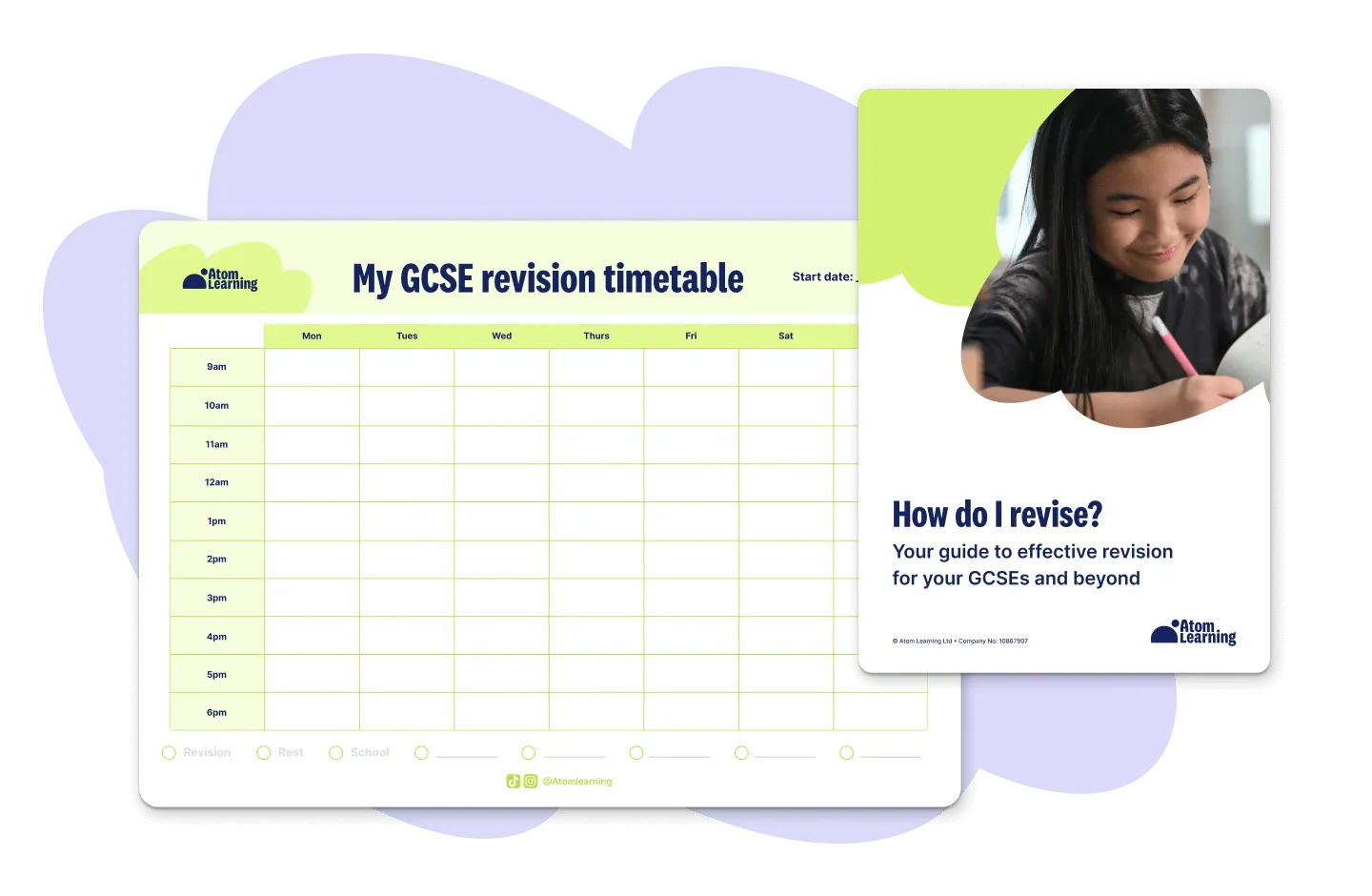
Download your free GCSE revision planner

Less stress, more success! Get your free GCSE revision planner and our handy guide to effective revision today.

Download now

What’s the difference between Higher and Foundation for Edexcel Maths?

Like other exam boards, Edexcel splits its papers into a Higher and a Foundation tier.

Foundation tier Maths Edexcel:

  • Covers the essential topics such as Algebra, Geometry and Statistics that students need to know for further study, work, and everyday life.
  • In Foundation Maths, the highest grade you can achieve is a 5.

Higher tier Maths Edexcel:

  • The higher tier covers topics at a more advanced level, such as more complex Algebra, higher-level Geometry, and deeper Functions.
  • For Higher tier Maths, you can achieve up to a grade 9 - the highest grade possible.

In terms of question types and difficulty for Higher and Foundation papers:

  • The Foundation papers tend to have more structured questions and less depth in certain topics.
  • The Higher tier contains more challenging algebra and harder problem solving.
  • As with most GCSE Maths exams, questions progress from easier to harder, with early marks secured via routine tasks and later marks involving multi-step reasoning or interpretation.
  • Since Paper 1 is non-calculator, you’ll see arithmetic, fractions, simplifying, factorising, basic calculations, and mental methods tested without calculator support.
  • In all papers, ‘method marks’ are often available, given for showing how you worked out a question, not just a correct answer.

Your school will place you in either the Foundation or Higher tier based on your Maths attainment in Year 9, although you can be moved up or down a tier during Years 10 or 11. You must take all three papers at the same level.

Edexcel offers Further Maths at GCSE as part of its International GCSEs; check with your school to find out if this is an option you could take.

What does the exam paper look like?

Each paper will include:

  • An instructions page: This is where students will need to fill in their personal details and where they can read through the materials, instructions, information and advice for each Edexcel Maths paper.
  • The question booklet: This will include all the questions and where students will write their answers and show their working out.
  • Additional pages: These are for extra space to include working out, if needed. You must write the question number in the left-hand margin to ensure you don’t lose marks.

What kinds of questions are there?

For each of the papers, a mix of GCSE maths questions will appear. The difficulty increases as you progress through the paper.

Towards the start of the paper, short, one or two-mark questions will appear:
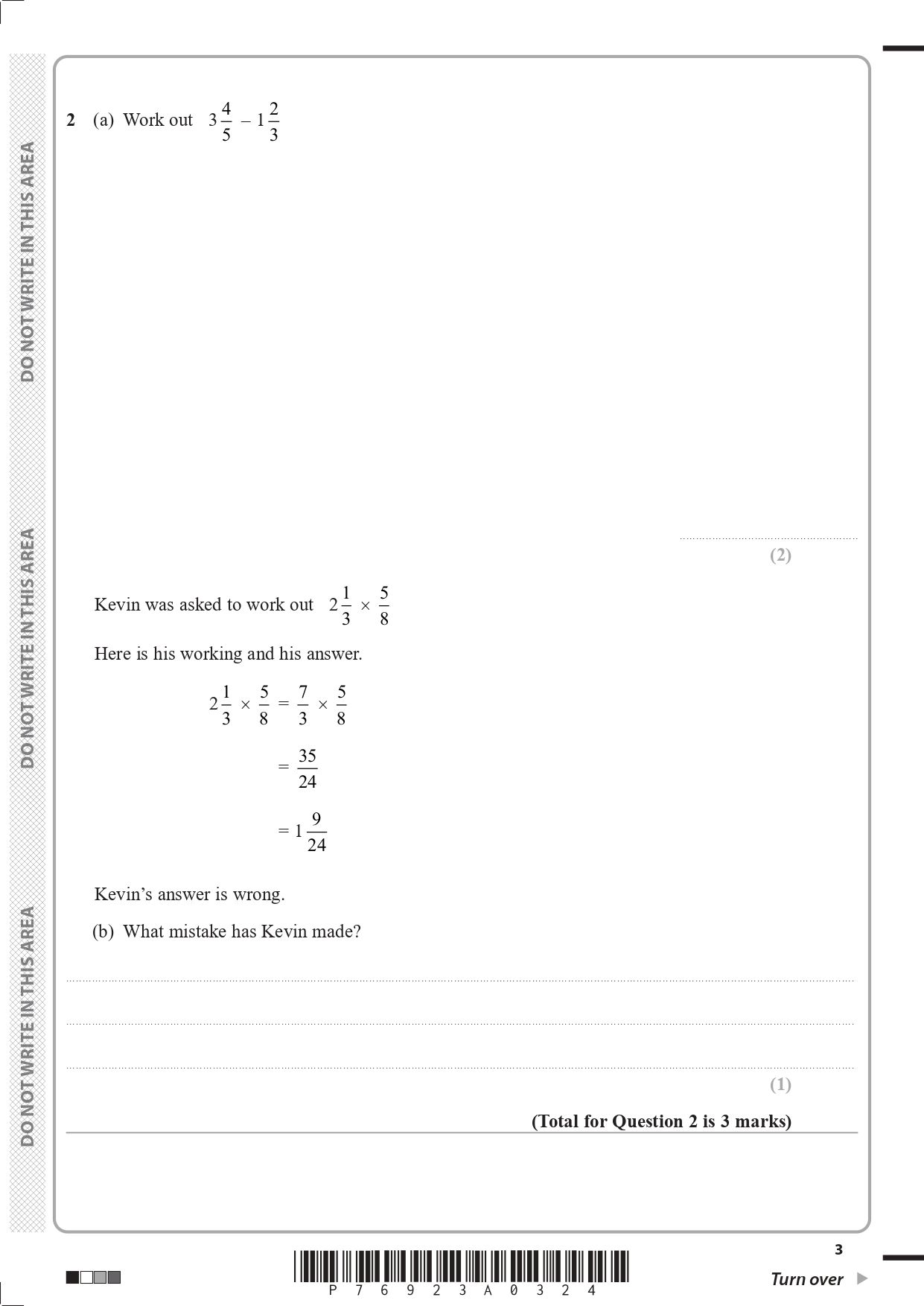
edexcel maths page 3.jpg

Pictured: Higher Tier, Paper 1 Edexcel GCSE Maths June 2024.

As you progress through the paper, multi-step problems with more marks will be included, requiring deeper thinking:
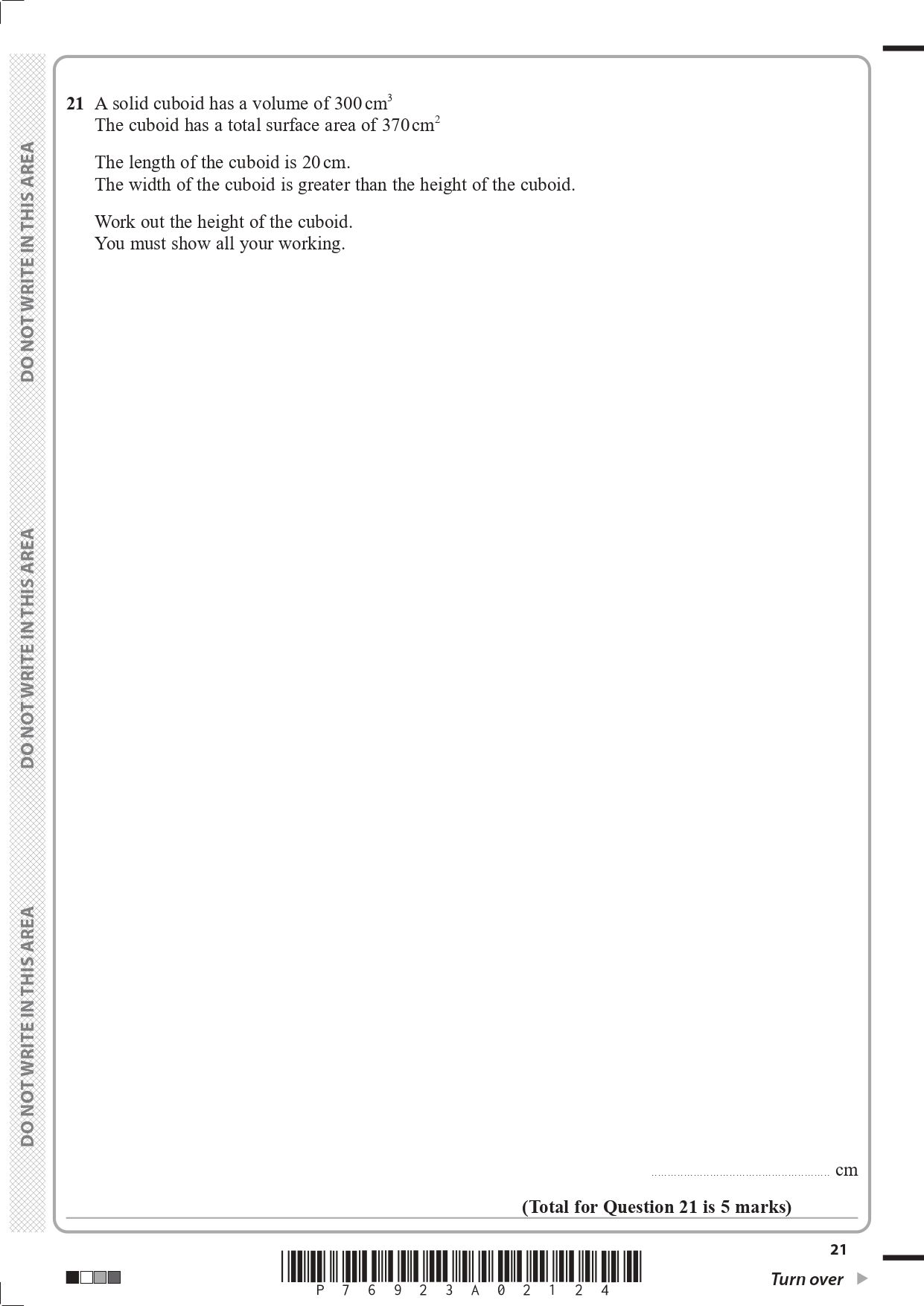
Edexcel maths page 21.jpg

Pictured: Higher Tier, Paper 1 Edexcel GCSE Maths June 2024.

Each paper is worth 80 marks total. Remember that the number of marks dictates the type of question and what you need to show.

Take a look at this breakdown:

1-mark questions:

  • These are often simple recall, single-step arithmetic, or quick fact questions.
  • They test basic skills: e.g. “Write ⅗ as a decimal,” “What is 7 × 8?”, “Calculate 15% of 80.”
  • They don’t require extended working. One line or even just the answer is enough (though working is beneficial in case of slips).
  • They’re designed to build confidence early in the paper.

Medium-mark questions (2–5 marks):

  • These questions require a few more steps to solve, and ask students to demonstrate more thought and understanding.
  • You may need to show intermediate workings or justify a step.
  • The mark scheme will award method marks (for correct setup or steps) as well as final answer marks.

Higher-mark, multi-step / reasoning questions (6, 7, 8+ marks):

  • These ask you to combine multiple areas of Maths - Algebra, Geometry, Statistics, or Ratio - in context.
  • They often include “show that”, “explain why”, “prove”, or “justify” wording.
  • You must lay out a clear method, break down steps, and sometimes consider alternative approaches or show reasoning.
  • Marks are split into different types. You can earn method marks for showing the correct steps and working, and accuracy marks for getting the right answers.
  • Even if the final answer is wrong, partial marks can be earned for correct working.

What are the grade boundaries for Edexcel Maths GCSE?

Grade boundaries are set after every exam series, so they shift a little each year, and they differ between the two tiers. In the June 2026 series — the most recent — a grade 4 standard pass in Edexcel GCSE Mathematics (1MA1) took 151 out of 240 (63%) at Foundation tier and 50 out of 240 (21%) at Higher tier. A grade 5 took 181 at Foundation and 82 at Higher. The top grade 9, available only at Higher tier, took 208 out of 240 (87%).

The full June 2026 boundaries for both tiers are below. Pearson publishes the boundaries for every series on its grade boundaries page.

Edexcel GCSE Mathematics (1MA1) grade boundaries for the June 2026 exams, showing the raw marks needed for each grade.
Grade Foundation tier Higher tier
Grade 9Not available at this tier208 out of 240 (87%)
Grade 8Not available at this tier177 out of 240 (74%)
Grade 7Not available at this tier146 out of 240 (61%)
Grade 6Not available at this tier114 out of 240 (48%)
Grade 5 (strong pass)181 out of 240 (75%)82 out of 240 (34%)
Grade 4 (standard pass)151 out of 240 (63%)50 out of 240 (21%)
Grade 3110 out of 240 (46%)34 out of 240 (14%)
Grade 269 out of 240 (29%)Not available at this tier
Grade 129 out of 240 (12%)Not available at this tier
No items found.

How many marks is each Edexcel Maths paper?

There are three papers, each 1 hour 30 minutes and worth 80 marks, so the GCSE is marked out of 240 and each paper counts for a third.

Paper 1 is the non-calculator paper; you can use a calculator on Papers 2 and 3. All three must be sat at the same tier in the same series.

Where can I find past papers and mark schemes?

Practising with Edexcel past papers and mark schemes is one of the most effective ways to prepare for GCSE Maths. Past papers help you understand the question style, see how marks are awarded, and build confidence with real exam timing and structure.

Head to the Edexcel website to find past papers and mark schemes from previous GCSE Maths exams. If you'd like more questions to work through alongside these, Atom gives you practice papers based on our team's predictions for the next GCSE year, with instant, examiner-style feedback on every answer.

Read the examiner's report, not just the mark scheme

After every series the board publishes an examiner's report on what candidates actually did — the questions that were misread, the answers that stopped half way, the marks lost to command words. It is the closest thing to being told in advance what to avoid, and almost nobody reads it.

Start with the Edexcel Maths 1MA1/1H Paper 1 Higher examiner's report (June 2025), then work through the rest on Edexcel Maths course materials.

A recent Edexcel Maths past paper to start with

If you want to sit one now rather than browse, use the June 2025 paper (1MA1/1H Paper 1 Higher): the question paper and the mark scheme. Give yourself the real time limit, mark it against the scheme, then read the examiner's report on the same paper to see where other candidates lost the marks you lost.

Are there predicted papers for Edexcel Maths?

Yes. Once you have worked through the real past papers, there is nothing left that you have not already seen — and the most recent papers are the ones every other candidate has done too. Predicted papers are fresh papers written to match the style, balance and difficulty of the real thing for the year ahead.

Atom writes a set of predicted papers for Edexcel Maths based on our team's predictions for the next GCSE series, marked instantly with examiner-style feedback so you can see exactly where marks were gained or lost — so you can keep sitting full papers under real conditions right up to the exam.

What key topics do I need to know for Edexcel Maths GCSE?

Each of the three Edexcel Maths papers covers a range of topics. You’ll need a thorough understanding of each to achieve top marks, so make sure you revise any areas you find tricky ahead of the exams.

The main topic areas are:

  • Number: Includes measures and accuracy, fractions, decimals and percentages, and number structure and calculation.
  • Algebra: Includes notation, vocabulary and manipulation, graphs, solving equations, and sequences.
  • Ratio, proportion and rates of change: Includes using scale diagrams, reducing ratios and more.
  • Geometry and measures: Includes properties and constructions, measuring and calculation, and vectors.
  • Probability: Includes constructing possibilities for experiments, recording, describing and analysing relative frequencies and more.
  • Statistics: Includes analysing population statistics, interpreting charts and graphs and more.

Check out the Edexcel GCSE Maths specification for the full list.

What are examiners looking for?

For Edexcel GCSE Maths papers, examiners aren’t just checking for the right answers; they want to see how you think. They’re looking for clear working, sensible explanations and answers that show genuine understanding of the questions.

Every question on the paper is written to show examiners what you can really do. Each question tests one or more of the three Assessment Objectives (AOs), which we’ve laid out below to help you prepare.

The three assessment objectives are:

1. AO1 – Use and apply standard techniques

Students should be able to:

  • Accurately recall facts, terminology and definitions.
  • Use and interpret notation correctly.
  • Accurately carry out routine procedures or set tasks requiring multi-step solutions.

2. AO2 – Reason, interpret and communicate mathematically

Students should be able to:

  • Make deductions, inferences and draw conclusions from mathematical information.
  • Construct chains of reasoning to achieve a given result.
  • Interpret and communicate information accurately.
  • Present arguments and proofs.
  • Assess the validity of an argument and critically evaluate a given way of presenting information.

3. AO3 – Solve problems with Maths in context

Students should be able to:

  • Translate problems in mathematical or nonmathematical contexts into a process or a series of mathematical processes.
  • Make and use connections between different parts of mathematics.
  • Interpret results in the context of the given problem.
  • Evaluate methods used and results obtained.
  • Evaluate solutions to identify how they may have been affected by assumptions made.

Every Edexcel Maths paper provides you with the opportunity to demonstrate what you truly understand. The best way to impress examiners is to approach each question step by step, show the working clearly, and check that your answers make sense.

By practising this approach regularly, you build the habits examiners look for: clear working, logical thinking, and confidence in tackling unfamiliar problems. It’s these skills, developed over time, that help turn preparation into strong, well-earned marks on exam day.

Is there a formula sheet for GCSE Maths?

Edexcel provides an “Exam Aid” booklet to all students during the exams. The DfE has confirmed that formula sheets will continue to be provided for Maths exams in 2025, 2026 and 2027.

The booklet contains formulas for areas, volumes, circles, Pythagoras’ Theorem, compound interest and probability. This is for all students at both Higher and Foundation tiers. Take a look at the 2025 booklet here.

Preparing for Edexcel Maths GCSE will be a little easier now that you know what to expect on the exam. Using past papers and mark schemes, you can build your exam confidence effectively. Remember, thorough revision will help you ace your exams on the day. Good luck!

No items found.
No items found.

Take control of your GCSE revision

Everything you need for GCSE success, in one place.

Feeling confident about your GCSEs comes from knowing what to revise, how to improve, and where to focus next.

🔮 GCSE practice papers based on our team's 2026 exam predictions

🎓 Guided courses that cover all the topics on your exams

✍️ Instant feedback that tells you where you’ve gained and lost marks

📈 Predicted GCSE grades and topic-by-topic tracking

Know where you stand and how to improve

Create your free account and start making real progress today.

Online GCSE revision

Contents