
St Albans High School for Girls 11+ guide
Are you thinking about applying to St Albans High School for Girls for 11+ entry? Find out everything you need to know about the admissions process and how to prepare for the entrance exam.
Key information for St Albans High School for Girls
- School type: girls' independent day school
- Location: St Albans, Hertfordshire
- Admissions contact: admissions@stahs.org.uk
- 11+ exam: ISEB Common Pre-Test
- Financial assistance: means-tested bursaries
- Scholarships: academic, drama, music (choral and instrumental), and sport
Important dates for 2027 entry
- Wednesday 30th September 2026: Scholars at STAHS information event for parents
- Saturday 10th October 2026 and Saturday 7th November 2026: Optional entrance assessment taster days
- Friday 13th November 2026: Application deadline, scholarship application deadline, and bursary application deadline
- Tuesday 5th January 2027: Entrance assessment day
- Thursday 21st January 2027: Academic scholarship assessment and interview day
- Friday 22nd and Monday 25th January 2027: Entrance interviews and parent meetings
- Friday 12th February 2027: Offers made
- Tuesday 23rd February 2027: Meet us again event (for offer holders)
- Wednesday 3rd March 2027: Acceptance deadline
How to apply to St Albans High School for Girls
St Albans High School for Girls (STAHS) is selective. This means that your child will need to take an entrance exam to be eligible for a place.
You must register your child for Year 7 entry via the school's admissions portal, OpenApply. A non-refundable registration fee applies.
STAHS uses the ISEB Common Pre-Test as its entrance assessment. The exam takes place in January when your child is in Year 6.
Children who perform well in the entrance assessment are shortlisted for interviews. These take place later in January.
You will receive your child's results in February. If they are offered a place at STAHS, you will have until early March to accept.
What will my child be tested on?
The STAHS 11+ entrance assessment uses the ISEB Common Pre-Test — a series of online, adaptive tests used by a number of leading independent schools. The tests take around 2.5 hours in total.
Some candidates may complete the ISEB Common Pre-Test at their current school if it acts as an invigilation centre. In these cases, children spend around half a day at STAHS for the remaining activities.
The ISEB Common Pre-Test
The ISEB Common Pre-Test consists of four separate online tests:
Maths
The maths test covers the National Curriculum up to the end of Year 5. All questions are multiple choice.
English
The English test assesses reading comprehension, sentence completion, spelling, and punctuation. All questions are multiple choice.
Verbal reasoning
The verbal reasoning test is designed to assess your child's ability and potential. It covers common words, antonyms, word combinations, letter transfer, and number codes. All questions are multiple choice.
Non-verbal reasoning
The non-verbal reasoning test also assesses ability and potential. It covers shape analogies, classification of items, and horizontal codes. All questions are multiple choice.
The tests are adaptive, meaning the difficulty adjusts to each child's ability as they go. Final scores are standardised and adjusted to take into account each child's age.
No special preparation is required for the ISEB Common Pre-Test. During the tests themselves, your child will work through practice questions before each section begins. An official ISEB test walkthrough is available to help your child feel familiar with the look and feel of the tests ahead of the day.
How are places decided?
Children who perform well in the entrance assessment are invited back to STAHS for an interview. These take place on Friday 22nd and Monday 25th January 2027.
Interviews are with senior members of staff. No preparation is required — the sessions are described by the school as relaxed and enjoyable, with pupils taking part in group activities. At the same time, parents meet individually with the Head and Deputy Heads. These parent meetings form no part of the assessment process for pupils.
Offers are made on Friday 12th February 2027. The deadline to accept a place is Wednesday 3rd March 2027.
Is your child ready for the ISEB Pre-test?
See where they stand in minutes. Atom’s free ISEB baseline tests give you an instant breakdown of their strengths and gaps. Know exactly what to focus on next and start preparing with direction, not uncertainty.
.png)
Financial information
St Albans High School is a fee paying school. Take a look at the school website for a full breakdown of fees per year group and for boarding students.
Financial assistance
When exploring independent schools for your child, scholarships and bursaries are worth considering. They can ease the pressure of school fees and open doors to opportunities that might otherwise feel out of reach.
Scholarships
Scholarships are awarded for a child’s talent or achievement. While many schools focus on academic excellence, some offer awards in music, sport, drama, art, or other specialist areas.
Scholarships often come with a small fee reduction and acknowledge your child’s talents, motivating them and boosting their confidence. Some schools automatically consider all applicants, while others may request an additional application, assessment or audition.
Visit your target school’s website to see what scholarships are available and how to apply.
For more information, read: Your guide to independent school scholarships.
Bursaries
Bursaries are means-tested awards (based on a family’s financial situation) designed to make independent education more accessible. Depending on your circumstances, a bursary could cover part or all of the school fees and sometimes extras like uniforms, lunches or school trips.
Families provide financial information to qualify, and awards are reassessed each year. For many families, bursaries make an excellent education possible that might otherwise seem out of reach.
Visit your target school’s website to find out what bursaries are available and how to apply.
For more information, read: Bursaries: a parents’ guide
How can I help my child prepare for the test?
Applying to senior school can feel like a big milestone, but preparation doesn't have to be overwhelming. Here's how you can help your child prepare for test day.
Stay on track with a clear plan
One of the hardest parts of exam preparation is knowing what to focus on, when, and how to make steady progress without it taking over family life.
A clear, structured plan helps your child feel less overwhelmed and more in control. It ensures they build skills in the right order, cover everything they need, and avoid last-minute cramming.
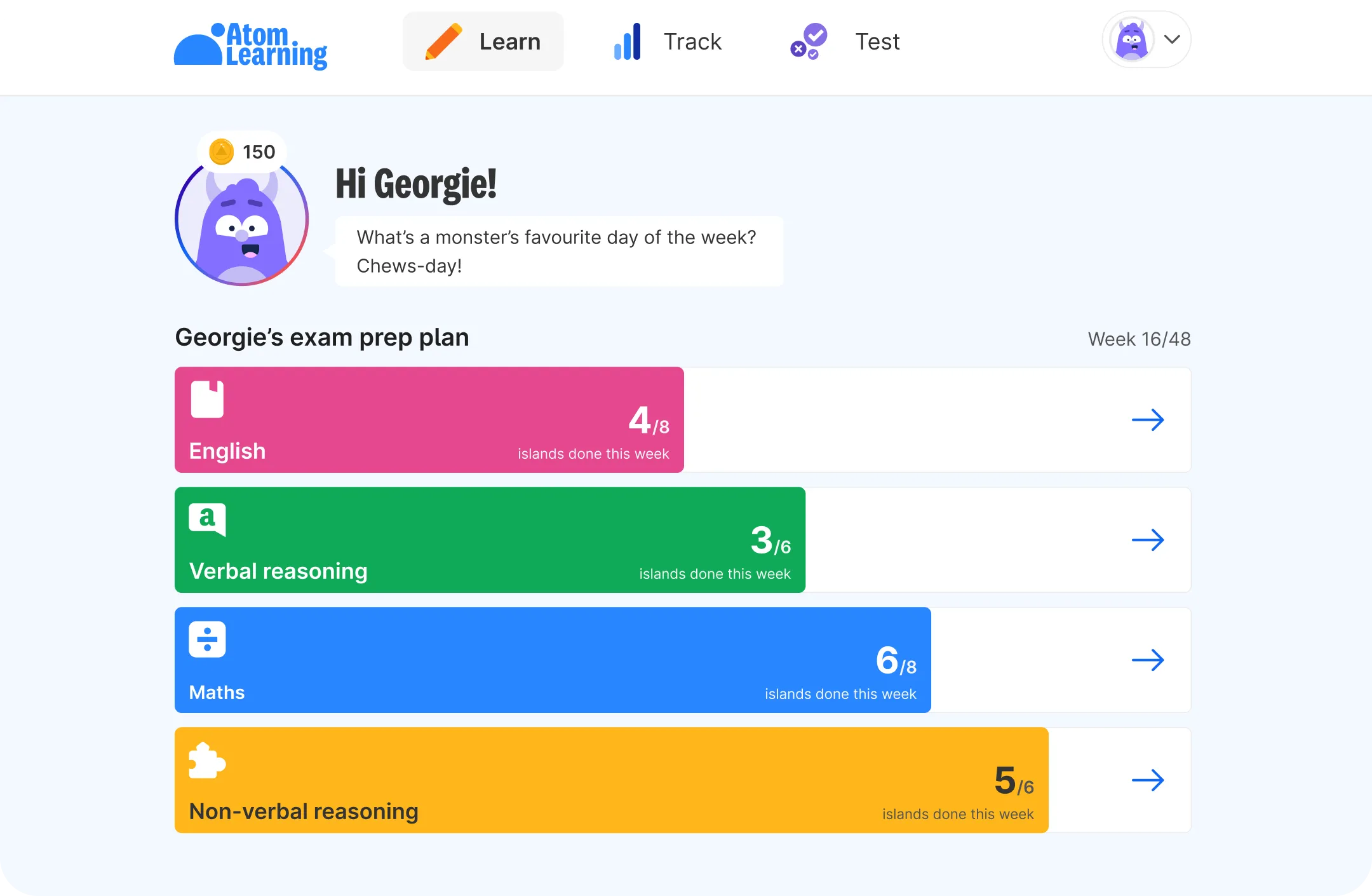
Atom's exam plan makes this easier. Enter your child's target schools and exam dates, and we'll create a personalised weekly plan tailored to the topics they'll be tested on. It shows them what to work on and when, adapts as they improve, and helps them build progress in a calm, manageable way — little and often.
That means less guesswork for you, less stress for them, and a clearer path all the way to exam day.
Build smart exam technique
As your child's knowledge grows, practice tests can help them feel more comfortable with the real exam format.
Atom's mock tests are exact replicas of real entrance exams. They're also unlimited — your child can take the same test repeatedly and see new questions each time. This helps them practise without repeating the same content.
Atom's mock tests are automatically marked. You'll see your child's standardised age score (SAS), where they're doing well, and what they should focus on next. You'll also learn how they compare to other children applying to the same school.
Encourage regular reading
Strong reading skills play a big role in preparation for entrance exams.
Encourage your child to read every day, even for just 10–15 minutes. The key is variety. Mix fiction and non-fiction, different genres, and a range of authors. This helps them become more confident in understanding tone, purpose, and meaning across different texts.
Over time, regular reading will:
- broaden their vocabulary
- improve comprehension and inference
- build confidence in tackling unseen texts
And just as importantly, it can help them enjoy reading — not just see it as exam preparation.
Looking for inspiration? Atom's reading and writing starter kit has suggestions spanning fiction and non-fiction for Years 3–6.
Celebrate progress, not just scores
When you're supporting your child through exam preparation, what really matters is knowing they're moving in the right direction — not just how they scored on a single test.
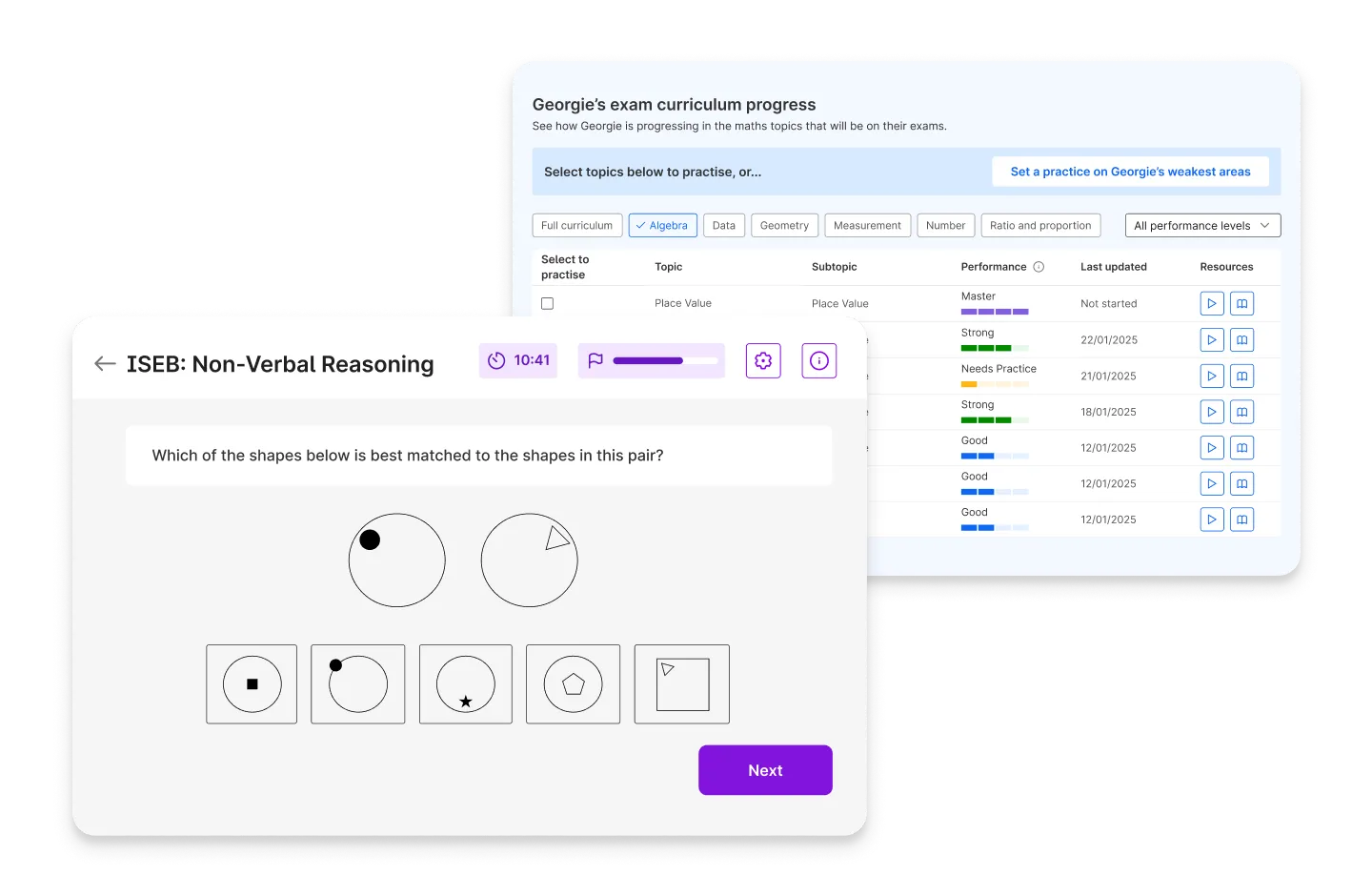
Atom's progress tracking gives you a clear, simple picture of how your child is doing in each topic and the direction they're moving in. You can see where they're on track, where they might need more practice, and spot progress as it happens.
That makes it easier to give meaningful encouragement, keep motivation steady, and focus on what matters most: consistent improvement, not just one-off results.
Remove the guesswork from ISEB prep.

Worried about how your child will perform in the ISEB Common Pre-Test? The adaptive format can feel unpredictable, but their preparation doesn’t have to.
Atom adapts to your child’s level as they work. We show you exactly what they need to practise and how they’re progressing.
- Follow personalised weekly exam plans that adjust to your child’s performance and show them what to learn next.
- Practise with replica ISEB mock tests that generate new questions every time, so they build real exam skills.
- Track progress and see how they compare to others preparing for the ISEB Pre-Test.
Start your free trial and watch your child master every ISEB subject.