It's completely normal for Year 8 maths to feel harder to read than Year 7, topics start building on each other more, homework starts combining several ideas at once, and it's not always obvious from the outside exactly how your child is doing. That's not a sign anything's wrong; it's simply what Year 8 maths looks like once the Year 7 basics are in place.
The first step to supporting your child well this year is knowing exactly what they'll actually be covering. This guide lays out exactly what to expect from Year 8 maths, topic by topic, so you know what's coming and precisely where your support will count for most.
Key takeaways
- Year 8 maths builds on the same six areas as Year 7: number, algebra, ratio and proportion, geometry, probability and statistics, but with more complexity and depth.
- Most schools introduce more structured end-of-year checks in Year 8, but these are still internal, low-stakes assessments rather than formal exams.
- The National Curriculum covers Years 7 to 9 as a whole, so exact sequencing varies by school. This guide covers what's typical for Year 8.
What does maths cover in Year 8?
Here's what typically develops in each area during Year 8:
- Number — more complex calculations with fractions, decimals and negative numbers, plus a deeper look at powers, roots and standard form.
- Algebra — expanding brackets, simplifying more complex expressions, forming and solving two-step equations, and a first introduction to sequences and finding patterns in them.
- Ratio and proportion — direct proportion in more depth, and a first look at inverse proportion (where one quantity goes up as another goes down).
- Geometry and measures — properties of circles, transformations (rotation, reflection, translation and enlargement), and area and volume of a wider range of shapes.
- Probability — combined events, using diagrams to work through more than one outcome at a time.
- Statistics — comparing data sets, spotting patterns with scatter graphs, and working with averages from larger, grouped data.
Schools sequence this content differently, so don't worry if your child's covering things in a different order to a friend at another school.
How does Year 8 maths build on from Year 7 maths?
Year 8 takes everything covered in Year 7 and asks your child to go a level deeper with it: more steps per problem, more abstract thinking, and less step-by-step guidance along the way.
This happens across every area of maths, not just one topic, ideas introduced last year are expected to be used more independently and combined together in more demanding problems, rather than tackled one at a time.
Assessment reflects this step up too. Many schools introduce a more structured end-of-year assessment in Year 8, and for the many families whose children are moving to a senior school at 13, this is often the year Common Entrance or scholarship exams are sat.
What's different about Year 8 maths?
A few things shift beyond the topic list:
- Problems take more steps. Where Year 7 questions often had one clear method, Year 8 starts combining ideas, applying ratio within a geometry problem, for example.
- More is expected independently. Your child's likely doing more of the thinking themselves, with teachers stepping back a little from guiding every stage.
- Assessment can look different too. Structured end-of-year checks are common from Year 8, and, as above, this is often when Common Entrance or scholarship exams are actually sat for children moving schools at 13.
Taken together, these shifts mean any gaps left over from Year 7 are more likely to show up in the work itself this year, which is exactly why it's worth acting on them now, before the pace picks up further into Year 9 and GCSE.
Why Year 8 maths matters for the years ahead
Year 8 matters because it's the year gaps tend to surface, not just the year the work gets harder. By now, it's often clearer to see where the transition into secondary school, and the growing expectations that came with it, might still be affecting your child's maths.
A rocky start to Year 7 doesn't always show up straight away, but as the pace and independence expected in Year 8 increase, any lingering effects have more room to surface, and if they're not identified and closed now, they tend to grow into bigger problems by Year 9 and GCSE rather than resolve on their own.
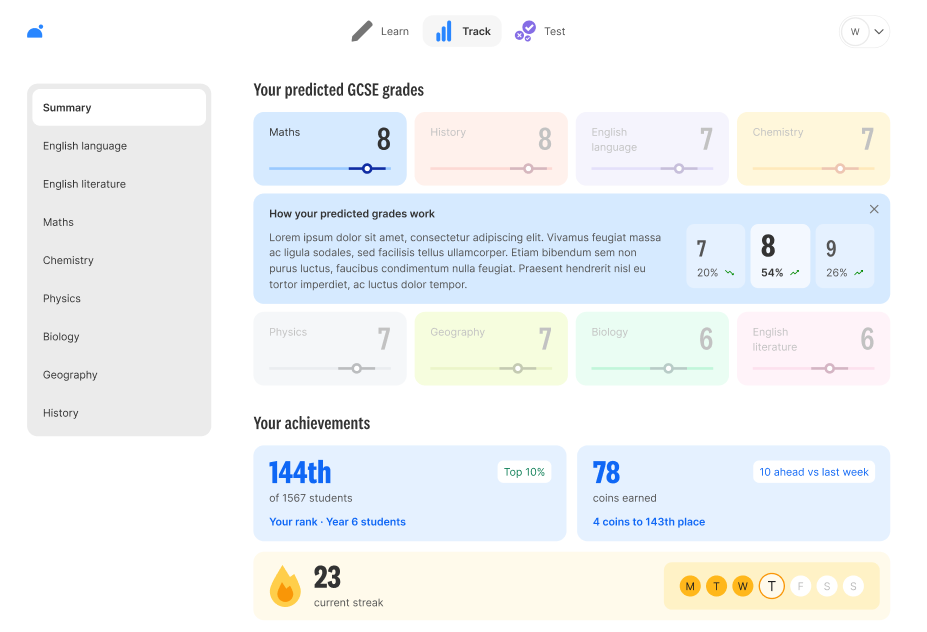
This is exactly what Atom is built for. As gaps from Year 7 start to show up in your child's work, the faster pace of Year 8 means there's less time for any one topic to be revisited before the class moves on. Atom's progress tracking is designed to catch exactly these gaps early, showing you where your child's actually at across every topic, not just what homework got handed in.
Over 350,000 families already use Atom to plug gaps, and prepare for the 11+ and GCSEs. Atom for Years 7-9 is designed to give that same clarity right through the years in between, so gaps get closed while they're still small.