Year 9 maths: key topics and how it sets up GCSE

Year 9 is a significant step forward for maths, and this is the year GCSE starts to take shape, both in the topics themselves and in how directly they begin building toward what's assessed at GCSE.
This guide sets out exactly what's covered in Year 9 maths and how it connects to GCSE, so you and your child can head into the year feeling confident and well prepared.
Key takeaways
- Year 9 deepens the same six areas from Years 7 and 8: number, algebra, ratio and proportion, geometry, probability and statistics, at a more advanced level.
- Many schools begin teaching GCSE-specification content from Year 9, even before your child's exam board is confirmed.
- Much of what's taught in Year 9 isn't a preview of GCSE maths, it's the foundation GCSE maths is built on.
- The National Curriculum covers Years 7 to 9 as a whole, so exact sequencing varies by school. This guide covers what's typical for Year 9.
What does maths cover in Year 9?
Here's what typically develops in each area during Year 9:
- Number — working confidently with standard form, more complex fraction and percentage problems, and greater precision with rounding and estimation.
- Algebra — solving more complex equations, an introduction to quadratic expressions, and starting to work with simultaneous equations.
- Ratio and proportion — direct and inverse proportion expressed algebraically, and compound measures like speed and density.
- Geometry and measures — Pythagoras' theorem, an introduction to trigonometry, and more complex area, perimeter and volume problems.
- Probability — combined and dependent events, using tree diagrams to work through more than one stage.
- Statistics — comparing distributions, and more sophisticated interpretation of grouped and continuous data.
Schools sequence this content differently, and some begin GCSE-specification topics earlier than others, so don't worry if your child's covering things in a different order to a friend at another school.
How does Year 9 maths build on from Year 8 maths?
Year 9 takes everything from Years 7 and 8 and asks your child to apply it with less structure and more independence. Where Year 8 problems often followed one clear method, Year 9 increasingly expects your child to work out which approach fits a question themselves, rather than being told which one to use.
This is also, for many schools, where the National Curriculum and the GCSE specification start to overlap. It's increasingly common for schools to begin teaching GCSE content from Year 9, sometimes before your child's specific exam board or tier has even been confirmed. If that's the case at your child's school, it's a sign of a head start, not a sign they're behind.
How does Year 9 maths set up GCSE?
Year 9 lays the groundwork for the topics that carry straight into GCSE: quadratics, trigonometry, and simultaneous equations. A confident finish to Year 9 makes the start of GCSE maths feel like a continuation rather than a new climb.
Atom is built to support exactly this stage, helping make sure your child's grasp of these topics is genuinely solid, right as they start to count directly toward GCSE.
Over 350,000 families already use Atom to prepare for the 11+ and GCSEs. Atom for Years 7-9 brings that same rigour to Year 9, so you know exactly where your child stands on these GCSE-defining topics, well before it's too late to act on it.
Atom for Years 7-9 is coming this November.
Built to keep your child on track for top sets and GCSE success. Join the waitlist for early access.

What's different about Year 9 maths?
A few things genuinely shift this year:
- GCSE content may already be underway. Depending on your child's school, some lessons may already follow the GCSE specification.
- Calculator and non-calculator skills start to separate out. GCSE maths splits into calculator and non-calculator papers, so Year 9 often starts building fluency in written and mental methods as distinct skills.
- Problems get more multi-step. Topics increasingly combine algebra, ratio and geometry within the same question, mirroring how GCSE questions are structured.
It's completely normal for Year 9 to feel like a bigger year, choosing options, hearing "GCSE" mentioned more often, and noticing lessons pick up pace. This is one of the more significant transitions in secondary school, and teachers are well prepared to guide your child through the options process and the step up in content, so they won't be navigating it alone.
How can I support my child at home?
You don't need to know quadratics or trigonometry yourself to help. A few things make a real difference:
- Ask about calculator vs. non-calculator work. Knowing which method your child finds harder points to exactly where a bit of extra practice would help most.
- Keep the homework routine going. Consistency still matters more than how much of the content you can help with directly.
- Don't panic about jargon. If your child mentions "simultaneous equations" or "compound measures," ask them to explain it back to you rather than trying to look it up yourself first.
- Check in on confidence, not just marks. A child who says maths "feels harder now" isn't necessarily falling behind, it might just mean the work has genuinely stepped up. Worth a quick word with the teacher either way.
Year 9 closes out the Years 7-9 maths curriculum and opens the door to GCSE. A confident finish here, with algebra, ratio, geometry all pulling together makes the transition into Year 10 feel like the next step rather than a leap.
Take control of your GCSE revision

Everything you need for GCSE success, in one place.
Feeling confident about your GCSEs comes from knowing what to revise, how to improve, and where to focus next.
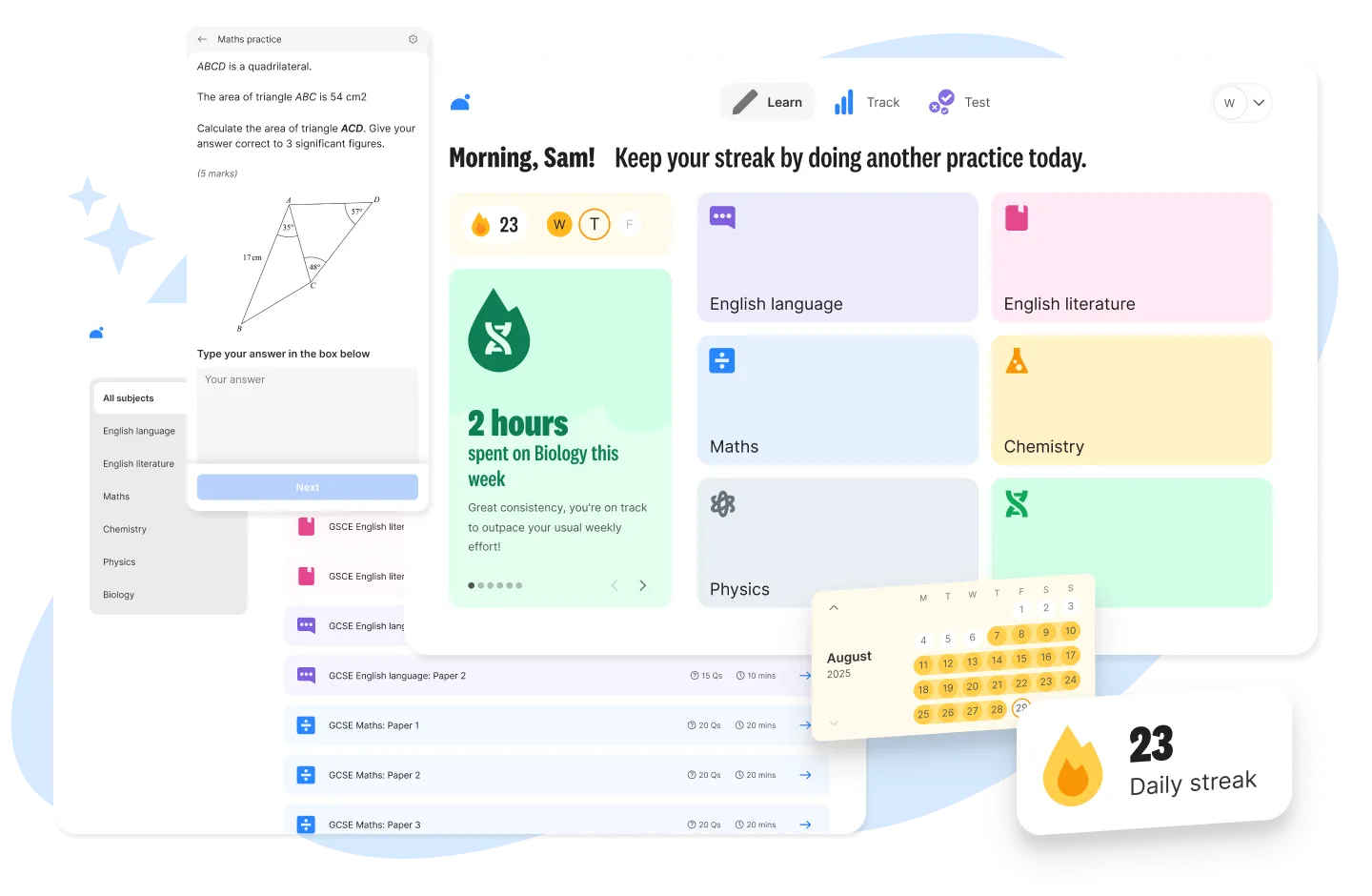
🔮 GCSE practice papers based on our team's 2026 exam predictions
🎓 Guided courses that cover all the topics on your exams
✍️ Instant feedback that tells you where you’ve gained and lost marks
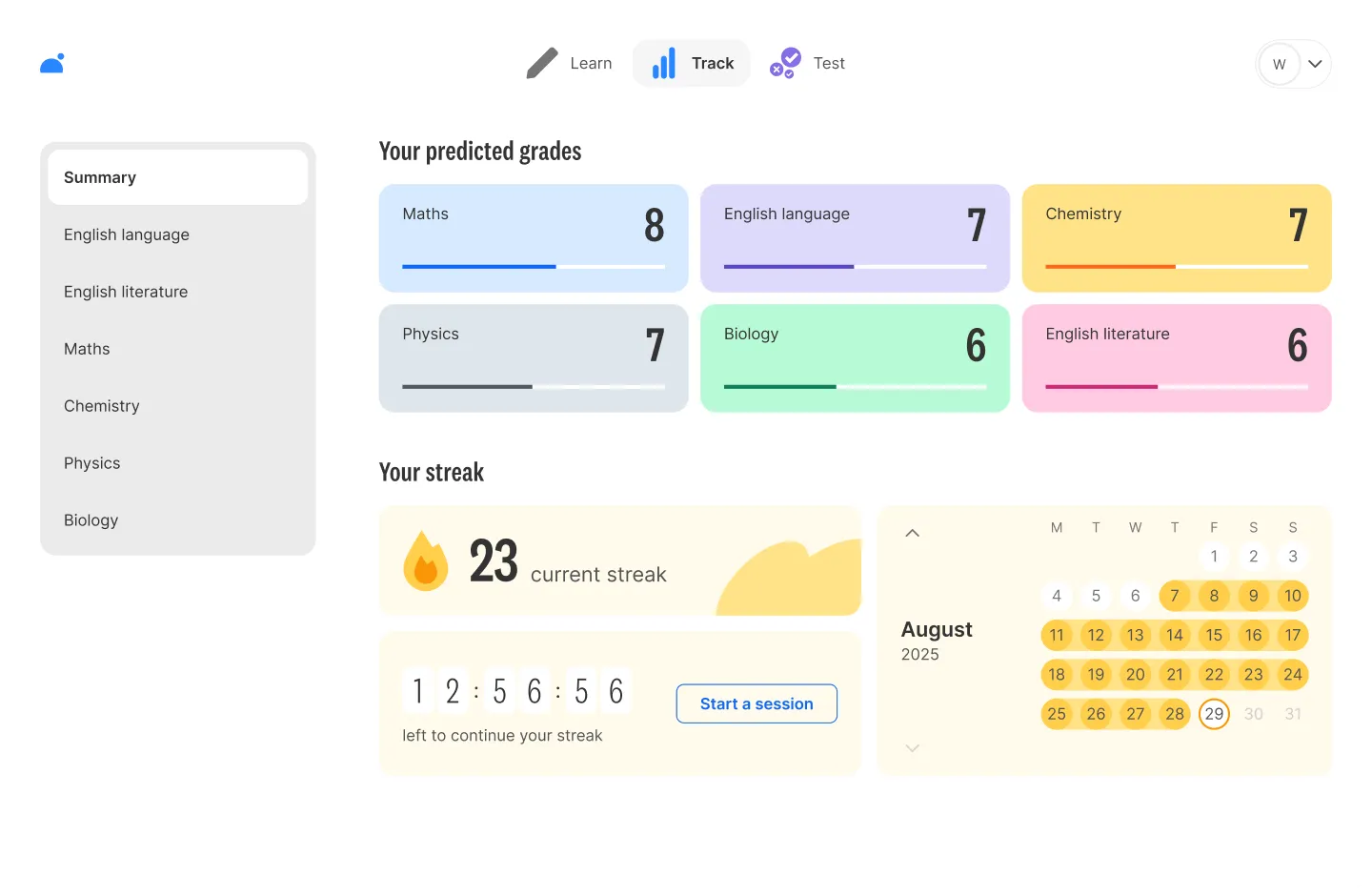
📈 Predicted GCSE grades and topic-by-topic tracking
Create your free account and start making real progress today.