
How much does 11+ tutoring cost in 2026? The honest breakdown.

If you've started researching 11+ preparation, you'll have picked up that private tutoring is expensive. But finding out what it actually costs takes some digging. Tutoring agencies rarely list their prices openly, and parents who've spent significant sums don't tend to broadcast it.
Here is the honest, specific breakdown.
The headline numbers
Private 11+ tutors in the UK charge between £40 and £80 per hour for one-to-one sessions. Rates vary by location - London, the South East, and grammar-heavy areas like Buckinghamshire, Kent, and the Midlands typically sit at the top of this range.
Most families who use a private tutor do weekly sessions for approximately twelve months — starting at the beginning of Year 5 and sitting the exam in September of Year 6.
One hour per week, roughly fifty sessions, at the UK average of around £55 per hour = approximately £2,750 for a standard twelve-month programme.
For families in competitive areas starting in Year 4, or using specialist tutors for multiple subjects, the total rises steeply. Mumsnet discussions regularly feature parents describing bills of £5,000–8,000 over two years. The mid-range of £3,000–5,000 is not unusual.
As one parent wrote on Mumsnet: "I feel awful that his education may be hindered as we don't have £150pm to throw at tuition."
The financial barrier is real: and it comes with guilt that's harder to quantify.
Full 11+ preparation cost comparison

A realistic all-in cost for a tutor-led preparation programme for one child is £3,000–5,000.
Is tutoring worth the money?
The honest answer is: it depends - and not entirely in the ways you'd expect.
Tutoring adds clear value when a child has specific learning needs requiring individual expert attention or when a child is significantly more responsive to working with a non-parent adult or can’t work independently.
The evidence is less clear for capable children preparing for standard grammar and independent school exams with a structured home programme. One Trustpilot reviewer provided a striking direct comparison:
"We had a tutor for 9 months and did not find out about Atom until the grammar school recommended it. My son and I both agree that the 4 weeks he used Atom was at least as valuable as his time with the tutor."
For some families, the decision wasn't about comparison at all — it was about finding something that worked without the pressure or cost:
"I did not want to go the tutoring route... too much pressure and it's also very expensive. Atom worked really well."
And for families where private tuition simply wasn't an option:
"We couldn't afford tuition and relied on books and online learning. Atom helped us a lot to fill in the gaps."
87% of Atom students get into their first-choice school — the majority without a private tutor.
Regional cost variation
Tutoring costs vary significantly by area. As a rough guide:
London and South East: £60–80/hr typical for experienced 11+ tutors. Some specialist tutors in super-selective areas charge £80–120/hr. Annual cost for weekly tutoring: £3,000–4,500+.
Buckinghamshire, Kent, Essex: £50–70/hr. Annual cost for weekly tutoring: £2,500–3,500.
Birmingham, Trafford, Lincolnshire: £40–60/hr. Annual cost for weekly tutoring: £2,000–3,000.
Wirral, Gloucestershire, Hertfordshire: £40–60/hr, broadly similar to the above.
Online tutoring removes geographic cost variation but requires finding qualified 11+ tutors with expertise in your specific exam board.
What families who don't use a private tutor actually spend
A family preparing entirely at home with structured resources and mock exams spends approximately £350–600 in total.
The difference between this and a tutor-led programme (sometimes £3,000 or more) is, in many grammar school areas, the difference between whether a family pursues the 11+ at all.
If tutoring isn't an option
Not having a tutor doesn't put your child at a disadvantage, it just means the structure needs to come from elsewhere.
These are the things that matter most:
- Start with a diagnostic assessment so you know exactly where your child is, rather than working through everything equally and hoping for the best. From there, build a consistent daily routine of 16 minutes — short enough to be sustainable, long enough to make real progress over time.
- Find out which exam board your local grammar school uses — whether that's GL, CEM, Quest or school-specific and make sure your child is preparing specifically for that format. The differences between boards are significant, and generic preparation can leave real gaps.
- Use tools that adapt to your child's actual weak areas rather than covering everything equally, and make sure they sit at least one timed mock exam before the real thing. Exam conditions feel different to practice, and familiarity with that pressure matters.
The families who look back most positively on this process are almost always those who kept it consistent and kept it calm. Consistent practice today means no gaps to worry about tomorrow.
Help your child ace the 11+
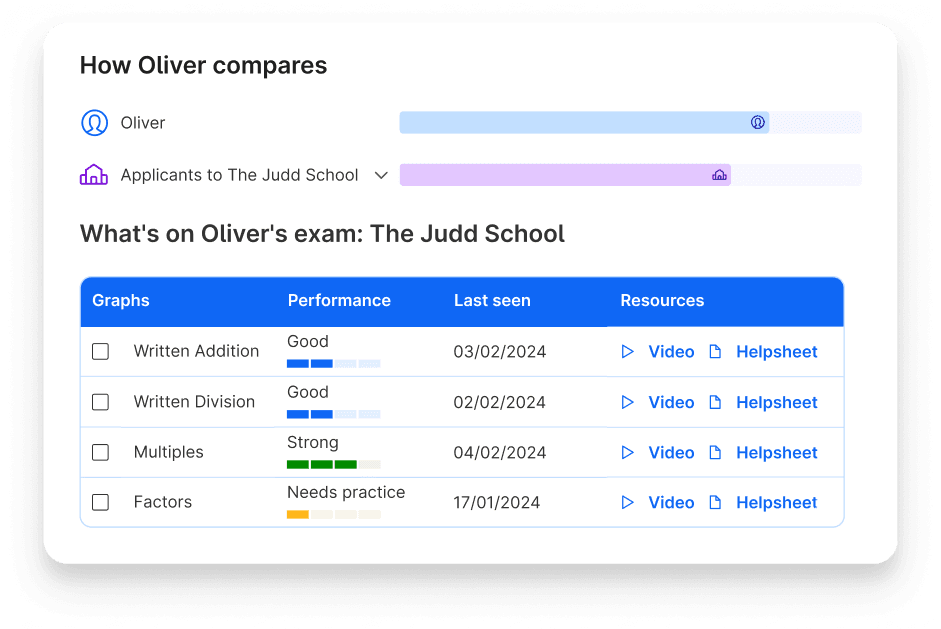
Get the pass mark you need with Atom Home – the leading exam platform for grammar and independent schools.
- Tailored exam prep plans for your child's target schools
- Practice questions for every 11+ topic
- Unlimited mock tests for every UK exam and school
- Performance data that shows how your child compares to other candidates (plus their standardised age score!)
Join 100,000+ families who trust Atom to help their children excel in Key Stage 2 and entrance exams. Endorsed by grammar schools, loved by parents.