
How to prepare for the 11+ at home: the daily routine that actually works

Most 11+ preparation advice is written as if your family has unlimited time, a child who sits down willingly every evening, and a parent with nothing else to do between 4pm and bedtime.
This describes approximately no family you know.
The reality is that you work. Your child has homework, clubs, and sometimes a genuinely bad day where the last thing they need is a practice paper. You have roughly forty minutes between getting home and starting the bedtime routine, shared between cooking, washing, and the occasional moment of actual connection with your child.
This is the real context in which 11+ preparation at home has to happen. And the counterintuitive finding (supported by both learning science and the experience of thousands of real families) is that this context is not a disadvantage. Short, consistent sessions are not a compromise. For most children, they work better than long, occasional ones.
Why 16 minutes a day is the right target
16 minutes a day is 100 hours of practice a year. That is a straightforward calculation most parents haven't made because they're comparing daily 16-minute sessions to the two-hour Saturday afternoon they imagine they should be doing, rather than to the total preparation that actually accumulates.
The evidence on learning and memory is equally clear: distributed practice (short sessions spread across multiple days) produces better long-term retention than the same content packed into longer, less frequent sessions. This is the spacing effect, one of the most robust findings in cognitive science. A child doing 16 minutes every day learns and retains more than a child doing the same content in a ninety-minute block on a Saturday.
There are practical reasons too. A session short enough to fit before dinner is a session that doesn't generate conflict. Short enough to become habitual. Short enough that the child accepts it as part of the day rather than something to dread.
One parent described it on our National Offer Day survey:
"We do Atom every day after school, about 4:30, before they watch anything. It took about three weeks for it to just become part of the routine. Now they actually remind me if we've forgotten. I think it's because it's not long enough to feel like a punishment."
Another, a single mother working full time:
"Fifteen minutes a day was genuinely manageable. I didn't have to be there for most of it — she just got on with it."
On Trustpilot:
"Atom makes tutoring stress-free and flexible. Our child could learn at their own pace... perfect for a busy household like ours!"
What the 16 minutes should actually contain
The trap with short sessions is rushing through a practice paper. A full 11+ practice paper takes 45-60 minutes under proper exam conditions. Cramming it into 16 minutes teaches bad habits and produces no useful data.
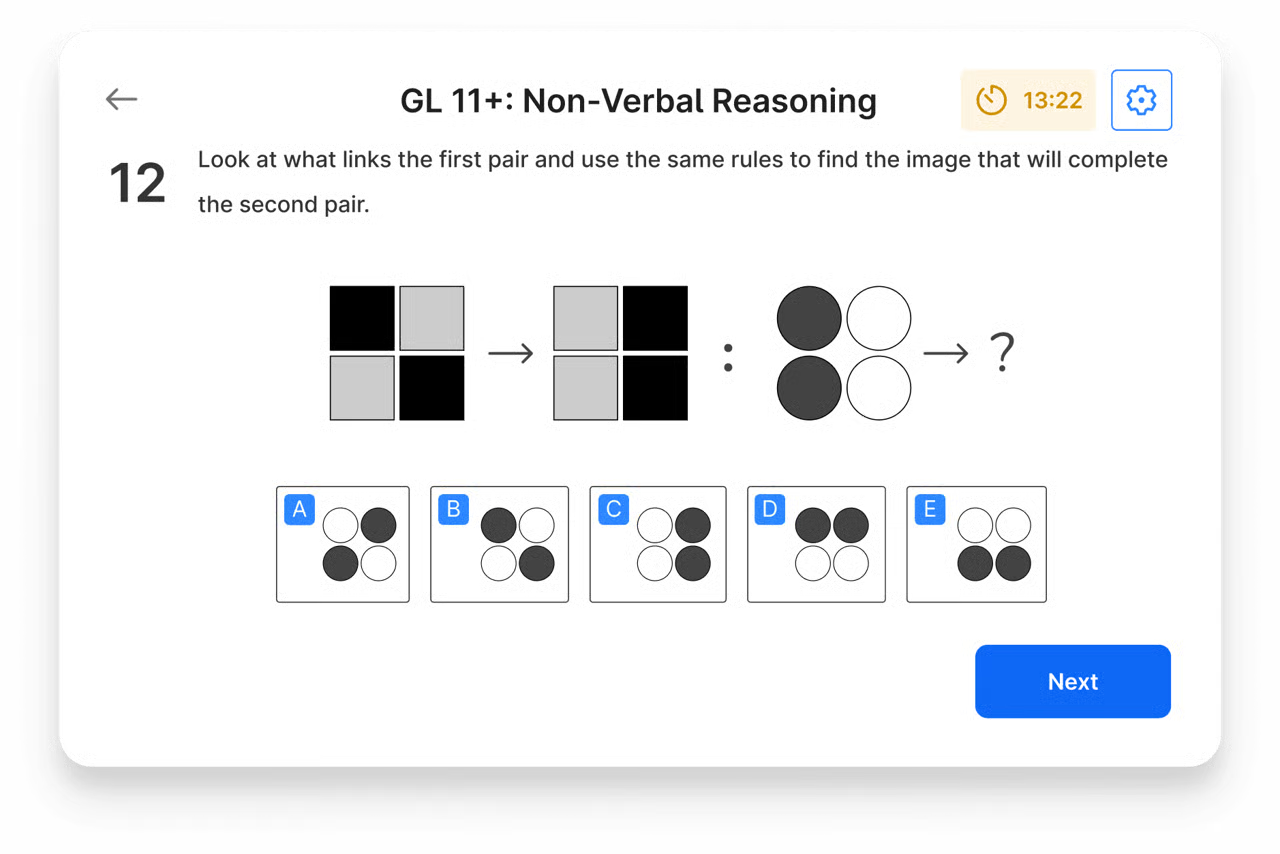
Instead, a focused session should target a specific skill — ten NVR matrix questions, a timed comprehension passage, or a specific verbal reasoning question type. Not "do some maths" but "practise these specific question types in this specific topic."
This is where an adaptive platform makes a big difference. Books present everything equally — they don't know what your child has already mastered or where they're consistently losing marks. Atom's adaptive platform sequences content around what your child actually needs, making every 16 minutes as efficient as possible.
Parents who've used it describe exactly that shift:
"Every weekend it highlights my son's weak areas and the next week it makes lessons on those topics and my son practises those topics until he masters them." Parent, Wilmington Grammar School for Boys
"The adaptive learning approach adjusted the difficulty based on performance, helping our child focus on areas that needed improvement while still reinforcing strengths." Parent, Highworth Grammar School
Building the routine: the practical steps
1. Choose a consistent time.
Not immediately after school if your child is usually depleted. Not right before bed. Roughly an hour after arriving home, before the dinner-to-bedtime rush, works for most families. Some find early mornings before school better. The specific time matters less than its consistency: same time, every day.
2. Make it non-negotiable but keep it short.
16 minutes — but not up for negotiation! On the days your child is happy to do it, great. On the days they push back, stay calm and hold the line.
After two or three weeks of showing up consistently, most children stop resisting simply because it has become part of the routine. It's just what happens after dinner, or before screen time, or whenever you've decided it fits.
3. Stay out of it.
This is the part parents find hardest to believe, but is genuinely liberating: you don't need to sit alongside your child. A good preparation platform runs independently: your child logs in, the platform presents appropriately calibrated content, and they work through it. You receive a progress report.
This is not lazy parenting! It is a deliberate choice to build the independence and self-directed learning that the exam itself rewards.
"I was convinced I needed to sit with her every evening because I felt guilty about working full time. The progress reports completely changed that for me. I check them on a Saturday morning with a cup of tea. She's doing more prep than I could have given her, and she's doing it on her own." — Parent survey
4. Review weekly, not daily.
A 16-minute Sunday review of your child’s progress — discussing persistent weak areas, adjusting focus for the week ahead — is more than enough! Every session does not need to be dissected in real time: keep pressure low to keep progress high.
5. Build in timed practice progressively.
For most of Year 5, roughly 60% skill-building to 40% timed practice is the right balance. In the final months, this shifts toward timed mock tests. The common mistake is starting timed practice too early — mock papers test skills, they don't build them.
What a good 11+ at-home timetable looks like
The following is a guide for a family starting structured preparation in Year 5, with the exam in September of Year 6. Adapt based on your starting point and your child's year group. See our full year-group timing guide for Year 3, 4, and 6.
Year 5, September–January (months 1–5):
- Systematic topic coverage, 16 minutes daily
- Focus on VR and NVR first — these are the least familiar from school
- English and maths alongside, with a focus on any KS2 topics not yet covered in school
Year 5, February–May (months 6–9):
- Introduce timed practice sections alongside topic work
- Begin working toward exam-condition familiarity
- Identify and focus on persistent weak topics
Year 5, June–August (months 10–12):
- Timed papers
- One or two formal mock exams per week
- Targeted revision of the specific topics still costing marks.
How to know the routine is working
This is the question most preparation advice doesn't answer: you're doing the daily sessions, but is it actually working?
The two most common ways parents try to track progress (counting correct answers on practice papers, and asking whether sessions seem to be going well) often leave them just as uncertain as before.
What you actually need to see is progress by topic across multiple sessions: which question types is your child consistently getting right, and which are they consistently getting wrong?
This is different from a single paper score. Without topic-level tracking, preparation tends to drift toward the areas the child already understands (because those sessions feel positive) while the genuine weak areas stay hidden.
What meaningful progress tracking involves:
Progress by topic, not just overall scores.
A child improving from 45% to 72% in verbal reasoning over three months is showing meaningful progress — but if the headline mock score hasn't shifted much, a parent looking only at papers won't see it.
Benchmarking against children applying to the same school.
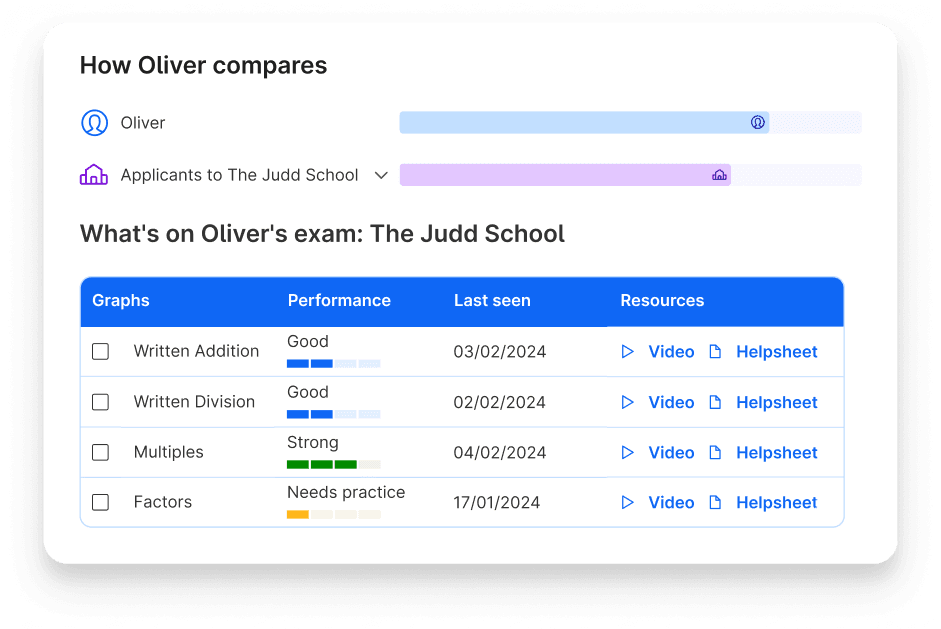
Grammar schools don't publish pass marks, and individual paper scores don't tell you how competitive your child's performance is relative to peers applying to the same school. Atom's benchmarking shows how your child is performing against real children targeting the same school, context that a mark scheme simply can't provide. Parents find it invaluable:
"It was helpful to see how he measured against past students who had completed work for the target school and if he was on track."— Parent, Ilford County High School
"I went from lying awake worrying whether it was working to actually knowing. That's the biggest thing Atom did for me."— Parent survey respondent
Trajectory over time, not snapshots.
Progress in this context means the direction of travel, not any single session's result. A child who scored below the required level in October but consistently improved month-on-month and passed in September is not a child who was "behind." They were on a trajectory.
"She started off well below the required level, but by the end was well and truly ready, and passed on the day!"
Parents who approached preparation this way, with consistent daily work building toward a goal rather than chasing a score in any single session, describe the results clearly. As one parent whose child got into South Hampstead High School put it:
"Building a strong foundation through daily work, combined with unlimited mock tests for extensive practice, was key to securing such a great offer."
See where your child is. Know what to do next.
Help your child ace the 11+
Get the pass mark you need with Atom Home – the leading exam platform for grammar and independent schools.
- Tailored exam prep plans for your child's target schools
- Practice questions for every 11+ topic
- Unlimited mock tests for every UK exam and school
- Performance data that shows how your child compares to other candidates (plus their standardised age score!)
Join 100,000+ families who trust Atom to help their children excel in Key Stage 2 and entrance exams. Endorsed by grammar schools, loved by parents.