
What A-levels do you need for law? (2027 guide)

Most law degrees ask for three strong A-levels, and several do not name any required subjects at all. Some also ask you to sit an admissions test called the LNAT. This guide uses the course pages of four universities (UCL, Bristol, Southampton and Nottingham) and the LNAT's own website, so you can see real offers for 2027 entry rather than general advice.
Key takeaways
- Whether any law course needs specific subjects, and whether A-level Law is one of them.
- A table of typical offers from four universities, and how a contextual offer works.
- What the LNAT is, which universities use it and the dates for 2027 entry.
- How an EPQ can change your offer, and a short plan for preparing.
Do you need specific A-levels to study law?
Usually not. None of the four universities we checked asks for a particular A-level subject for its law degree.
UCL has the strictest wording. It asks for at least two A-levels from its list of preferred subjects, and your third can be in any subject. Southampton says no specific subjects are required, and Bristol's course page lists a grade offer without naming any subjects. Nottingham asks for three A-levels and says it does not normally accept a combination with more than one non-traditional or practical subject among your three.
A few subjects are ruled out. UCL does not accept General Studies, Critical Thinking or Global Perspectives and Research towards its entry requirements. Southampton excludes General Studies and Critical Thinking.
Do you need to study law at A-level?
No. A-level Law is not required by any of the four course pages, so you can apply with three other subjects.
UCL lists Law among its preferred subjects, so it counts towards UCL's "two from the list" rule. That is different from being required. A grade A in a subject you enjoy can have a stronger position than a lower grade in Law.
Which A-levels do law universities like best?
Law courses do not publish a ranking of subjects, so the honest answer is the ones you can get top grades in.
UCL's preferred list is one general list covering arts and humanities, social sciences, and sciences and technology. That tells you a mix of subjects works. Many students pick subjects that involve building an argument in writing, such as English Literature, History or Politics. That is a sensible approach, not a rule any of these universities sets.
If you are still choosing, check each course page you might apply to. Course pages are the only place to see the exact wording, and it can change from one year to the next.
What grades do law courses ask for?
The four courses we researched ask for between AAA and A*AA at A-level. Here is how they compare for 2027 entry.
| University | Typical A-level offer | LNAT | Offer with an EPQ |
|---|---|---|---|
| UCL (Law LLB) | A*AA | Required for all applicants | Not mentioned on the course page |
| Bristol (LLB Law) | A*AA or A*A*B | Required | Not mentioned on the course page |
| Southampton (LLB Law) | AAA | Not required | AAB with an A in the EPQ |
| Nottingham (Law LLB) | AAA | Not mentioned on the course page | One grade lower with an A in the EPQ |
UCL and Bristol both list a lower contextual offer of AAB. A contextual offer is a reduced offer for applicants from backgrounds the university wants to reach more widely. UCL runs its scheme under the name Access UCL, and each university has its own page that explains who qualifies.
GCSEs count too. UCL asks for English Language and Maths at grade 6 (a B in the old system), and Southampton asks for English and maths at grade 4. If you want to see how the 9 to 1 grades work, our guide to how GCSEs are graded explains them.
Ready for A-Levels?
Atom is.
Guided revision, instant feedback, built for the specs that matter.
Join the waitlist for early access, whether you're the one sitting the exams or the one supporting them.

What is the LNAT and which universities use it?
The LNAT is the Law National Aptitude Test, an admissions test that checks how well you can read, reason and argue, rather than what you have learnt in class. It is used by some law schools alongside your A-level grades.
The test lasts two hours and 15 minutes and has two sections:
- Section A: 42 multiple-choice questions based on 12 passages that make an argument, with 95 minutes to answer them.
- Section B: 40 minutes to write one essay from a choice of three questions.
Section A gives you a score out of 42. There is no pass mark. Your essay is not scored, but universities can read it, and each one decides how to use it. Some use it as the starting point for interview questions, and others use it to separate close candidates.
The LNAT website lists these universities as requiring it for law: Bristol, Cambridge, Durham, Glasgow, King's College London, the London School of Economics, Oxford, SOAS and UCL. That list is labelled for 2026 entry or deferred 2027 entry, so check the current list on lnat.ac.uk and the course page. Southampton's page says the LNAT is not required.
UCL publishes some score information. For 2025/26, the average LNAT score of results it received was 23, and the average for applicants who received an offer was 30 (27 for contextual offers). UCL adds that no score makes an offer certain.
When do you take the LNAT for 2027 entry?
Dates depend on where you are applying. These are the dates the LNAT site gives for 2027 entry.
- Oxford and Cambridge: UCAS application and LNAT by 15 October 2026. That date has now passed.
- UCL, King's College London and the LSE: sit the test by 31 December 2026.
- Bristol and Durham: book, submit your UCAS application and sit the test by 13 January 2027 (UCAS by 18:00 UK time).
- Most other LNAT universities: submit your UCAS application by 13 January 2027 at 18:00, book by 20 January and sit the test by 25 January 2027.
Testing started on 1 September 2026. For this cycle, the LNAT says a result from before the 2026 summer holiday will not count. UCAS gives 13 January 2027 at 18:00 UK time as the equal consideration deadline for most courses, which means universities treat every application that arrives by then equally.
There is a test fee. The LNAT waives it for UK and EU students who receive certain state benefits, and you apply for that bursary before you book. It takes at least a week to process.
Can an EPQ or Extended Project help your law application?
At some universities, yes. An EPQ (Extended Project Qualification) is a stand-alone research project that AQA describes as worth half an A-level, or 28 UCAS points.
Southampton asks for AAB with an A in the EPQ if you take it alongside three A-levels, where the standard offer is AAA. Nottingham lowers its offer by one grade for an A in an EPQ, Core Maths, the IB Extended Essay or an additional AS-level, with extra eligibility rules on top. UCL's and Bristol's course pages do not mention the EPQ, so do not assume it changes your offer there.
Each university decides this for itself, so read the course page before you commit to the extra work.
How can you prepare for a law application?
Start with reading and writing, because both the LNAT and law degrees test them. These steps are practical, and you can start now.
- Read arguments, not just facts. Pick one long article a week and write two sentences on what the author claims and what evidence is offered.
- Write to time. The LNAT essay is 40 minutes for one of three questions, so practice planning in five minutes and writing for the rest.
- Practice short passages. Section A is 42 questions in 95 minutes, which works out at a little over two minutes a question. Read a passage, then say in your own words what the argument is.
- Look at the real course pages. Check the offer, the subject rules and the test dates for each university on your list before you finalise your A-level choices.
- Build a steady study routine. Our guide to building an effective study routine has five simple tips, and our post on preparing for exams mentally and emotionally can help with the days before a test.
Choosing the right subjects is easier when you know what universities are asking for. Once you have a shortlist, the rest is steady practice.
Take control of your A-Level revision

Everything you need for A-Level success, in one place.
Feeling confident about your A-Levels comes from knowing what to revise, how to improve, and where to focus next.
📄 A-Level practice papers matched to your exact exam board
🎓 Guided courses that cover every topic on the syllabus
✍️ Instant feedback that shows what's working, and what needs another look
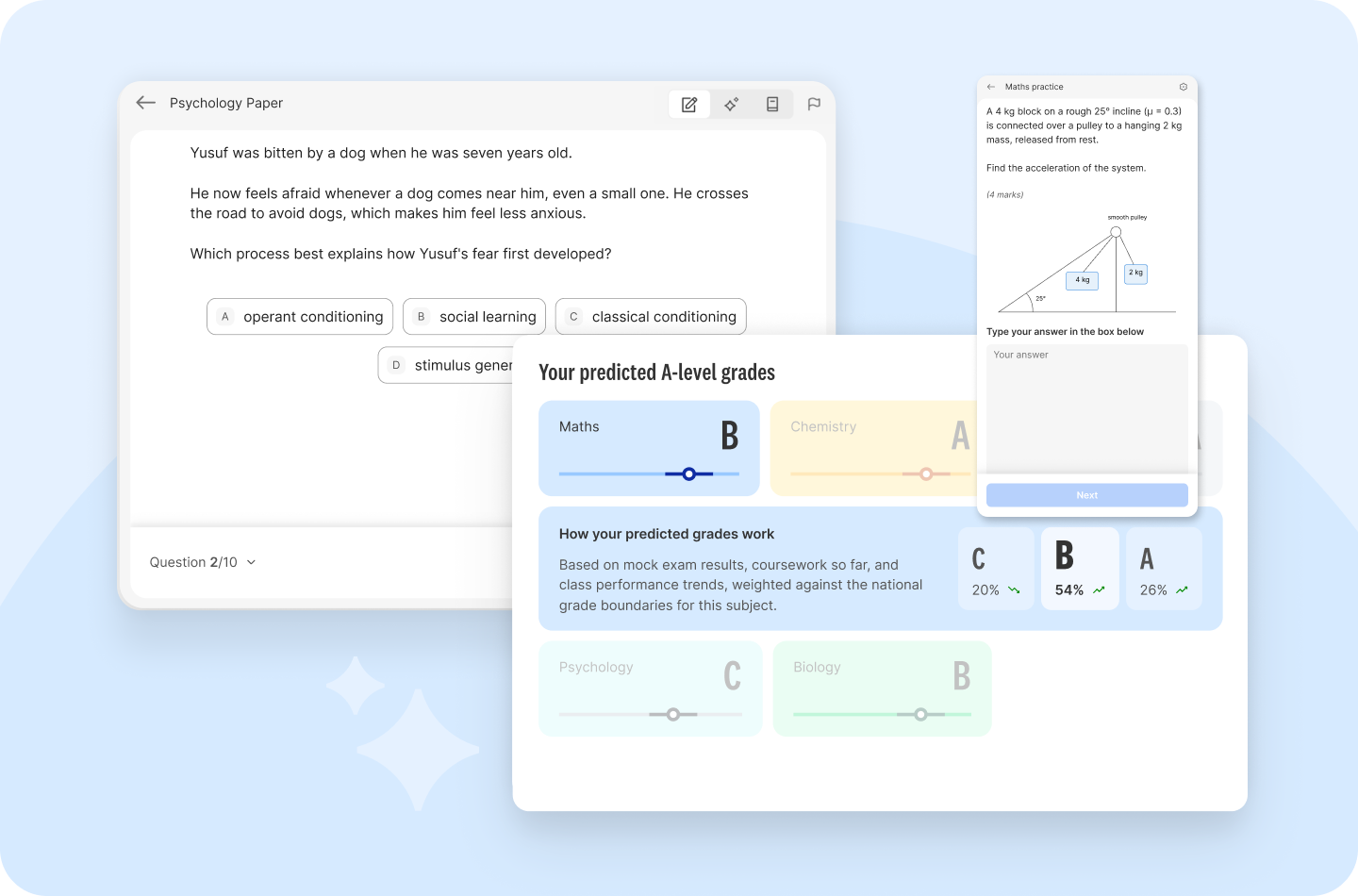
📈 Predicted A-Level grades and topic-by-topic tracking
Join the waitlist now for early access, whether you're sitting the exams or supporting someone who is.