How hard is it to get into grammar school?

Every year, hundreds of thousands of children sit the 11+ for a chance at a grammar school place. If you're starting to think about grammar schools for your child, the most useful question isn't how hard it is to get in - it's what actually determines who does.
Grammar schools are free to attend and open to any child who applies. Places are offered based on how children perform in the 11+, an entrance exam which is designed to assess your child’s academic ability. Getting to grips with what that exam involves for each grammar school, and how your child can prepare for it, is the most useful place to start.
This guide breaks down what competition looks like across England, and what the evidence tells us about who secures a place.
Key takeaways
- Nationally, around 1 in 5 children who sit the 11+ secures a grammar school place.
- In some areas, thousands of children compete for fewer than 200 places at a single grammar school.
- Atom students are nearly 4x more likely to earn a grammar school place than the national average
- Grammar schools are free to attend and select pupils based on academic ability; entry is assessed via the 11+ exam.
What is a grammar school?
Grammar schools are state-funded secondary schools that select their pupils based on academic ability. The schools use entrance exams commonly known as the 11+ to identify children who are likely to thrive in an academically selective environment.
There are 163 grammar schools in England today, spread across the country, with high concentrations in Kent, Buckinghamshire, Lincolnshire, parts of London, and the West Midlands.
Take a look at our guide to finding your local grammar school to see which grammar schools are near you.
Grammar schools consistently produce strong academic results, and many families see them as a route to a high-quality, free secondary education. That demand, combined with a fixed number of places, is what makes the admissions process so competitive.
What does the 11+ actually test?
The 11+ is not a single exam. The subjects tested, the number of papers, and the format all depend on which schools your child is applying to and which exam board they use.
Most 11+ exams test some combination of the following subjects:
- English — usually reading comprehension, and sometimes creative writing
- Maths — covering the Key Stage 2 curriculum, often with more challenging problem-solving elements
- Verbal reasoning — tests a child's ability to understand and work with language
- Non-verbal reasoning — tests spatial awareness and pattern recognition
Subjects tested may vary between schools and consortia, so it's important to check what the school is testing when thinking about prep.
Verbal and non-verbal reasoning are not part of the national curriculum, so most children will encounter them for the first time during 11+ preparation. Introducing them early in your prep will give your child plenty of time to get comfortable with both subjects.
The exam is designed to identify children working at the top of their year group; typically the top 25%. That's why preparation matters. The more familiar your child is with the format and subjects they'll face, the better placed they'll be on the day.
You can find out more in our complete guide to the 11+.
How competitive is the 11+? The numbers by region
Around 1 in 5 children who sit the 11+ secures a grammar school place.
In some parts of the country, a single school receives thousands of applications for fewer than 200 places.
Here's what the numbers look like across every region in England with grammar schools.

Reading
Over the years, Reading School has received around 975 applications for 150 places.
In 2024, Kendrick School received 747 applications for 128 places.
Slough
Around 4,233 children sat the Slough Consortium 11+ in 2020, competing for a combined 510 selective places across three grammar schools.
Every child attending a state primary school in Buckinghamshire is automatically registered to sit the Buckinghamshire Secondary Transfer Test.
In 2024, 12,238 children sat the test, competing for approximately 3,500 places across the 13 grammar schools.
Queen Elizabeth Grammar School, Penrith receives around 640 applications for 160 places every year.
East Devon
Around 640 children applied to Colyton Grammar School for 160 places in 2024.
Plymouth
Plymouth's three grammar schools received a combined total of around 1,832 applications in 2024 across Devonport High School for Boys, Devonport High School for Girls, and Plymouth High School for Girls, competing for a total of 458 places.
Around 3,660 children sat the Dorset Consortium 11+ in 2024, competing for places at four grammar schools, each offering between 180 and 192 places.
In 2023, 4,977 children sat the CSSE 11+, competing for places across seven selective schools in Essex and Southend-on-Sea, offering a combined total of around 1,200 places.
Around 3,130 children sat the Gloucestershire Grammar School Consortium 11+ in 2024, competing for approximately 1,050 places across seven grammar schools.
London Borough of Barnet
Barnet is home to some of the most oversubscribed grammar schools in the country. In 2024, Queen Elizabeth's School received around 3,800 applications for 180 places.
Henrietta Barnett School received 3,121 applications for just 104 places, a ratio of more than 30 applicants per place.
London Borough of Bexley
In 2024, 7,000+ children competed for just 800 places across four grammar schools in Bexley.
London Borough of Bromley
St Olave's Grammar School received around 1,600 applications for 128 places in 2024. Newstead Wood School received around 900 applications for 168 places (2016).
London Borough of Enfield
The Latymer School received 3,285 applications for 192 selective places in 2024, meaning more than 17 children competed for each place.
London Borough of Kingston upon Thames
At both Tiffin School and Tiffin Girls' School, 9 applicants competed per place in 2023, with over 1,500 applications for 180 places at each school.
London Borough of Redbridge
Around 3,000 children sat the Redbridge 11+ in 2024, competing for 360 places across Ilford County High School and Woodford County High School.
London Borough of Sutton
The Sutton Selective Eligibility Test (SET) consortium received around 6,000 applications for just 891 fully selective places across five grammar schools. Of those, 3,126 applications came from girls competing for just 420 places across the two girls' grammar schools: Nonsuch High School and Wallington High School for Girls.
Kent has the highest concentration of grammar schools in the country. In 2024, 16,446 children sat the Kent Test, competing for around 5,000 places across 32 grammar schools.
Around 3,260 children sat grammar school entrance exams across Lancashire in 2024, competing for places across four grammar schools.
The Lincolnshire Consortium of Grammar Schools attracted 8,468 applicants in 2024 across 14 grammar schools.
In 2023, 3,906 children sat the Medway Test, 2,034 from within the county and 1,872 from outside, competing for approximately 1,093 places across six grammar schools.
Liverpool
The Liverpool Blue Coat School received 1,260 applications for 180 places in 2024, meaning 7 children were competing for every single place.
The Wirral
Around 3,996 children sat grammar school entrance exams across the Wirral in 2024, with St Anselm's College and Upton Hall School each receiving around 1,248 applications for 156 places.
Birmingham
Around 2,209 children sat the West Midlands Grammar Schools Entrance Test across Birmingham in 2023, competing for places across eight King Edward VI schools with a combined intake of approximately 1,500 places.
Shropshire, Walsall and Wolverhampton
Around 4,150 children sat grammar school entrance exams across this region in 2024.
Queen Mary's Grammar School received around 900 applications for 180 places.
Haberdashers' Adams received approximately 1,000 applications for 150 places.
Warwickshire
In Warwickshire 2024, around 2,250 children sat the West Midlands Grammar Schools Entrance Test, competing for approximately 1,063 places across the six grammar schools.
Around 1,120 children sat grammar school entrance exams across Wiltshire in 2024, competing for places at Bishop Wordsworth's School and South Wilts Grammar School.
North Yorkshire
North Yorkshire attracted around 1,444 applicants across three grammar schools in 2024: Ripon Grammar School, Skipton Girls' High School, and Ermysted's Grammar School.
West Yorkshire
Heckmondwike Grammar School, North Halifax Grammar School and The Crossley Heath School each received around 1,200 applications for approximately 180–210 places in 2023–24.
These numbers reflect just how significant demand for grammar school places is across England and how consistently it outstrips supply in almost every region.
The important next question is: what actually determines whether a child gets in? The evidence is clear: preparation is the single biggest factor.
The difference effective preparation makes in securing a grammar school place
Nationally, around 20% of children who sit the 11+ secure a grammar school place.
In 2026, 75% of Atom students were accepted at a grammar school, meaning that children who use Atom are four times more likely to earn a grammar school place.
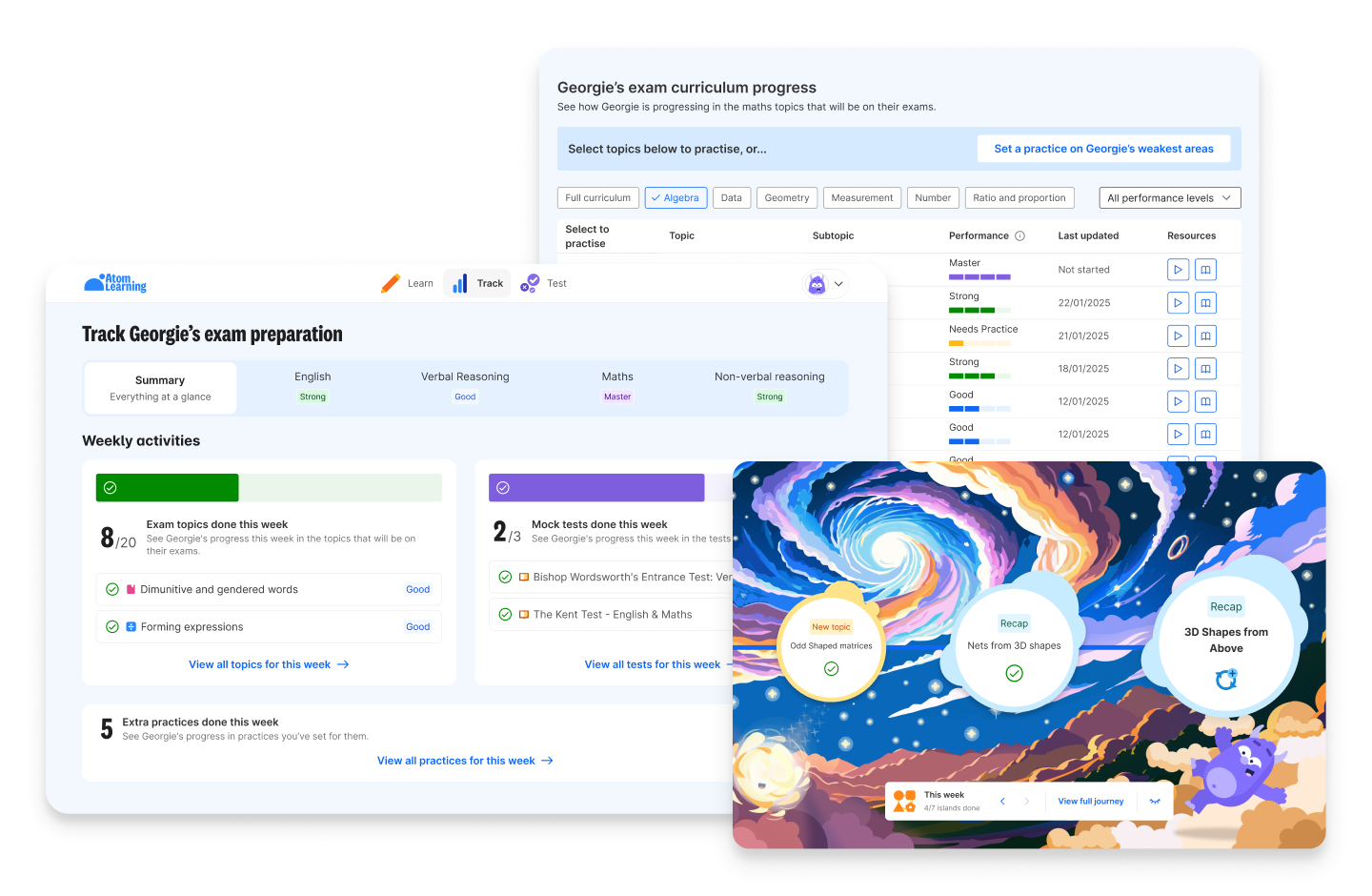
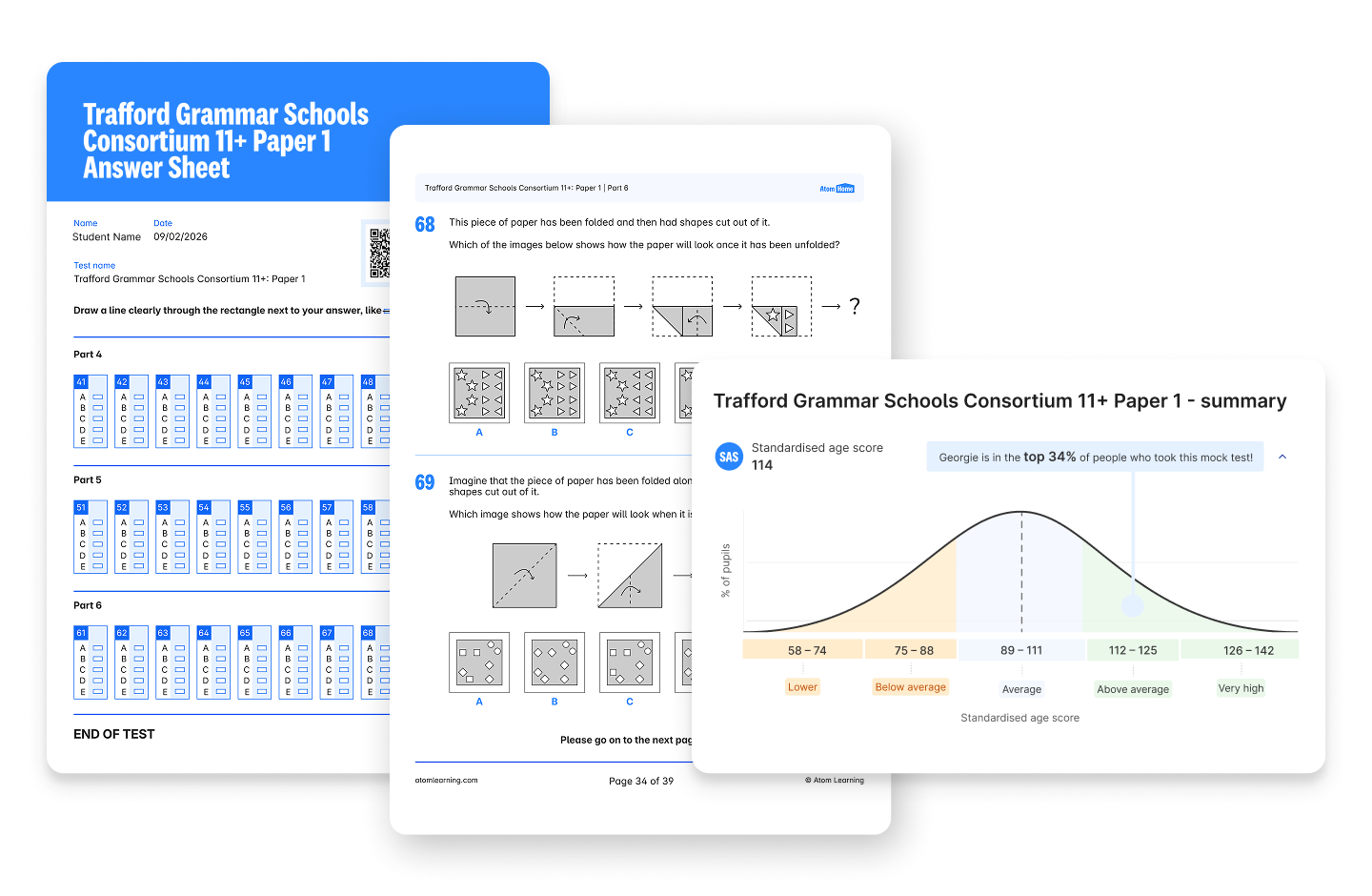
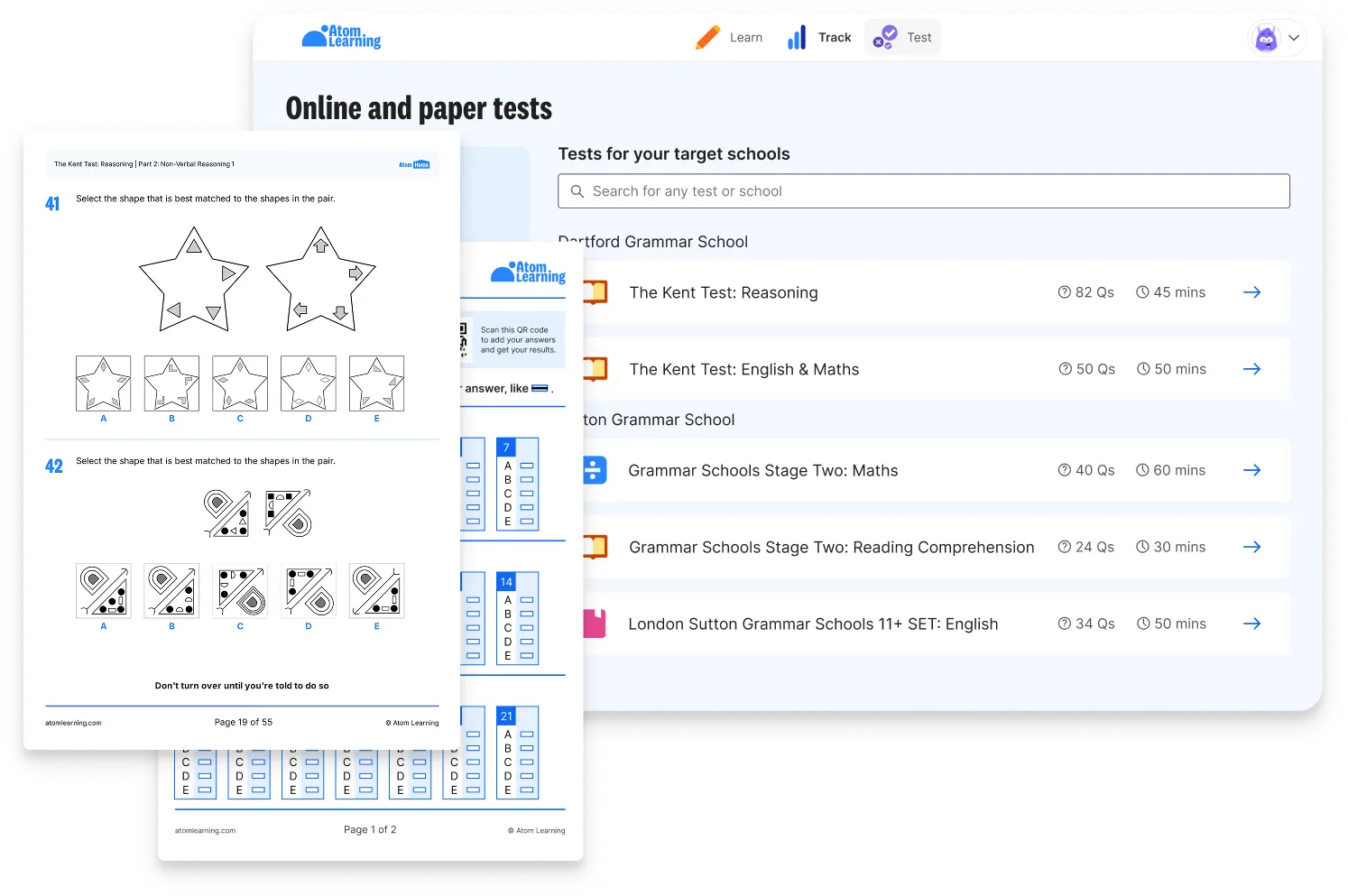
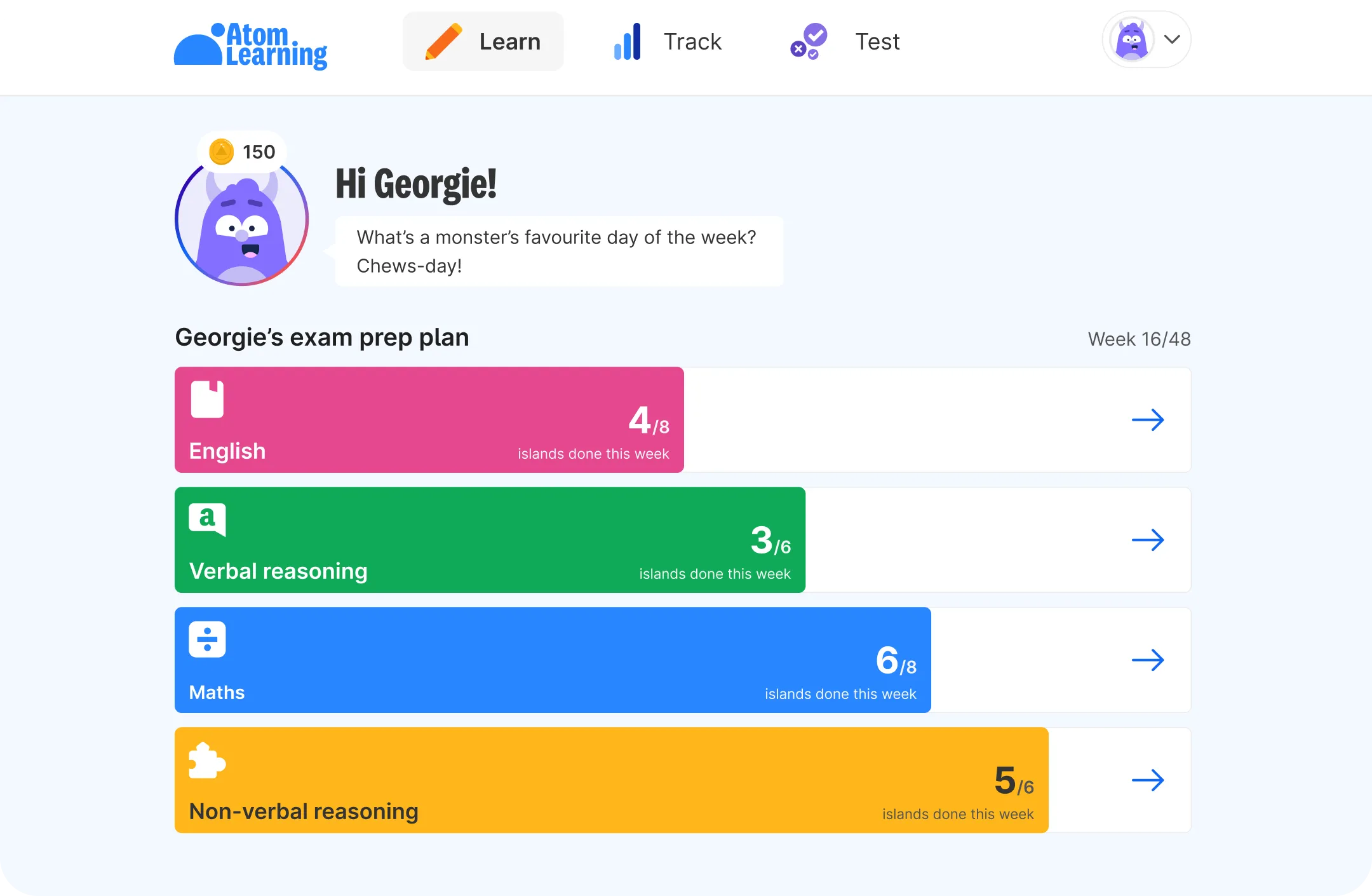
Atom Home is an online learning platform used by over 110,000+ families to prepare for the 11+. It identifies where your child is across every 11+ subject, builds a learning plan around their target school, and tracks their progress so you always know where they stand.
Built to fit around family life, short daily sessions on Atom give your child consistent, targeted practice, building the skills and confidence they need to walk into exam day feeling prepared.

"The adaptive learning approach adjusted the difficulty based on performance, helping our child focus on areas that needed improvement while still reinforcing strengths." — Parent, Highworth Grammar School

"Building a strong foundation through daily work, combined with unlimited mock tests for extensive practice, was key to securing such a great offer." — Parent, South Hampstead High School
These are the results of consistent, targeted preparation, and they're available to any family who starts on Atom.
Supporting every child's preparation
Across the country, a growing number of grammar schools are partnering with Atom Learning to support our Pupil Premium programme that provides eligible Pupil Premium students with access to Atom Home.
Among the families who responded to our 2026 survey and prepared through one of these partnerships, 88% of those applying to grammar schools received an offer.
The results point to a consistent conclusion: when children have access to structured, targeted preparation, the approach delivers.
"I wasn't able to afford a tutor. Atom Learning meant that my child was able to revise the subjects needed for the Kent test, just like any other child with the funds able to do so." — Parent, The Norton Knatchbull School
"He passed his 11+ without any tuition and used Atom Learning as his sole support to practise and learn. It was immeasurably valuable." — Parent, The King's School, Grantham
If your child is eligible for Pupil Premium, it is worth checking whether they can access Atom Home through one of these school partnerships. Find out if your child is eligible.
Your next steps
Preparing for the 11+ is a journey, and done well, it builds far more than exam results. The logical thinking, careful reading, and ability to problem-solve under pressure are skills that stay with your child long after exam day.
The families who succeed aren't the ones who worked hardest. They're the ones who started, stayed consistent, and prepared in a way targeted exactly to where their child was.
Wonder what that could look like for your child? Start your free trial today and see how Atom builds from where your child is right now.

.avif)