

Quest Assessments 11+ timeline: what to expect and when
Exact dates vary by school, but most grammar schools using Quest Assessments follow a similar timeline. Understanding when each stage happens can help you plan ahead and feel confident you haven’t missed anything important.
Year 4 - 5 (age 9–10)
Most families start structured preparation by now. The content tested in Quest Assessments exams is based on learning up to the end of Year 5.
If your child’s exam tests verbal reasoning and/or non-verbal reasoning, it’s a good idea to start learning these types of questions now. These subjects aren’t taught at school, so early preparation is key to feeling confident in the exam.
Registration for grammar school entrance tests often opens towards the end of Year 5. Take a look at our school guides to find out the key dates for your child’s target grammar schools.
Year 6 (age 10–11)
Quest Assessments 11+ exams are sat early in the autumn term. Your child might sit the papers on one day or across multiple days, depending on the school. You’ll receive their results in October, so that you can submit your secondary school common application form by 31st October.
Grammar school offers are made in early March. Always check individual schools’ admissions policies for exact dates and arrangements.
What’s tested on Quest Assessments 11+ exams?
Quest Assessments tests English, maths, verbal reasoning and non-verbal reasoning. Your target grammar school will choose which combination of subjects to assess.
Here’s what each involves.
English
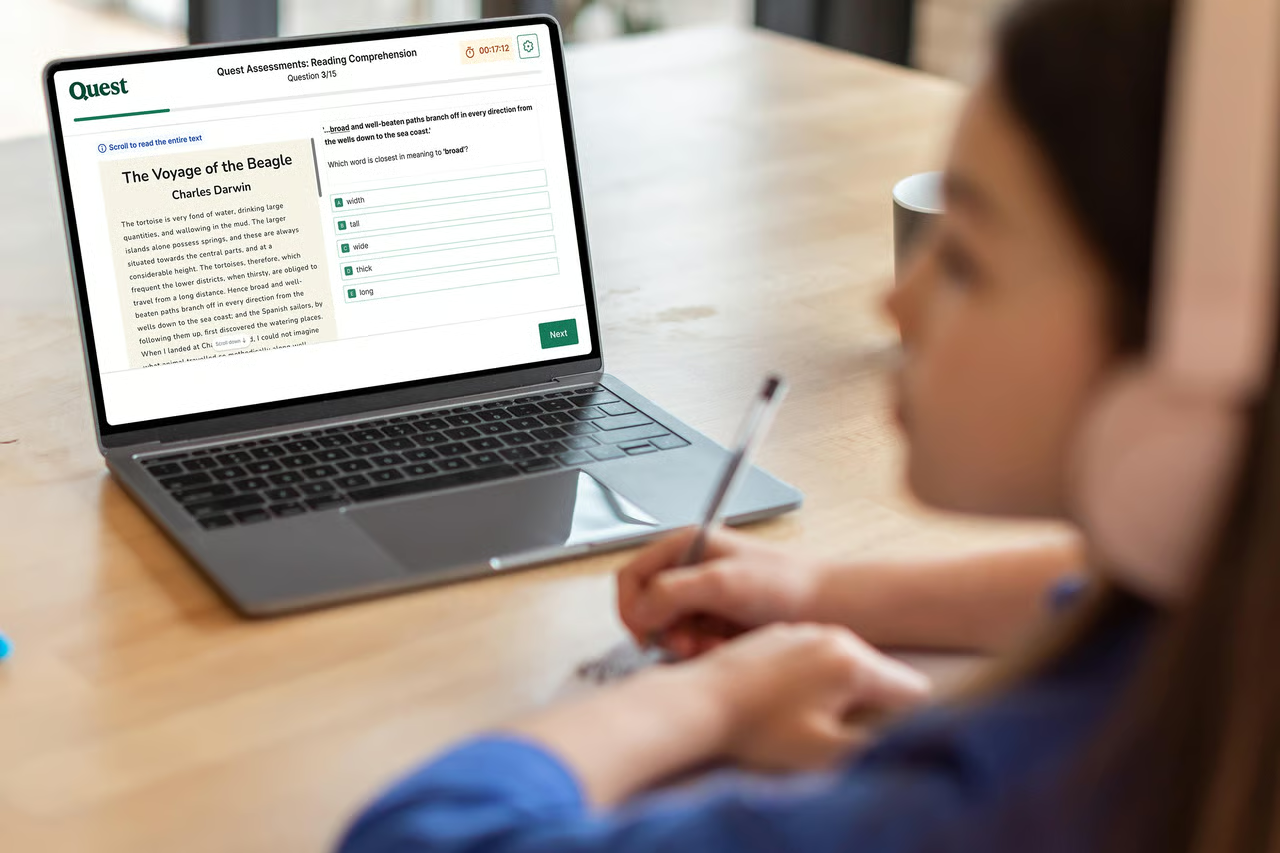
Your child will answer questions on reading comprehension, grammar, vocabulary and spelling – all familiar elements of the primary English curriculum. Questions are based on skills your child already uses in school, such as reading, understanding meaning, and identifying correct grammar.
The English test might include:
- A reading booklet followed by comprehension questions
- Vocabulary questions (synonyms, antonyms, contextual meaning)
- Grammar and punctuation correction
- Sentence- and word-level reasoning
Maths
Quest maths papers cover Key Stage 2 content up to the end of Year 5. Children may see questions on topics like:
- Arithmetic: addition, subtraction, multiplication, division
- Fractions, decimals and percentages
- Word problems requiring reasoning
- Place value
- Measure and geometry
- Data handling
Verbal reasoning
Verbal reasoning isn’t taught at primary school. Some 11+ exams include verbal reasoning because it assesses how your child thinks and solves problems, rather than what they know. It involves understanding and manipulating words, logic and language patterns.
Typical verbal reasoning content includes:
- Synonyms and antonyms
- Letter and word codes
- Odd-one-out
- Word relationships
- Analogy questions
- Sentence logic
- Cloze (missing word) tasks
Non-verbal reasoning
Like verbal reasoning, non-verbal reasoning isn’t taught at school. It looks at how your child spots patterns, uses visual logic and understands shapes. It doesn’t rely on language, so it gives children a chance to show their problem-solving skills in a different way.
Typical questions include:
- Sequences and patterns
- Rotation, reflection and symmetry
- Identifying missing shapes
- Solving codes using attributes like shape, size or shading
What do Quest Assessments 11+ exams look like?
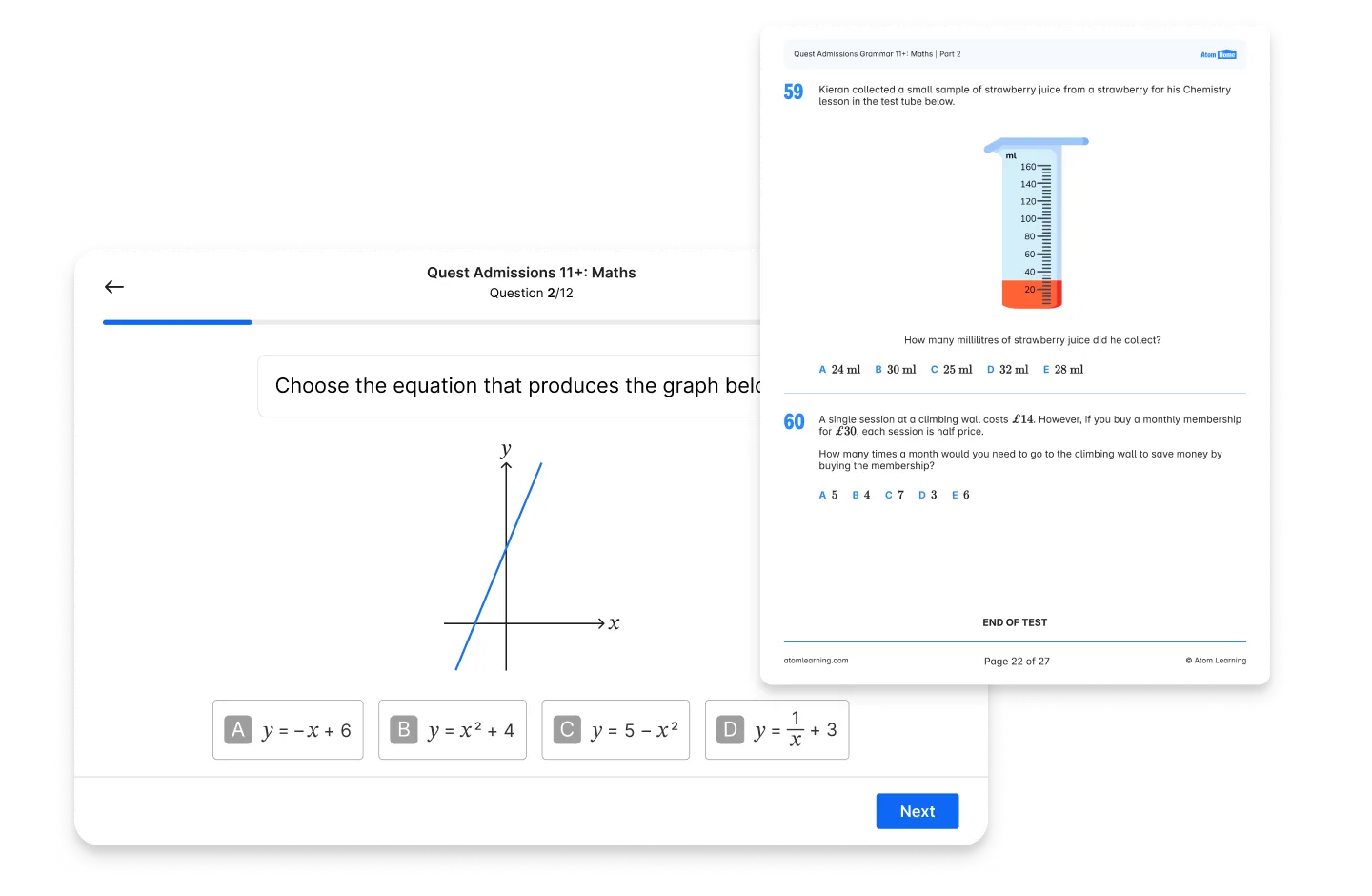
Quest Assessments 11+ exams are paper-based. Here’s what your child can expect to see.
Question booklet and answer sheet
Each paper comes with a question booklet and a separate answer sheet. Most questions are multiple-choice. Your child will record their answers by drawing a line through the box next to their chosen option.
If they need to change an answer, they can erase it and mark a new one.
Instructions before each paper
Before each test begins, instructions are read aloud so your child knows how to complete the paper and how long they have. They can raise their hand if they have a question.
Varied question styles
The papers include a mix of shorter and longer questions.
- English may include comprehension, vocabulary and grammar questions
- Maths may include arithmetic, problem-solving and reasoning questions
- Verbal and non-verbal reasoning papers include short puzzle-style questions
Working out in the booklet
Your child can use their question booklet to jot down workings or notes. Only answers recorded on the answer sheet are marked.
Timed sections
Each paper has a set time limit. Your child should keep an eye on the clock, attempt all questions, and move on if a question is taking too long.
How do grammar schools use Quest Assessments 11+ results?
Quest Assessments provides the exam papers, but schools control admissions decisions. This means the way results are used will depend on each school.
Most grammar schools:
- Mark and standardise scores (a process known as age-standardisation) so children born later in the year aren’t at a disadvantage
- Rank children by their final Standardised Age Score (SAS)
- Offer places based on this ranking and their admissions criteria (such as catchment area, looked-after children, or siblings already attending the school)
- Place additional candidates on a waiting list
How to prepare for Quest Assessments 11+ exams
Preparing well makes a big difference to how confident children feel on test day. Here are some practical ways to support your child in the lead-up to the Quest Assessments 11+ exam.
1. Strengthen skills across all subjects
The Quest Assessments 11+ exam assesses skills in reading, writing, maths and reasoning. The best way to prepare is to keep building strong foundations across all of these areas.
Encourage your child to:
- Read regularly to develop vocabulary and comprehension
- Practise mental maths and written methods
- Try puzzles and logic activities to boost reasoning
- Ask questions when they don’t understand something at school
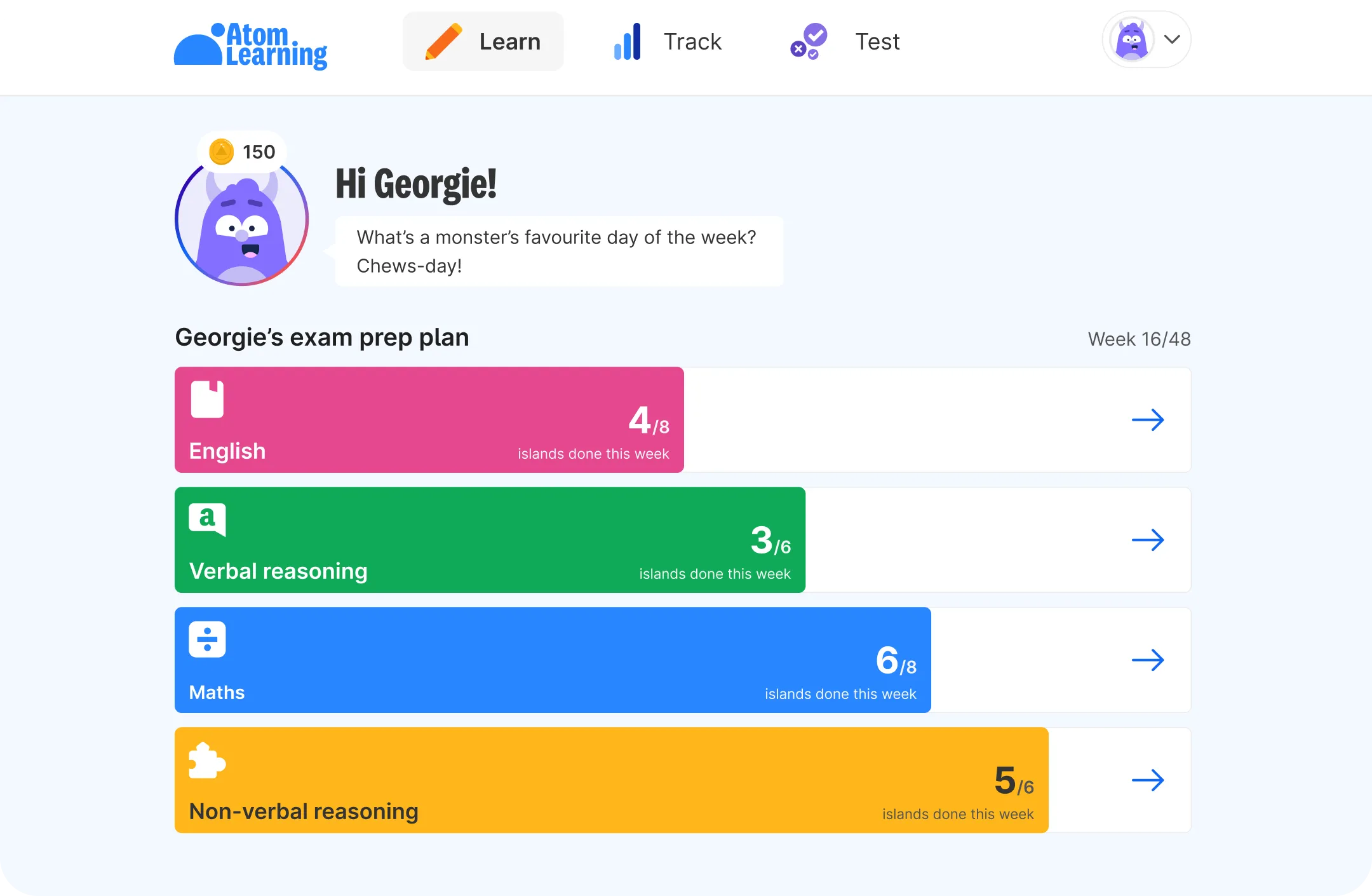
On Atom, your child can work through a personalised exam plan covering everything they need to know for their 11+ exam.
2. Build confidence with the exam format
Understanding how the papers work helps children feel more at ease on the day. Practise:
- Working through question booklets
- Recording answers clearly on a separate answer sheet
- Using the booklet space for notes and workings
You can help your child develop good time awareness by encouraging them to:
- Keep a steady pace
- Move on if a question feels too difficult
- Return to unanswered questions if they have time at the end
Atom’s unlimited 11+ practice papers follow the same multiple-choice format your child will see in their assessment. Simply upload photos of your child’s answer sheets to get them marked automatically.
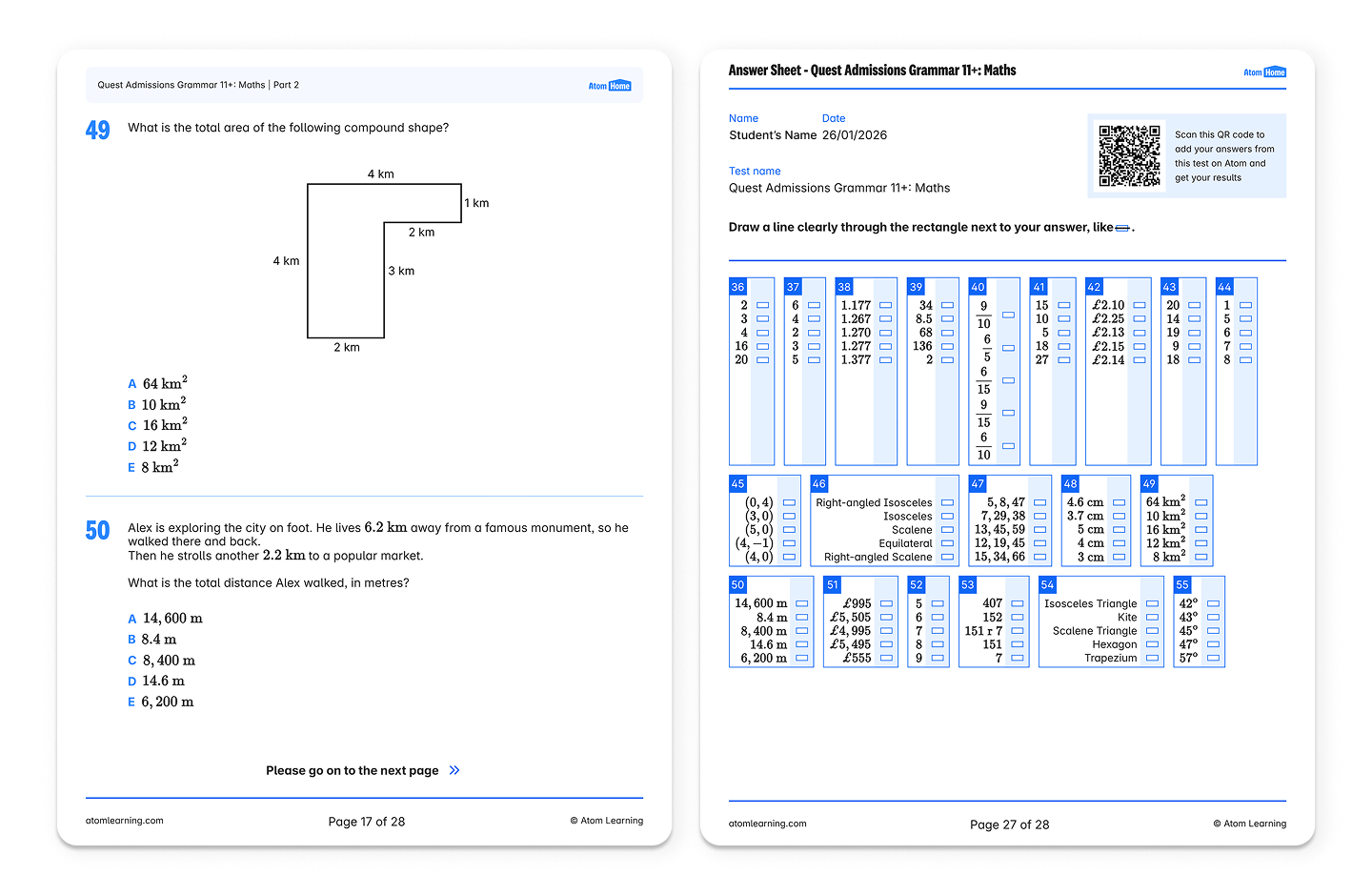
They help children get comfortable with:
- Reading and navigating a paper-style booklet
- Recording answers separately
- Working steadily through a set of questions
Regular exposure to this format helps the experience feel more familiar, which can build confidence on the day.
3. Practise little and often
Short, regular practice is far more effective than long revision sessions. Aim for:
- Small, manageable chunks of learning
- Revisiting tricky topics
- Keeping practice varied and enjoyable
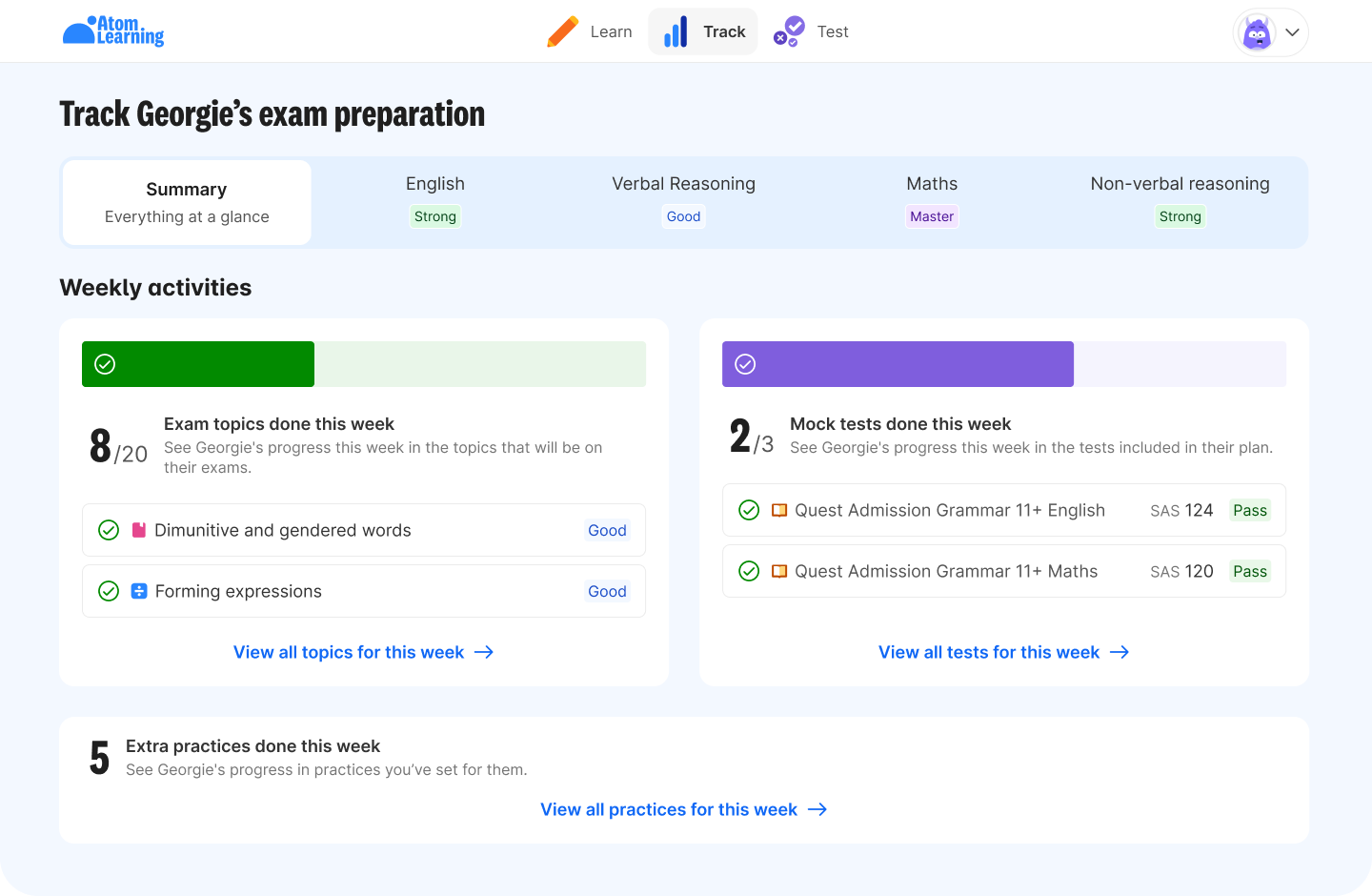
Atom helps you understand how your child is doing with detailed progress tracking. You can see at a glance:
- Which topics they’ve mastered
- Where they need more support
- How they compare to others applying to the same schools.
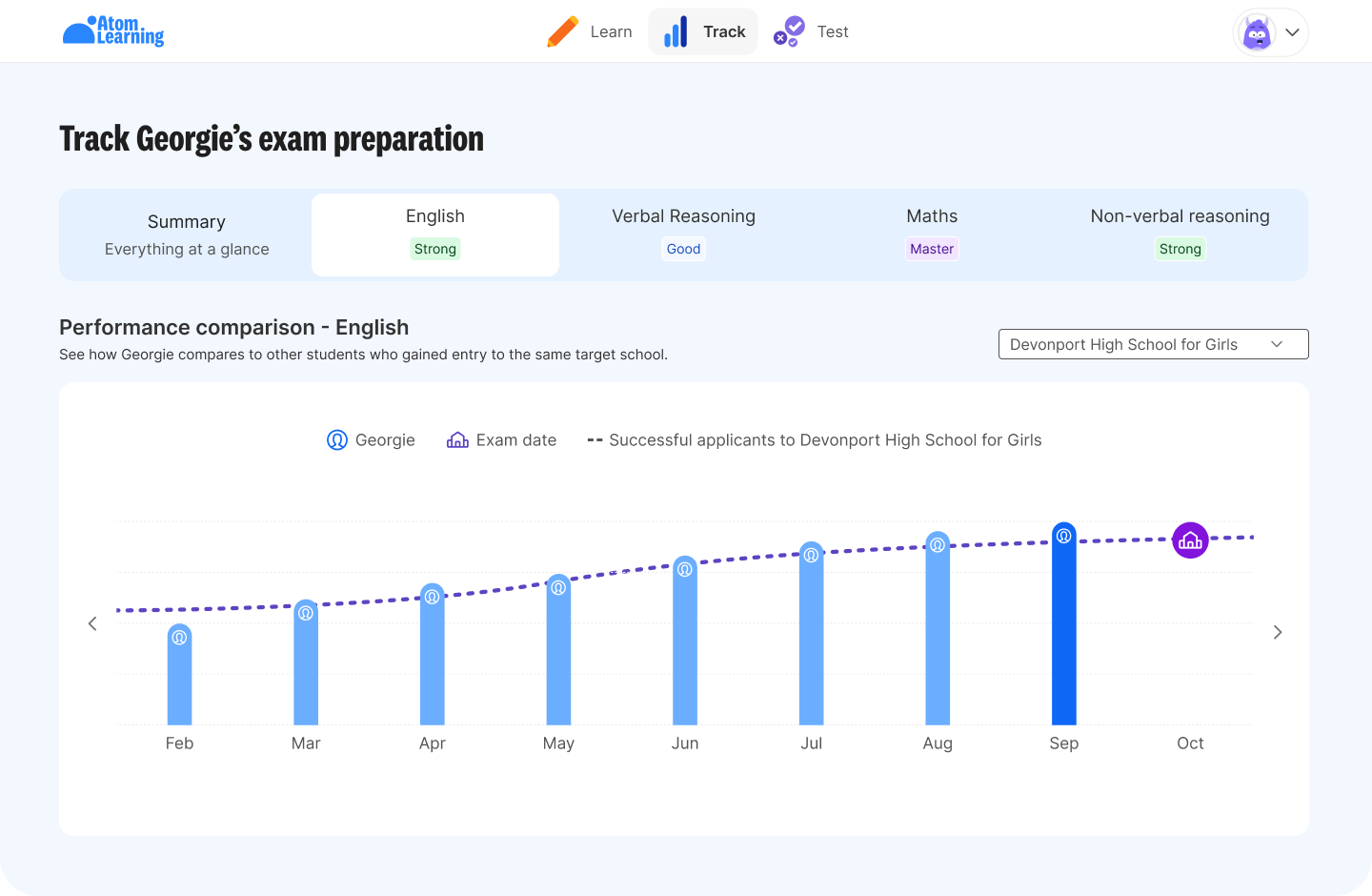
You’ll also see your child’s Standardised Age Score (SAS) in every practice test. This makes it easier to track progress, celebrate improvements and see if they’re on track to pass the exam.
4. Keep a healthy balance
Children do their best when they feel well-rested and supported. Encourage:
- Plenty of sleep
- Regular breaks between study sessions
- Time for hobbies, friends and exercise
- A calm routine in the days before the assessment
A balanced approach helps children stay focused, positive and ready to learn.
5. Build a calm exam-day mindset
A confident mindset makes a big difference on the day. Help your child to:
- Take deep breaths if they feel nervous
- Read each question carefully
- Move on if they feel stuck and return later
- Double-check answers if they have time
Remind them that they simply need to try their best. The goal is to show what they can do, not to be perfect.