What happens if you fail your GCSEs: your guide to next steps
By
Atom
|
August 27, 2026
Worried about what happens if your GCSE results aren't what you hoped for?
You're not alone; thousands of students face this every year, and there are more options than you might think. This guide explains exactly what failing a GCSE means, what you can do next, and how to move forward with confidence. Read on to find out more.
What does it mean to fail a GCSE?
In England, GCSEs are graded from 1 to 9. A grade 4 is known as a "standard pass." A grade 5 is called a "strong pass." If you get a grade 3 or below, this is generally considered a fail.
It is worth knowing that a lot of students do not reach grade 4. In summer 2025, around 32.6% of all GCSE entries in the UK did not achieve a grade 4 or above. That is roughly one in three entries. So if you are in this situation, you are far from alone.
Failing one GCSE is not the end of the road. You can resit the exam, explore alternative qualifications, or take a different path entirely and this guide covers all of your options.
What happens if you fail GCSE maths or English language?
Maths and English language are treated differently from every other GCSE. The government requires students who have not achieved a grade 4 in either subject to carry on working towards that grade. This is sometimes called the condition of funding requirement.
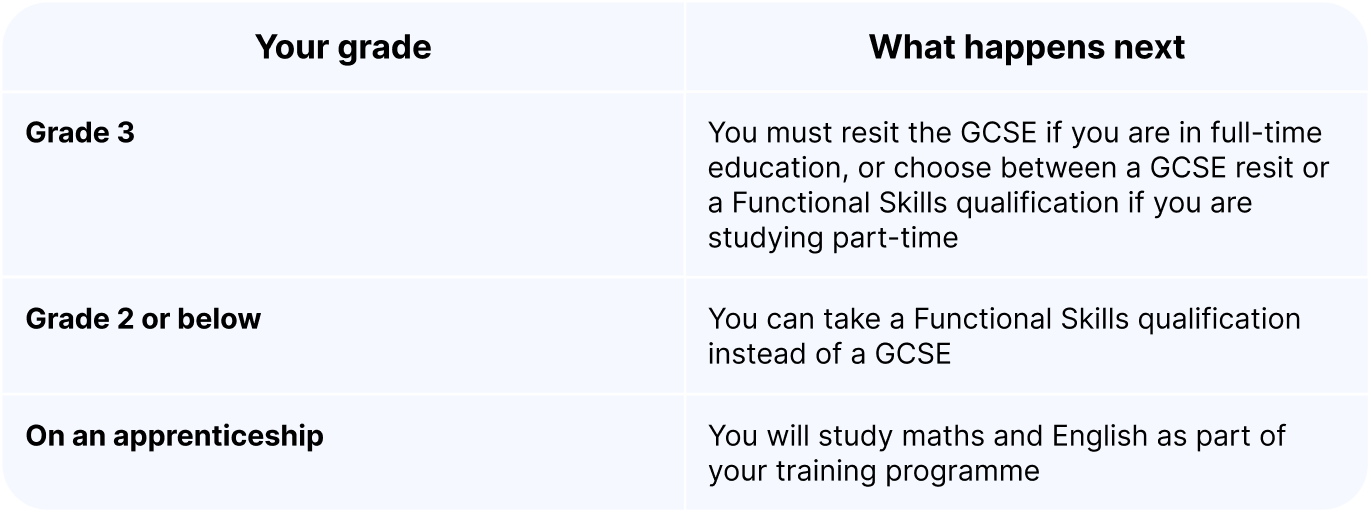
Here is what that means in practice, depending on your grade:
You will need to keep working towards these qualifications until you pass or turn 18.
The good news is that if you are resitting maths or English language because you did not reach a grade 4, you will not have to pay to take the exam. The cost is covered.
What is a Functional Skills qualification?
Functional Skills is an alternative to GCSE that focuses on practical, everyday use of maths and English. Many employers and colleges accept it as an equivalent. If you found the GCSE format very difficult, it can be a good route to explore. Talk to your school, college, or sixth form about which option is right for you.
What are your options after failing other GCSEs?
For every subject other than maths and English language, resitting is your choice. You are not required to retake any other GCSE. If a failed subject is holding you back from the next step you want to take, however, a resit could be worth it.
Here is an overview of your main options.
1. Resit your GCSEs
You can resit most GCSEs in November or the following summer. Maths and English language are available in the November series. Most other subjects are only available in the summer.
If you are still at school or college, your institution will usually enter you automatically. If you have left school, you will need to register as a private candidate through an exam centre and pay a fee. It is a good idea to book around six months before the exam date.
Both your original grade and your resit grade will appear on your results transcript. For things like UCAS applications, you can use whichever grade is higher.
2. Go to sixth form or college
Failing one GCSE does not automatically stop you from going to sixth form or starting A levels. Many sixth forms and colleges will let you begin your course while resitting the subject you did not pass. It is always worth having a conversation with your chosen institution, as many are flexible, especially for one failed subject.
A typical entry requirement for A levels is five GCSEs at grade 4 or above, including English and maths. If you are missing more than one, you may be asked to start at Level 2 instead of Level 3.
Courses like BTECs and T Levels can be a great fit if you prefer coursework and practical learning over exams.
A BTEC (Business and Technology Education Council) is a practical, work-focused qualification. Instead of sitting exams, most of your grade comes from coursework and projects. BTECs are available in a wide range of subjects, from business and health to sport and engineering, and are accepted by many universities and employers.
T Levels are equivalent to three A levels and involve a mix of classroom study and a substantial industry placement. They are designed with employers and focus on preparing you for a specific career area.
These courses often have different entry requirements to A levels, so they may be open to you even if your GCSE grades were mixed.
4. Start an apprenticeship
An apprenticeship lets you earn money while you learn. You work for an employer most of the week and spend time training towards a qualification. Apprenticeships are available in almost every industry, from engineering to healthcare to digital technology.
Most apprenticeships require you to have passes in English and maths, and many programmes include training to help you reach that level if you have not already. If you are on an apprenticeship and have not yet passed GCSE maths or English language, you will work towards these as part of your programme.
Can you still go to university if you fail a GCSE?
Yes, in most cases. Universities set their own entry requirements, and these usually focus on your A level grades or equivalent qualifications rather than every single GCSE. However, most universities do require a grade 4 or above in both GCSE English language and GCSE maths, so it is important to work towards those if you have not yet passed them.
If you are thinking about university, check the entry requirements for the specific courses you are interested in. Some universities also offer a foundation year, which is an extra year of study before your main degree, which can be a good route in if you do not meet the standard entry requirements.
5 top tips for resit success
1. Find out exactly where you lost marks
You can request a copy of your marked exam paper from your school or as a private candidate. Looking at where you lost marks tells you exactly what to work on, rather than going back over everything and wasting time.
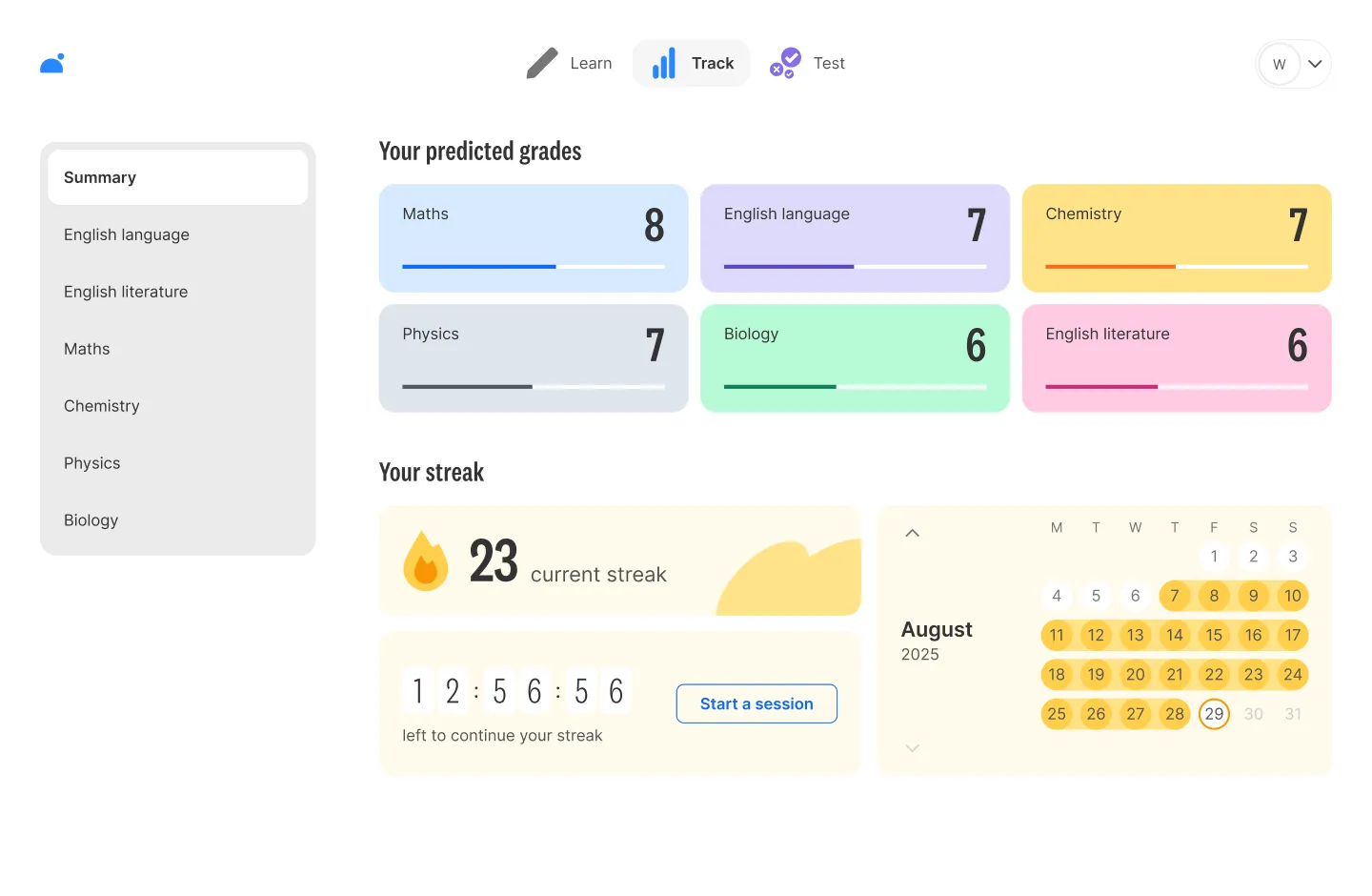
Top tip: Ask your teacher or check an examiner report to help you understand the marking. These reports explain what the strongest answers included and where most students went wrong. Atom's progress dashboard shows you exactly which topics you are losing marks on, so you always know precisely where to direct your effort.
2. Practise with past papers under timed conditions
Doing past papers is one of the most effective ways to prepare for a resit. Sit them under real exam conditions: time yourself, work in silence, and then mark your answers using the official mark scheme.
Top tip: Do not just check whether your answer is right or wrong. Read the mark scheme carefully to understand what specific points you needed to include to earn each mark. Atom's predicted papers are built to mirror the style and difficulty of your real exam, so every timed practice session you do is as close to the real thing as possible.
3. Focus your revision on the topics you found hardest
Rather than starting from the beginning and covering everything, look at which topics you struggled with in your first attempt. Spending more time on weak areas will move your grade further and faster than going over things you already know well.
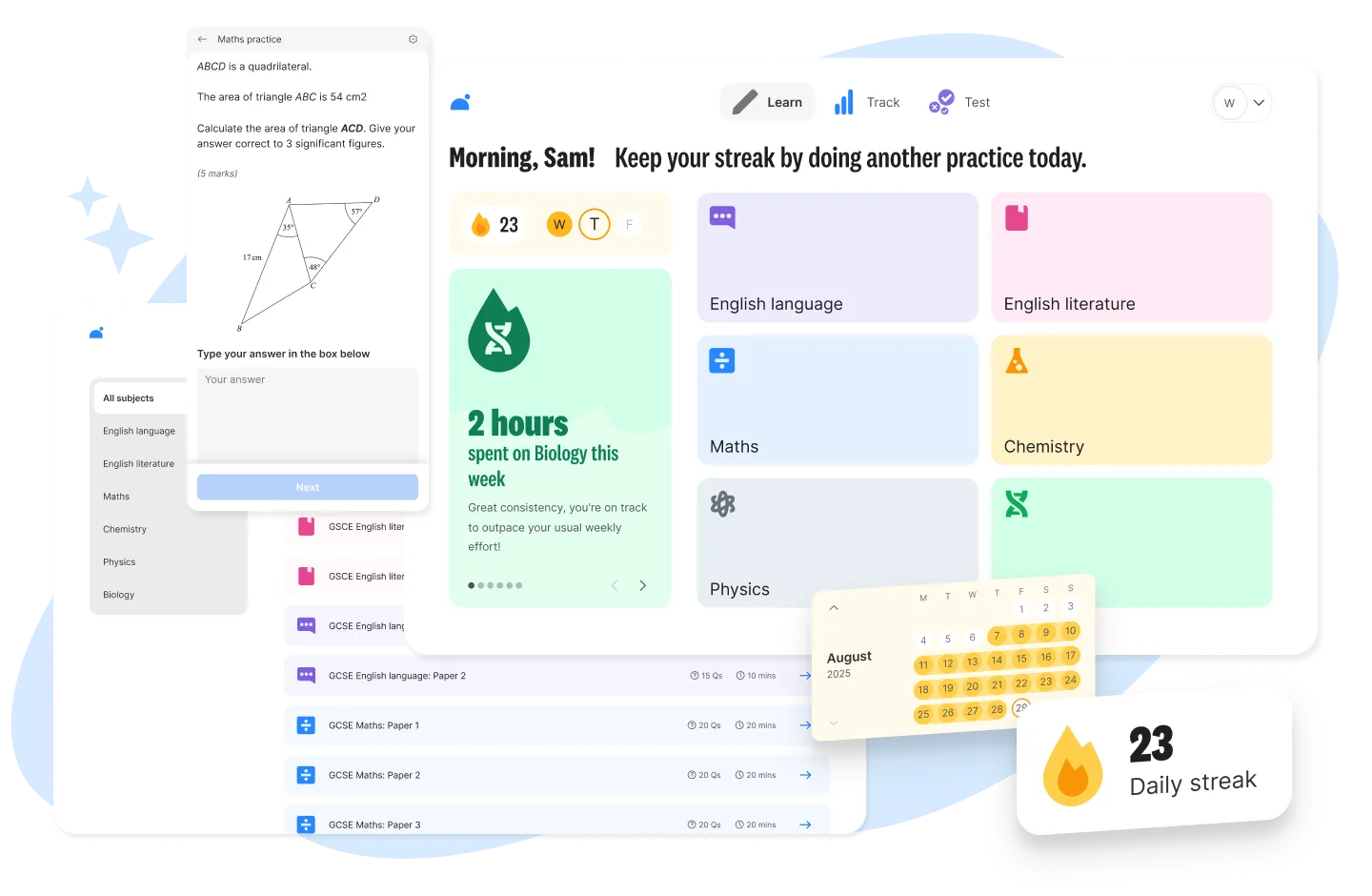
Top tip: Use your marked paper or teacher feedback to make a short list of your three or four weakest topics. Start there. On Atom, you can go straight to the specific topics you need to improve and practise questions at exactly the right level, rather than working through content you already know.
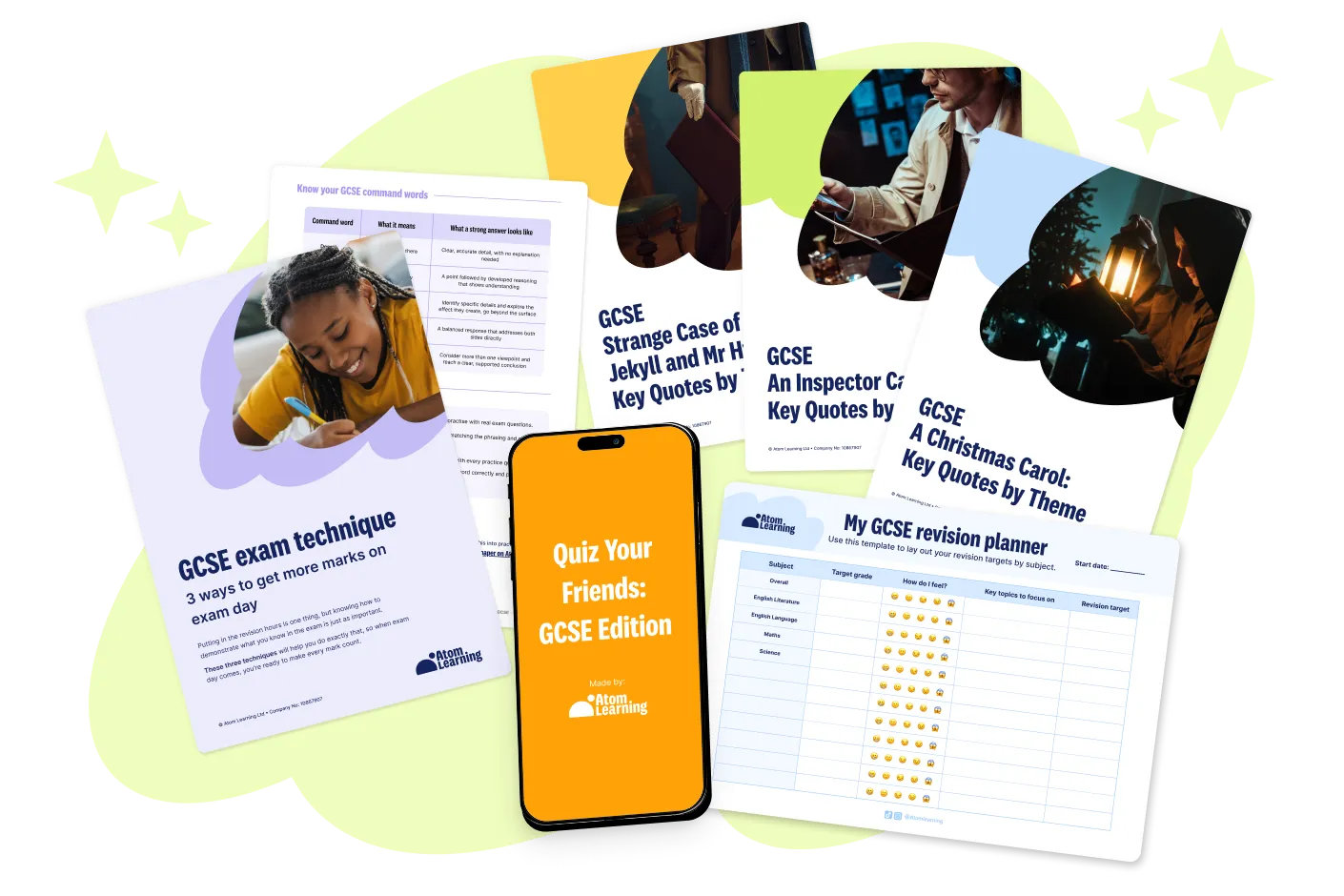
Not sure where to start with revision? We've got you.
From revision planners to formula sheets, we've got the tools to make revision feel a little less daunting.
Examiners follow a mark scheme very closely. The way you write your answer matters, not just whether you know the content. Look at model answers and the mark scheme for your subject and exam board so you know exactly what to include.
Top tip: Many exam boards publish "examiner reports" after each series. These are free to download and tell you the most common mistakes students make and how to avoid them. Atom gives you instant, examiner-style feedback after every single question, telling you exactly what you included, what you missed, and what you need to do to score higher.
Want to make sure your answers hit every mark? Download our free GCSE exam technique guide, three techniques to help you decode questions faster, write the right amount, and structure answers that score.
5. Build a study routine you can stick to
Revising little and often is more effective than cramming everything at the last minute. Short, focused sessions over several weeks help your brain hold on to information for longer.
Top tip: Even 20 to 30 minutes of focused revision each day adds up. Set a specific time each day, treat it like an appointment, and keep track of what you have covered so you can see your progress building. Atom's streak counter tracks your daily revision and shows your progress growing session by session, giving you a simple reason to keep showing up.
Ready to move forward?
Finding out you have not passed a GCSE is disappointing, and it is completely normal to feel that way. What matters is what comes next. Whether you decide to resit, try a different qualification, or take a new path altogether, there is a route forward that works for you.
If a resit is your next step, having the right support in place makes a real difference. Atom gives you practice questions and predicted papers tailored to your exam board, so you always know you are revising the right things. After every question, you get instant, examiner-style feedback that shows you exactly where you gained and lost marks. You can track your progress across every topic and see your predicted grade improve as you put the work in.