The Year 8 dip: why Year 8 can feel harder than Year 7

The Year 8 dip is the name some teachers, schools and survey organisations give to a drop in confidence, interest or results as children move from Year 7 into Year 8. It is a pattern schools recognise, it has understandable causes, and there are practical things you can do at home. This guide is for parents who have noticed a change in their 12 or 13 year old and want to know what is normal and what helps.
Key takeaways
- The Year 8 dip is a label for a pattern, not a diagnosis, and not every child goes through it.
- Pupil surveys and Ofsted's review of Key Stage 3 give some clues about why Year 8 can feel harder.
- At home it often looks like boredom, slower homework or "fine" as the answer to everything.
- Most dips ease with steady routines, and a few are worth raising with school.
- Year 8 sits well before GCSE courses, and there are no national tests in Years 7 to 9.
What is the Year 8 dip?
The Year 8 dip is a dip in motivation, confidence or grades that some children experience between Year 7 and Year 8. Teachers and researchers use the phrase loosely, so there is no official definition and no single test for it.
Year 8 is the middle year of Key Stage 3. That is the stage covering Years 7, 8 and 9 (ages 11 to 14), the three years between primary school and GCSE courses. If you want the full picture of what children study across those years, our Key Stage 3 explained guide covers it.
Not every child has a wobble in Year 8. If yours does, it helps to know that schools and surveys have noticed the same pattern.
Why does Year 8 feel harder than Year 7?
There is no single proven cause, but a few things can combine to make Year 8 feel flatter or harder than Year 7.
- The newness has worn off. In Year 7 there is a new building, new friends, new teachers and a new timetable. By Year 8, school is just school, and that spark can fade.
- The work can change. Ofsted's 2015 review of Key Stage 3 found that some pupils were repeating work from primary school in Years 7 and 8. Headteachers told inspectors this could lead to "a dip or plateau in progress". In Year 8, the content may feel properly new for the first time.
- More is expected of your child. More subjects, more homework from more teachers, and less checking up from adults. Our guide to how much homework Year 7 should get shows how quickly that builds.
None of these is a fault in your child. They are features of a big change that happens at roughly the same age for everyone.
Is the Year 8 dip real? What does the evidence say?
There is some evidence that Year 8 pupils report a less positive experience than Year 7 pupils, though it does not tell us what is happening for any one child. Here is what two sources show.
What does the Edurio pupil survey say?
Edurio, a company that runs surveys for schools, asked 157,468 secondary pupils about their experience of school in the 2024/25 academic year. It found that 60% of Year 7 pupils say their teachers explain work clearly. In Year 8, that falls to 45%, and it stays at around that level in later years. Edurio also reports that the share of pupils who say they feel safe in class is lower after Year 7 than in it.
These are averages across many pupils, comparing year groups. They do not tell you why the numbers change, or how your own child feels. They are a useful sign that what your child is noticing is not unusual.
What did Ofsted say about Key Stage 3?
In September 2015, Ofsted, the schools inspectorate for England, published a report called "Key Stage 3: the wasted years?". It looked at Years 7 to 9 as a whole and does not use the phrase "Year 8 dip".
Inspectors found that progress in Key Stage 3 was often slow, particularly in English and maths. They also said the move from primary to secondary was not always handled well enough, and that homework quality was too variable. Ofsted asked secondary schools to give Key Stage 3 more priority.
The report is more than ten years old, so take it as background rather than a picture of schools today. It does show that people who work in education have been paying attention to these years for a long time.
Atom for Years 7-9 is coming this November.
Built to keep your child on track for top sets and GCSE success. Join the waitlist for early access.

What does the Year 8 dip look like at home?
At home, the dip often looks like a change in attitude rather than a dramatic event. You may notice:
- "Fine" or "nothing" as the answer to every question about school.
- Homework that takes longer, or gets left until the last minute. For example, maths homework due on Thursday is started at 9pm on Wednesday.
- Comments such as "this is boring" or "what's the point of this?"
- A teacher described as "rubbish" or "can't explain anything".
- Less enthusiasm for clubs or subjects they used to enjoy.
- Grades or comments that are slightly lower than in Year 7.
Changing moods are also a normal part of the teenage years. The NHS notes that many changes parents see can be put down to normal teenage behaviour, so one grumpy week is not a cause for alarm.
When is it normal, and when is it worth talking to school?
A dip is usually normal when it is gradual, affects a few subjects and comes with ordinary teenage ups and downs. It is worth talking to school when something is more sudden, more serious or does not ease.
It is worth getting in touch if:
- One subject has changed sharply while the others are steady.
- Your child is reluctant to go to school, or has mentioned problems with other pupils.
- Reading, writing or organisation seems to be a real struggle. If you think your child may have special educational needs, contact the SENCo (special educational needs co-ordinator) at their school.
- Low mood or sadness is not going away. The NHS advises talking to your child, asking the school whether staff have concerns, and booking a GP appointment if you are worried.
A form tutor or head of year is usually the best first contact. Our guide to getting the most out of parents' evening has questions you can take along.
What can parents do about the Year 8 dip?
Small, steady habits help more than big talks. Here are six to try, each with an example.
1. Ask about one thing, not everything
Open questions about specific moments get further than "How was school?". Try "What was the most interesting thing you did in science this week?" or "Which lesson dragged today?"
Top tip: The NHS advises avoiding persistent direct questioning when you are worried about a teenager, as it can make them feel threatened. Ask one question at a relaxed moment, like in the car or while cooking, then leave it.
2. Give homework a regular slot
A fixed time and place takes away the daily negotiation. For example, homework happens at the kitchen table at 5pm after a snack, with phones in another room.
Our 5 tips to build an effective study routine has more ideas.
3. Do a five-minute planner check on Sunday
Look together at what is due this week. Ask "which one will take longest?" and put that first. This builds the planning skills Year 8 starts to expect from students, without you doing it for them.
4. Ask the teacher one specific question
A short email works well: "Maths has become harder for Sam this term. Is there one topic you would suggest we focus on?" It is easier for a teacher to answer than a general worry.
5. Notice and name small wins
Say what you saw, not "well done". For example: "You started your French homework without being asked on Tuesday." Specific comments show your child you are paying attention to what they do, not just their results.
6. Check the basics
Tiredness, hunger and friendship worries can all make school feel flat, so it is worth looking at the whole day. Ask about the parts that are not lessons, for example "Who did you sit with at lunch?", and keep a regular bedtime. Our guide to getting into a school-night sleep routine has ideas.
How does the Year 8 dip connect to GCSE options and Year 9?
GCSE courses belong to Key Stage 4 (Years 10 and 11), and there are no national tests in Years 7 to 9. GOV.UK lists national tests in earlier years and GCSEs in Years 10 and 11, but none for Key Stage 3. A wobble in Year 8 is not a fixed point on the way to GCSE.
Before GCSE courses begin, your child will choose their options, the subjects they study beyond the compulsory ones. The timing varies by school, so ask yours when the process begins. At GCSE, English, maths and science are compulsory, and schools must offer at least one subject from each of four areas: arts, design and technology, humanities and modern languages.
Ofsted also recommended careers guidance from Year 8 onwards. If your child seems unsure what the point of school is, a chat about what they might enjoy doing later can help. Our guide to how to choose your GCSE subjects is a good next read.
A calm routine, a few good questions and a steady line to school are often enough to help a child find their feet again.
Take control of the years that shape GCSE success.

Everything you need to support Years 7, 8 and 9, in one place.
Over 350,000+ families already trust Atom for 11+ and GCSE. Now we're bringing the same support to Years 7-9, the years that set the pace for everything after.
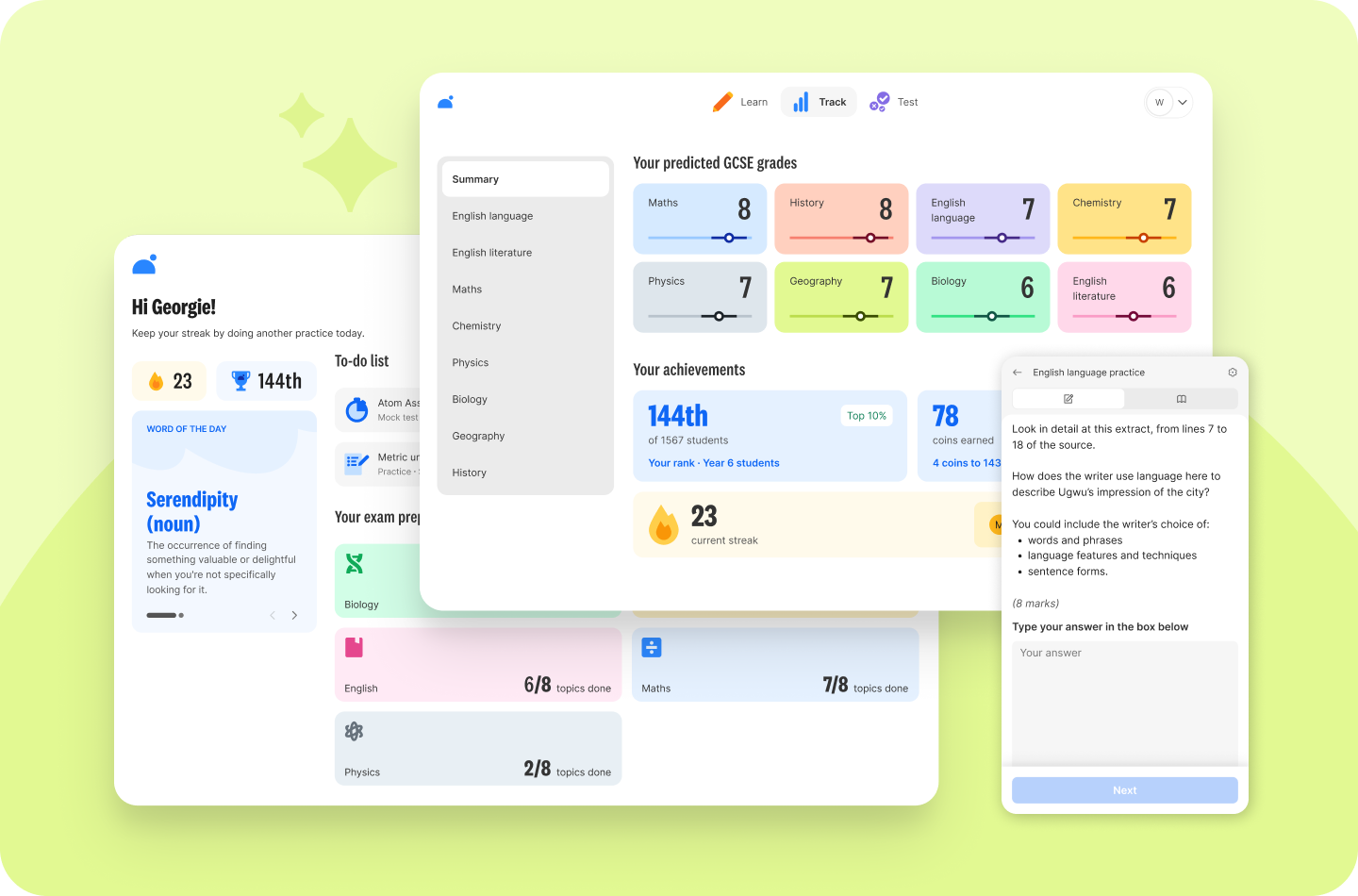
📄 Topic-by-topic practice across Maths, English, Biology, Chemistry and Physics, so you always know exactly what's covered
🎓 Guided learning that meets your child where they are, whether that's reaching top sets or building confidence in weaker subjects
✍️ Instant feedback on every question, including full written answers
📊 Personalised weekly goals and topic-by-topic progress tracking
Join the waitlist now for early access, ahead of the November launch.