

Back to blog

11+ exam pressure: how to prepare your child without it becoming harmful

By
Atom
|
April 13, 2026

Most articles about the 11+ tell you how to get your child ready for the exam. This one is about something different: how to do that without the preparation process becoming something you and your child will both look back on with dread.

This worry is more common than you might think. It surfaces in nearly every honest conversation about the 11+, in forums, school playgrounds, and the searches parents type at 11pm. Not "are we doing enough?" but "are we doing too much? Are we damaging something?"

One parent put it plainly on Mumsnet:

"I didn't want to aggressively tutor my child. I knew she wouldn't agree to intense prep anyway, and I wasn't sure I wanted to do that to her even if she would."

Another described the extreme end of what can happen:

"He did say that we wouldn't love him as much as if he didn't pass."

That sentence is the thing most parents are quietly trying to avoid. For some families, the way preparation is handled creates exactly that kind of damage: a child who begins to measure their own worth by whether they pass or fail.

Why the 11+ creates particular pressure

The 11+ is unusual among childhood experiences in a few specific ways that make it more likely to cause harm if handled badly.

Firstly, it is high stakes and highly visible. Unlike a school test that comes and goes, it produces a binary outcome that shapes secondary school options in ways the child can clearly see and feel.

Secondly, it sits in a developmental stage (ages 9 to 11) when children's self-concept is forming and when failure is felt particularly acutely. A child who internalises "I'm struggling with this exam" as "I'm not clever enough" is absorbing a message at an age when it sticks.

It also runs through the family, not around it. Unlike an exam a child sits at school, 11+ preparation typically happens in the home, mediated by parents. There is no separation between the child's preparation and the parent's anxiety.

What the evidence on pressure and performance actually shows

The research is consistent: moderate challenge improves performance, but high anxiety gets in the way of it. The children who perform best in competitive exams are not those who have been pushed hardest. They are those who arrive feeling confident, capable, and relatively calm.

A child who has spent years preparing under intense pressure may know the material inside out and still underperform on the day, simply because anxiety makes it harder to think clearly. The preparation approach that builds and protects confidence isn't the softer option. It's the smarter one.

What proportionate preparation looks like

Short daily sessions rather than intensive blocks.

16 minutes a day is 100 hours of practice a year. That is not a compromise; it is the most effective preparation format!

A child doing 16 minutes before dinner on a school night has not sacrificed a meaningful portion of their day. A child doing three hours on a Saturday has, and while the total hours might look similar over time, the experience of getting there is completely different. One builds a quiet habit. The other turns weekends into something to dread.

Progress tracking that builds confidence rather than revealing inadequacy.

Seeing a score that feels like a verdict on ability is one of the most anxiety-producing features of traditional practice paper preparation.

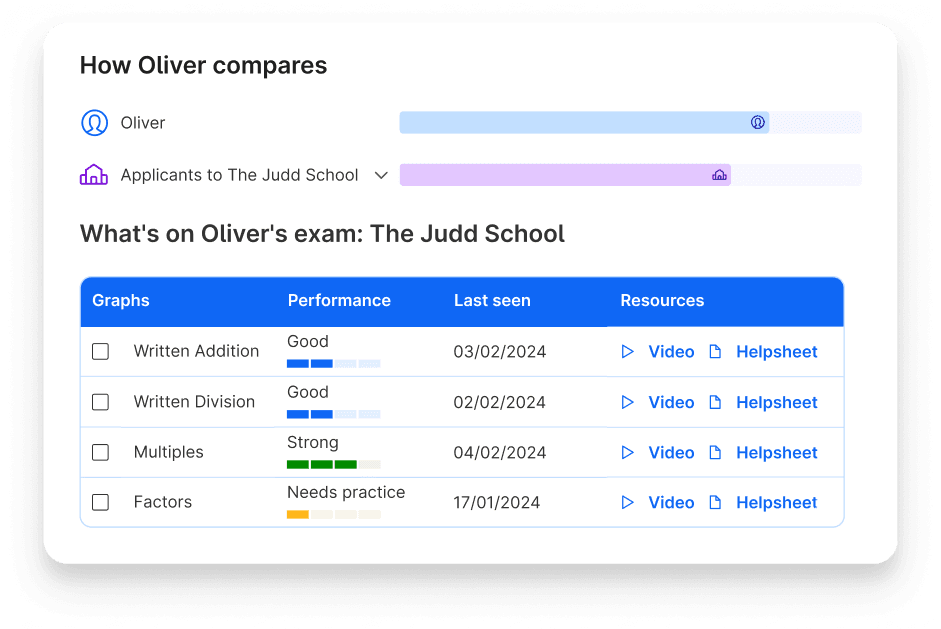
Progress tracking that shows a child what they've mastered, where they're improving, and what to focus on next is qualitatively different from a raw score. One builds agency; the other often builds dread.

Don't give up the things that matter.

Football. Music practice. Time with friends. Unstructured play. These are not things to sacrifice to the 11+: they are the conditions under which a child's brain consolidates learning and remains emotionally regulated. The families describing the healthiest 11+ experiences are those where preparation happened around life, not instead of it.

One parent on our survey said:

"We kept all her clubs and didn't change our family routine. Atom fitted around everything else. She didn't feel like the 11+ was consuming her, and I think that's why she was so calm on exam day. She knew the work. She wasn't dreading it."

Separating preparation from parental anxiety.

It's easy for 11+ preparation to quietly become about what makes you feel better — doing more, buying more resources, adding another session. That's not a criticism; it's human. When the stakes feel high, action feels like control.

But more isn't always better for your child. The families who look back most positively on the process are often those where a parent noticed the moment preparation started serving their own anxiety rather than their child's needs and pulled back.

A useful question to return to: is this next thing for them, or for me?

How to talk to your child about the 11+

Be honest about what it is (a way of finding out whether a particular school is a good fit) without framing it as a test of worth. "We're going to practise some things so you feel ready" is different from "you need to get this right."

Separate the outcome from the relationship explicitly and repeatedly. Children who develop exam anxiety often do so because they worry that the result matters to their parents' opinion of them. Making it explicit, more than once, that they are loved and valued regardless of what happens on the day is what makes the preparation possible, not what undermines it.

Celebrate progress, not just performance. A child who couldn't do a question type in September and can now do it has achieved something real and worth naming. The exam is in the future. The progress is happening now.

No items found.

When preparation starts to erode confidence

Sometimes the anxiety isn't the parent's — it's the child's. The preparation process itself, particularly when conducted using traditional methods, can quietly erode the very confidence you most need them to have.

Here's how to recognise it and what actually helps.

Why 11+ prep erodes confidence in some children

Practice papers produce visible, repeated failure — especially early on. A child working through a Bond book in October will get many questions wrong. This is expected; it's the start of a process. But a child doesn't experience it that way. They don't think "this is normal for where I am right now." They think "I can't do this." For children whose sense of self is tied to being good at school, that feeling is particularly destabilising.

Comparison to peers makes it worse. Children know others are preparing, and without any objective sense of where they actually stand, the comparison they make is between their own recent failures and an imagined peer who never gets anything wrong.

What doesn't help — but is often the instinct

Reassurance without evidence won't land. A child who knows they're struggling won't be convinced by "you're so clever, I know you can do this." Increasing intensity, doing more of the same thing that's producing the problem, doesn't fix it either. Abruptly stopping preparation creates its own anxiety: the sense that the parent has given up on them entirely.

Most of the time, what a child needs isn't more or less preparation. It's a clearer sense of progress, and a parent who seems calm about the process.

What actually rebuilds confidence

Making progress visible, in specific and objective terms, is the single most consistent finding in our review data.

A child who can see that they scored 42% on a topic in October and 71% in December has real evidence that they are capable of improvement. That evidence cannot be dismissed the way verbal reassurance can.

It's why parents using tools like Atom, which breaks down exactly where a child needs to focus and structures the work around that, describe a shift in how their child relates to the work. As one parent whose daughter got into Bacup and Rawtenstall Grammar put it:

"Atom Learning made it so easy to target development areas and structure the learning to her tailored needs. It was a calm in the storm we needed."

Sometimes the most effective thing you can do is change how your child is practising, not how much. A child who has switched off from workbooks but responds to a different format hasn't failed; they've just found that one approach doesn't suit them.

The same goes for difficulty level. If every session feels overwhelming, a child stops believing they can improve. Starting with material they can actually succeed at, then gradually building up, does more for their confidence and their results than pushing harder on something that isn't working.

One parent on our survey put it best:

"When I stopped treating every wrong answer as something to fix and started treating it as information about what to practise next, her whole relationship with prep changed. She stopped being scared of getting things wrong."

The prize outlasts the exam

What's really being built through this process isn't just exam readiness. A child who shows up consistently for something difficult, who learns that sustained effort actually works, carries that with them long after results day.

The preparation approach that builds this is consistent, daily, and emotionally honest. It isn't pressure-free — there is genuine challenge involved. But it's proportionate, and it leaves the relationship between parent and child intact.
No items found.
No items found.
No items found.
No items found.

Help your child ace the 11+

Get the pass mark you need with Atom Home – the leading exam platform for grammar and independent schools.

Watch your child's scores soar

Join 100,000+ families who trust Atom to help their children excel in Key Stage 2 and entrance exams. Endorsed by grammar schools, loved by parents.

Get started today

Contents