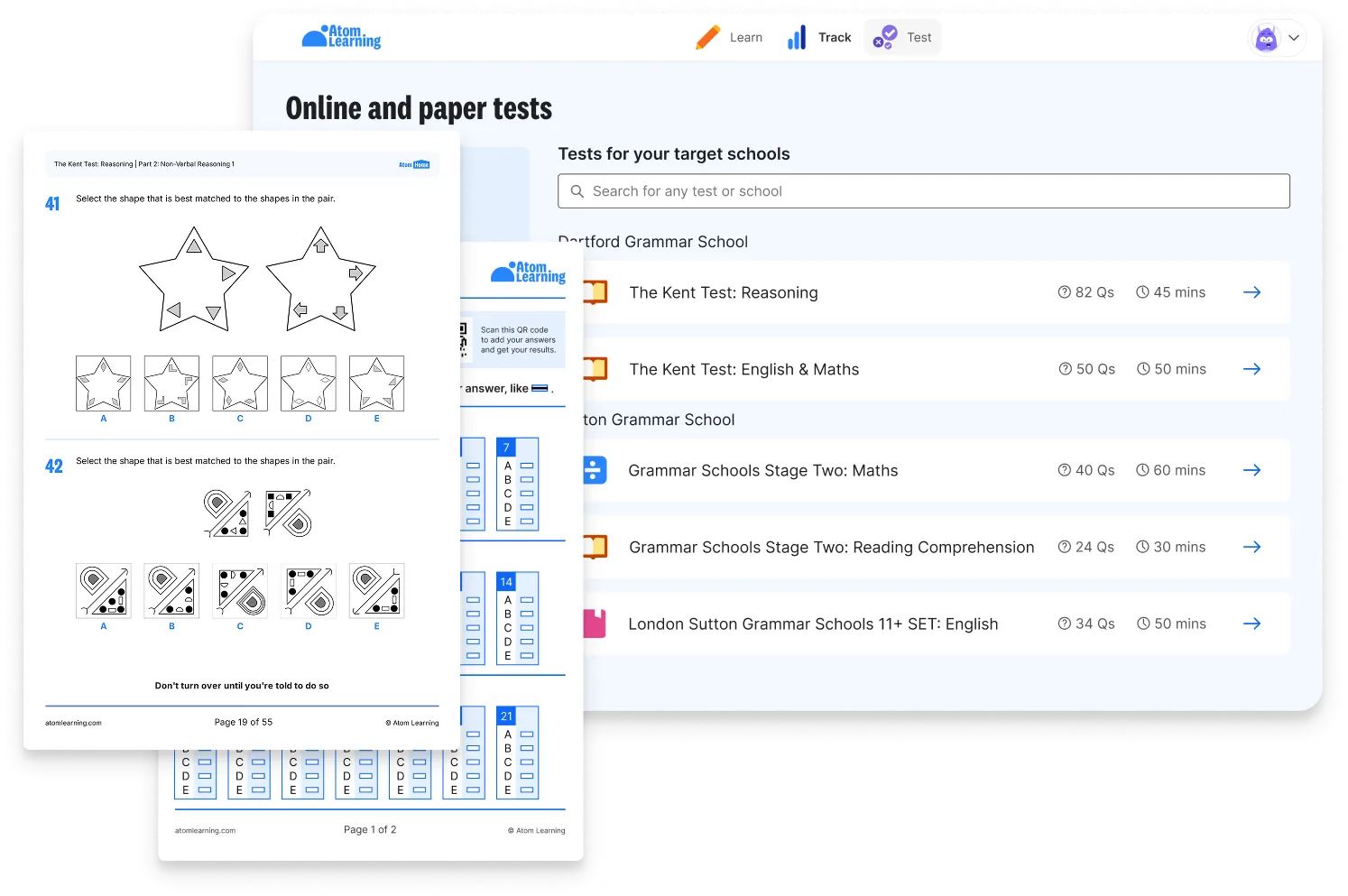
If your child is sitting an adaptive 11+ or entrance test, it helps to know how it works before exam day, so nothing about the format catches them off guard. Most grammar school papers are fixed: every child answers the same questions in the same order. A growing number of 11+ and independent school entrance tests work differently. They're adaptive, meaning the questions your child sees are chosen one at a time, based on how they've just answered.
Understanding this now means you can help your child prepare with confidence. On an adaptive test, the first ten or so questions matter most, because they set the difficulty band the rest of the exam explores.
Key takeaways
- Adaptive tests choose each new question based on the previous answer, unlike fixed-paper tests.
- The first 10 or so questions matter most, because they set the difficulty band the rest of the test explores.
- A shaky start doesn't cap the final score, but it does cost time getting back to harder, higher-scoring questions.
- Accuracy in the opening questions matters more than speed.
- Most adaptive tests, including ISEB's Common Pre-Test, don't allow skipping a question or going back to change it.
How is an adaptive 11+ test different from a fixed-paper test?
On a fixed-paper test, every child answers the same questions in the same order, whatever they've scored so far. Most grammar school papers still work this way: one printed paper, one fixed order, marked the same way for every child who sits it. For more detail on how this compares across exam boards, see Atom's GL Assessment 11+ guide.
An adaptive test responds instead. After your child answers a question, the system picks the next one based on whether they got it right: a correct answer leads to a harder question next, an incorrect one to an easier question. The test starts by estimating a suitable difficulty from the child's year group, then adjusts from there as it learns more about how they're doing.
This is what people mean by "adaptive learning" technology, used here in a testing context rather than a teaching one. The same underlying idea explains how adaptive learning works more broadly: the questions respond to the child in front of them, not a fixed script written in advance. Atom's own adaptive 11+ practice papers work the same way, so your child gets used to a test that responds to them long before exam day, whatever type of test they end up sitting.
Why the first 10 questions matter most
The system hasn't learned anything about your child yet, so it needs a handful of answers before it can judge, with any confidence, roughly where their ability sits. Those first responses decide which pool of questions the test explores next, whether harder, easier, or somewhere in between, and that decision shapes the difficulty band your child spends most of the rest of the exam working within.
ISEB, which sets the Common Pre-Test used by many senior independent schools, builds in some room for a nervy start: a child who answers the first couple of questions incorrectly and then settles down can still finish with a high score. What a shaky start does cost is time, since the test takes longer to work its way back to the harder, higher-scoring questions than if it had read your child's ability accurately from the start. A calm, accurate opening gets a capable child into the harder question pool faster, and gives them more of the exam to show what they can do at that level.