In this example, a child can't take both History and Computer science, because they sit in the same block. Some schools build the blocks around pupils' choices instead, by asking for preferences first and then designing the timetable. The options booklet will explain which approach your school uses.
Will my child get their first choices?
Not always. Subjects can be oversubscribed, a course may not run if too few pupils choose it, and timetable clashes happen. Schools usually ask for reserve choices for this reason. Treat reserves as real choices: make sure your child picks a subject would be happy to study, not a filler.
Can my child change their options later?
Often, but only for a short time. Many schools allow changes in the first few weeks of Year 10, if there's space in the new class. After that, changing usually means catching up on missed content. Ask about this at options evening.
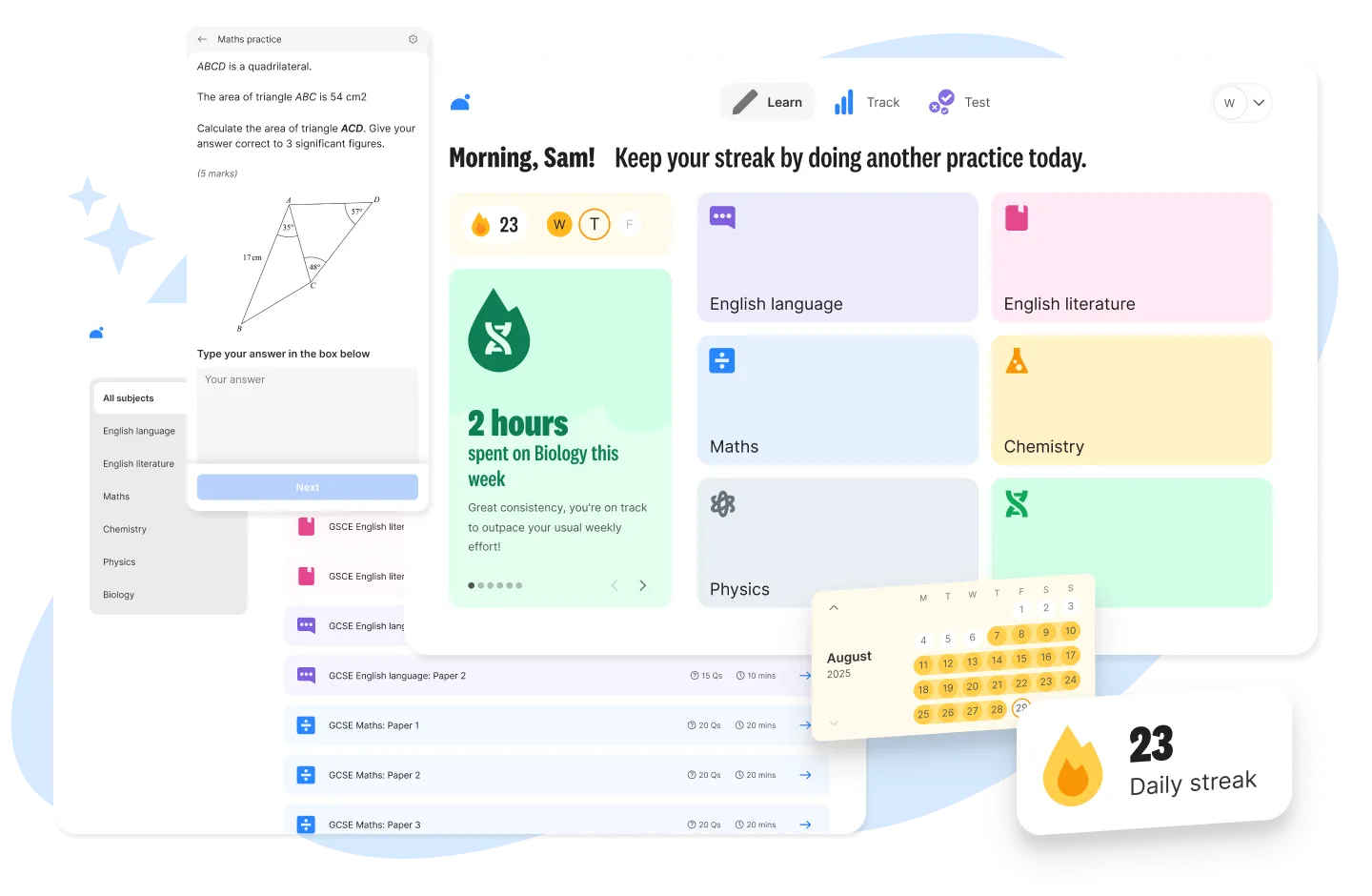
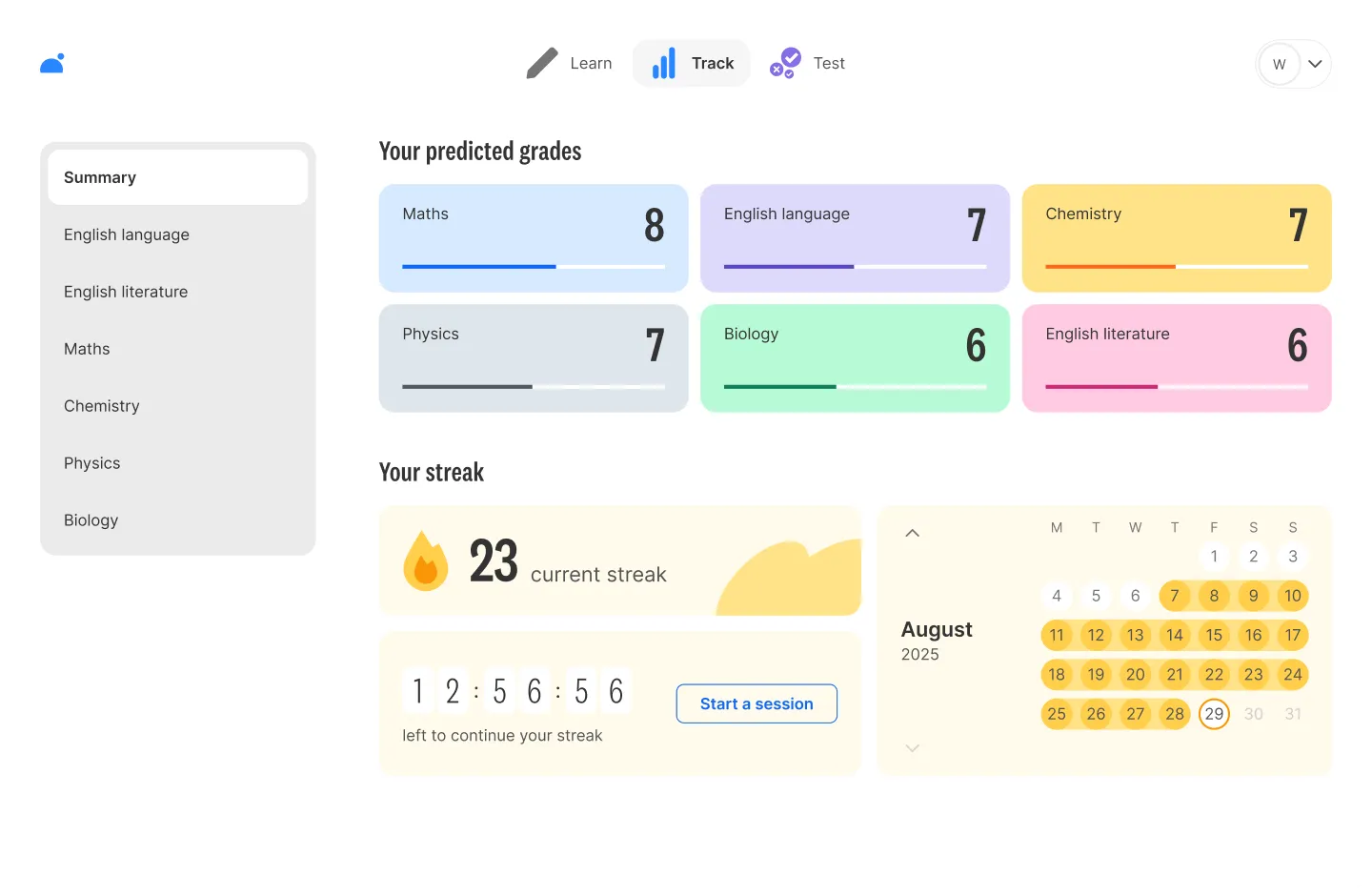
The start of Year 10 is also a good moment to set up steady GCSE habits from day one. Atom brings courses, practice questions and progress tracking for your child's exact exam boards into one place, so whether they're settling into their chosen subjects or catching up after a late switch, they can see where they stand in every subject from the first week.
What are GCSE tiers?
In some subjects, pupils are entered for either the Foundation or the Higher tier, which means sitting different papers. Tiers apply in maths, the sciences and modern foreign languages.
- Foundation tier covers grades 1 to 5. The questions are more accessible, but grade 5 is the highest grade available.
- Higher tier covers grades 4 to 9. The questions are harder, and a pupil who falls well short of grade 4 may not get a grade at all.
Tier decisions are usually made in Year 10 or 11, not at options time. It's still good to know about, because it can affect which A levels are an option later. Many sixth forms ask for a grade 6 or 7 in a subject before a pupil can study it at A level, and only the Higher tier makes those grades possible.
What is the EBacc, and does it still matter?
The English Baccalaureate (EBacc) is a set of subjects: English, maths, sciences, a language, and history or geography. For years, schools were measured on how many pupils took this combination, and many schools steered pupils towards it.
That's changing. Following the national Curriculum and Assessment Review, the government confirmed in November 2025 that it would remove the EBacc from school performance measures. It is also consulting on a new version of Progress 8, one of the main measures used to judge secondary schools. The proposal would require pupils' best subjects to include at least two from humanities, creative subjects and languages.
For your child, this means two things. Their school may feel less pressure to push a language or a humanity. A balanced mix is still a sensible choice for most children, though, because it keeps the widest range of sixth form and university courses open. Dropping every language and humanity at 14 closes more doors than it opens.
Are GCSEs changing?
Yes, but not for children currently in Year 9. The government plans to publish a revised national curriculum by spring 2027, for first teaching in September 2028. Updated GCSEs are due to be introduced in two phases, with first teaching from 2029 and 2030.
The government has also said that updated GCSEs will cut the time pupils spend in exams by 2.5 to 3 hours on average. A new computing GCSE is planned to replace computer science.
If your child is in Year 9 in the 2026 to 2027 school year, they'll start GCSEs in September 2027 and sit them in summer 2029, on the current courses. Children now in Year 7 are likely to be among the first to take updated GCSEs in some subjects. Ask your school how it's planning for this.
How should my child choose their GCSE options?
The best choices balance four things: what your child enjoys, what they're good at, what keeps future doors open and what the course actually involves. A subject that scores well on three of these is usually a good pick.
1. Enjoyment
Two years is a long time to study something your child dislikes. Enjoyment leads to effort, and effort shows in results. Ask: "Which lessons do you look forward to? Which do you dread?"
2. Evidence of ability
Look at what your child's results and teacher feedback actually say, not just how they feel about a subject this term. A Year 9 student who struggled with one topic may still be strong in the subject overall. Teachers can give a realistic view at options evening.
3. Future doors
If your child has a career or A level in mind, check whether it needs particular GCSEs. Most careers don't need specific GCSE options, but some routes are easier with them. For example, a child who wants to study a language at A level will usually need the GCSE. If your child has no idea yet, that's very common at 14, and a broad mix is the safest choice.
4. What the course involves
Subjects are assessed in different ways. Some are almost all written exams. Others include a large share of non-exam assessment, which means coursework or practical projects marked during the course. For example, in AQA GCSE Art and Design, the portfolio is worth 60% of the grade. Read the options booklet or ask the teacher how each subject is assessed, and think about how your child works best.
Which GCSE options might be new to my child?
Some GCSE subjects aren't taught in Key Stage 3, so your child will be choosing them without having tried them. These include psychology, sociology, business, media studies, statistics and classical subjects, depending on the school. Ask the subject teacher what a typical lesson and homework look like, and look at the exam board specification online. Our guide to how to choose your GCSE subjects has a subject-by-subject overview.
What mistakes should we avoid?
The most common mistakes come from choosing for the wrong reasons. Watch out for these:
- Following friends. Friends may end up in different classes anyway, and friendships change over two years.
- Choosing the teacher, not the subject. Your child may well have a different teacher in Year 10.
- Avoiding a subject just because it's hard. A difficult subject your child enjoys can still be the right choice. Ask the teacher whether the difficulty is temporary.
- Assuming a new subject is easy. Subjects like psychology and business have a lot of content and terminology.
- Leaving it to the last week. Start the conversation in the autumn term, so there's time to visit taster sessions and ask questions.
What should I ask at options evening?
Options evening is your best chance to get specific answers. Take a short list with you:
- How many options does my child choose, and how are the blocks arranged?
- Are first choices guaranteed? What happens if a course is oversubscribed?
- How is this subject assessed? What share is coursework or practical work?
- What does a typical week of homework look like in this subject?
- Based on what you've seen, how is my child likely to do in this subject?
- Which subjects do your sixth form, or local sixth forms, require for the A levels my child is interested in?
- How is the Triple Science decision made?
- Can my child change subjects in Year 10, and until when?
How can I help my child decide without taking over?
Your child will be more committed to choices they've made themselves. Your job is to ask good questions and make sure they have the facts, not to decide for them.
Try these conversation starters:
- "If you could only keep three subjects, which would they be, and why?"
- "Which subject would you miss most if it stopped next year?"
- "Is there anything you're interested in doing after school that we should check?"
- "What would change your mind about this subject?"
If you disagree with a choice, ask your child to make the case for it, then talk to the subject teacher together. Often the conversation shows whether a choice is well thought through.
Where can we get careers advice?
Your child's school must provide independent careers guidance from Year 7. Schools must also give colleges, apprenticeship providers and other education and training providers the chance to talk to all pupils in Years 8 to 13. Ask the school's careers leader what's available in Year 9. The National Careers Service also has free tools for exploring jobs and the subjects they involve.
How much do GCSE results matter?
GCSEs matter, but they aren't all-or-nothing. The Department for Education describes grade 4 as a "standard pass", and grade 5 in English or maths as a "strong pass". Our guide to whether a grade 4 is a pass explains what that means in practice.
English and maths matter most for what comes next. Students who stay in education after 16 without at least a grade 4 in these subjects carry on studying them. Full-time students with a grade 3 must keep studying towards the GCSE.
For options, the useful takeaway is this: no single choice decides your child's future. Choose a balanced set of subjects your child can commit to, and the grades tend to follow.
How can Year 9 set up a good start to GCSEs?
The most useful thing your child can do, right from the start of secondary school in Year 7, is build secure foundations. GCSE courses build directly on Key Stage 3, especially in maths, science and English. A topic that never quite clicked in Year 7 or 8, such as algebra or writing an analytical paragraph, is much easier to fix early than in the middle of Year 10. Atom supports this across the early secondary years, spotting gaps as they appear and building on them steadily, so by Year 9 your child is strengthening what they know rather than catching up.
Once options are confirmed, a calm summer before Year 10 helps more than an early start on revision. When GCSEs begin, our GCSE revision timetable can help your child plan from the start.
Choosing options is one of the first big decisions your child makes about their own education. With good information and a few honest conversations, most families find it's a decision they make well.