What a realistic weekly routine looks like
There's no single hours-per-week figure that fits every student, every subject mix, and every stage of the course, so treat any number you see online with caution. What matters more is the shape of the week: short, regular sessions spread across several days, with topics revisited rather than each one revised once and left.
In Year 10
Year 10 is about building the habit, not piling on hours. Content is often still being taught, so revision at this stage is mostly about consolidating what you've covered in class and getting comfortable with self-testing, rather than working through entire subjects. Our Year 10 GCSE preparation guide covers this stage in more detail.
A steady handful of short sessions across the week, rotating between subjects rather than staying on one for hours at a time, is enough to build the routine without it taking over evenings and weekends.
In Year 11
Year 11 is when revision needs to grow, but gradually, not overnight. As mocks and coursework deadlines arrive, sessions naturally become more frequent and start covering more ground. The aim is a routine that scales up in steps across the year, not one that suddenly appears in the spring term.
The routine that worked in September will need to change by exam season, and that's expected rather than a sign anything has gone wrong.
Signs you're doing too much, or too little
Under-revising tends to look like this: leaving whole topics until the last few weeks, avoiding past questions because they feel too hard, or being genuinely surprised by what comes up in a mock. If you can't say roughly what a subject's mock covered afterwards, that's a useful signal to revisit your routine.
Over-revising looks different. It's hours that push out sleep, friends, or exercise, a sense of being permanently tired, or revising the same comfortable topics again and again while avoiding harder ones. Doing more hours without seeing any improvement is often a sign the method needs to change, not that you need to do even more of it.
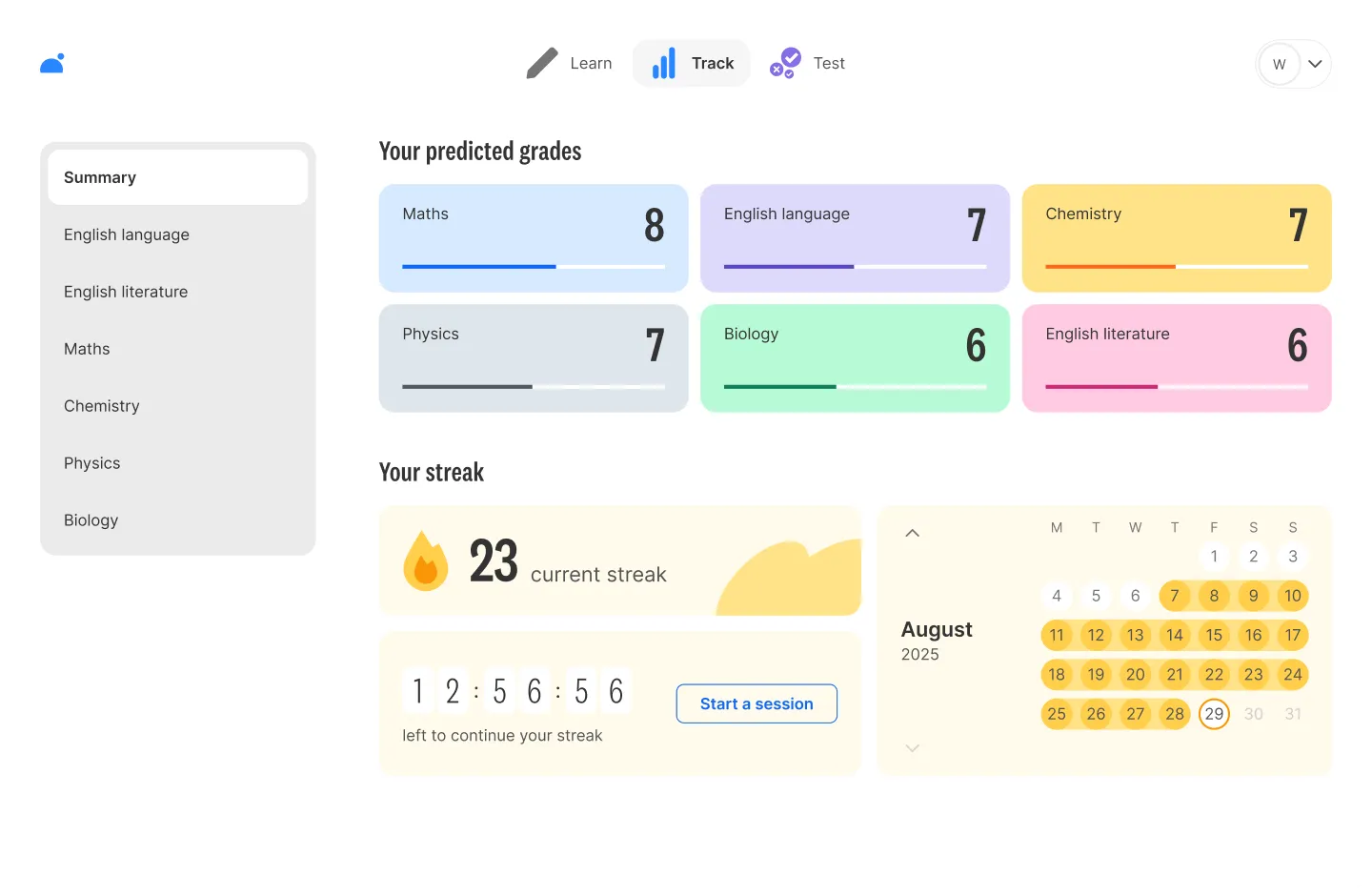
Past papers are one of the clearest ways to check whether a routine is actually working. If your marks on practice questions are improving over time, your revision is doing its job, whatever the number of hours behind it. Atom's progress tracker pulls this together automatically, showing which topics are moving and which aren't, so you can find the right balance without having to guess.
Adjusting your revision as exams approach
A routine set up in September won't look the same by May, and it shouldn't. Our month-by-month guide to when to start revising for GCSEs sets out how this shift tends to happen across the year.
Mock exams are usually the first real checkpoint. They're a chance to see which topics need more attention before the real exams, not a verdict on how the whole course is going. Use the results to rebalance time towards weaker topics rather than repeating what you already know well.
Closer to the real exams, sessions often become more frequent, but the same principles still apply: short, focused, and spaced across topics rather than one long block on a single subject.
5 ways to make your revision time count
1. Use past papers as your measure, not the clock.
Time spent revising is hard to judge from the outside, including by you. Marks on practice questions over time are a far clearer sign of progress than hours logged.
Top tip: Atom tracks your marks on every practice question over time, so you can see straight away whether your revision is actually paying off, not just how many hours you've put in.
2. Rotate topics instead of finishing one before starting the next.
Mixing related topics across a session, rather than working through a subject start to finish, helps information stick and mirrors how questions are actually mixed in exams.
Top tip: Atom's topic-by-topic tracker flags exactly where you're weakest, so you always know which topic to rotate to next.
3. Test yourself before you reread.
Trying to recall an answer first, then checking it, works better than reading notes over again, even when it feels harder in the moment.
Top tip: Atom gives instant, examiner-style feedback on practice questions, based on real mark schemes, so you know straight away what to fix.
4. Build in space, not just sessions.
Revisiting a topic after a few days, then again after a couple of weeks, makes it stick far better than one long session on it and then moving on for good.
Top tip: Atom's courses follow your exam board's own specification, so topics naturally come back around as you progress, building the spacing in for you.
5. Review your routine every few weeks, not just at half term.
What worked in September may need adjusting by December, and what works in December won't be the same in the spring.
Top tip: Atom's grade predictions update as you go, so it's easy to spot when your routine needs to shift well before half term forces the issue.
There's no single number of hours that guarantees a top grade, but a steady routine that grows as your exams get closer, built around testing yourself and spacing topics out, will get you further than any amount of cramming.