
Is my child on track for the 11+? A clear guide for Year 4 parents

By Year 4, most parents have moved past "should we be thinking about the 11+?" and arrived at a harder question: “We're doing something, but is it enough?”
There's no school report that answers that. No official benchmark that tells you where your child stands. This guide does.
Why 'on track' is the wrong question and what to ask instead
The problem with "Is my child on track?" is that it implies a single standard against which every child can be measured. In reality, there isn't one.
The 11+ is not a curriculum test. It's a competitive admissions process. Whether your child is on track depends on which school you're targeting, how selective it is, and what your child's current level is relative to the likely cohort. The bar isn't the same everywhere; some schools are significantly more competitive than others, and preparation needs to reflect that.
The better questions and the ones that are actually answerable are:
- Where is my child right now in English, maths, verbal reasoning, and non-verbal reasoning, relative to the standards required by our target schools?
- Where are the gaps, not just which subjects are weaker, but which specific topics within those subjects need more work?
- Are we making progress, not compared to other families, but compared to where my child was three months ago?
- Do we have a clear plan? One that covers the full curriculum, adapts to my child's specific needs, and leaves enough time before exam day?
These are the questions Atom Home is built to answer. The rest of this guide will walk you through each one.
What 'Year 4 readiness' actually looks like
Rather than a fixed standard, think of Year 4 readiness as a set of foundations. A child who has these in place is well-positioned to move into structured preparation. If there are gaps, that's not a problem; it's a starting point.
English
The 11+ English paper tests a child's ability to read carefully, understand at a surface and inferential level, and respond to questions about a passage. In Year 4, the foundations to look for are:
- Reading widely and regularly, fiction and non-fiction, a range of genres and styles.
- The ability to talk about what they've read: what happened, why characters made choices, and what might happen next. This is the everyday version of the inference skills that the 11+ tests directly.
- Beginning to develop a broad vocabulary, encountering new words through reading and being curious about what they mean.
To help build vocabulary without it feeling like revision, try Atom's Vocab Word of the Day, a simple, low-pressure way to introduce and improve your child's vocabulary.
- Writing in structured sentences with reasonable punctuation. Creative writing confidence is a bonus, not a requirement at this stage.
If reading has been a consistent habit since Year 3, your child is already building these skills. If it hasn't, Year 4 is a very good time to establish it.
Finding the right books at the right level makes a real difference to whether the habit sticks. Looking for inspiration? Browse our 100 books every 7–9 year old should read, a hand-picked collection to help you find the right read for your child right now.
Maths
11+ maths tests the Key Stage 2 curriculum up to and including Year 6 content. In Year 4, children are working through the middle section of that curriculum, which means there is still a significant amount left to cover.
The foundations to look for:
- Times tables up to 12×12, secure and quick to retrieve. This is the single most important foundation in maths at this age.
- Confident mental arithmetic, including addition, subtraction, multiplication and division with two and three-digit numbers.
- Beginning to work with fractions, decimals and simple percentages.
- Approaching problems with curiosity rather than anxiety. A child willing to try an unfamiliar question, regardless of whether they get it right, has a significant advantage over one who shuts down.
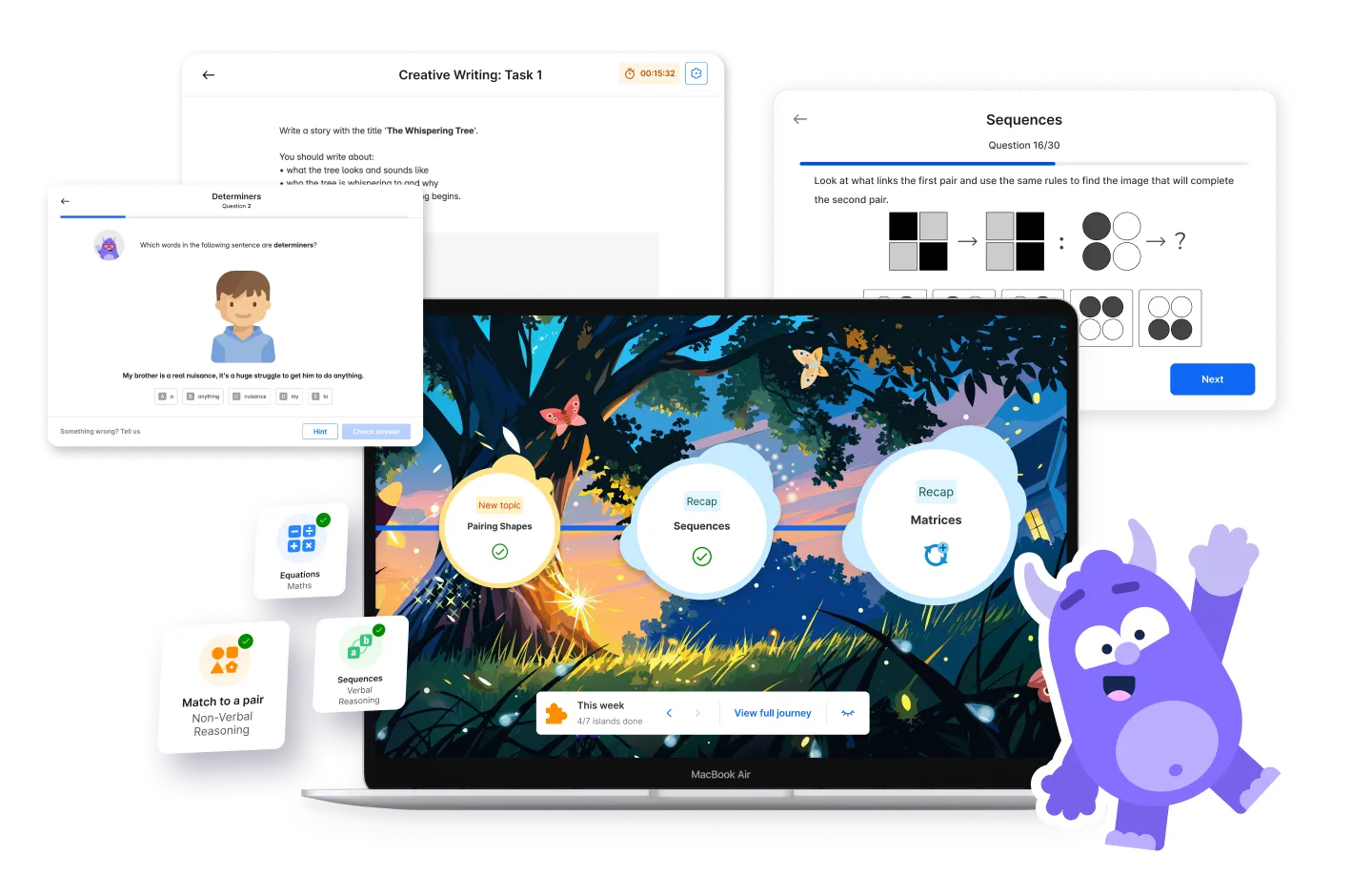
Atom Home's learning islands break the maths curriculum down into specific, concept-level topics. Rather than telling you your child is "good at maths" or "struggles with maths", the platform tells you exactly which topics are secure and which need more work. That granularity is what makes targeted preparation possible at this stage.

Verbal reasoning
Verbal reasoning tests your child's ability to solve problems using words, letters and language patterns. It isn't taught in primary school, so most Year 4 children have never encountered it.
It is entirely learnable, and the children who do well are those who have had enough time to build genuine familiarity with the question types through regular exposure. The earlier your child starts, the more time they have to build that familiarity naturally.
When your child tries a question type for the first time, the goal isn't to get it right. It's just to have a go. Encouraging that willingness to try, guess, and learn from the answer is the most valuable thing you can do at this stage.
Non-verbal reasoning
Non-verbal reasoning (logical problems using shapes, patterns and diagrams) follows the same logic. It isn't taught in primary school, but it's learnable. The skills it draws on are ones all children can build with practice: spatial awareness, pattern recognition and logical thinking.
Atom introduces both verbal and non-verbal reasoning from the start, building each question type from first principles. Your child does not need to have seen any reasoning questions before they begin. Their personalised exam prep plan will introduce each type progressively, adapting the pace to your child's level.
How Atom answers the question for you
"Is my child on track?" is hard to answer at this stage because most parents rely on instinct rather than information. Atom changes that by giving you a clear, up-to-date picture of exactly where your child stands across every tested subject.
A personalised exam prep plan from day one
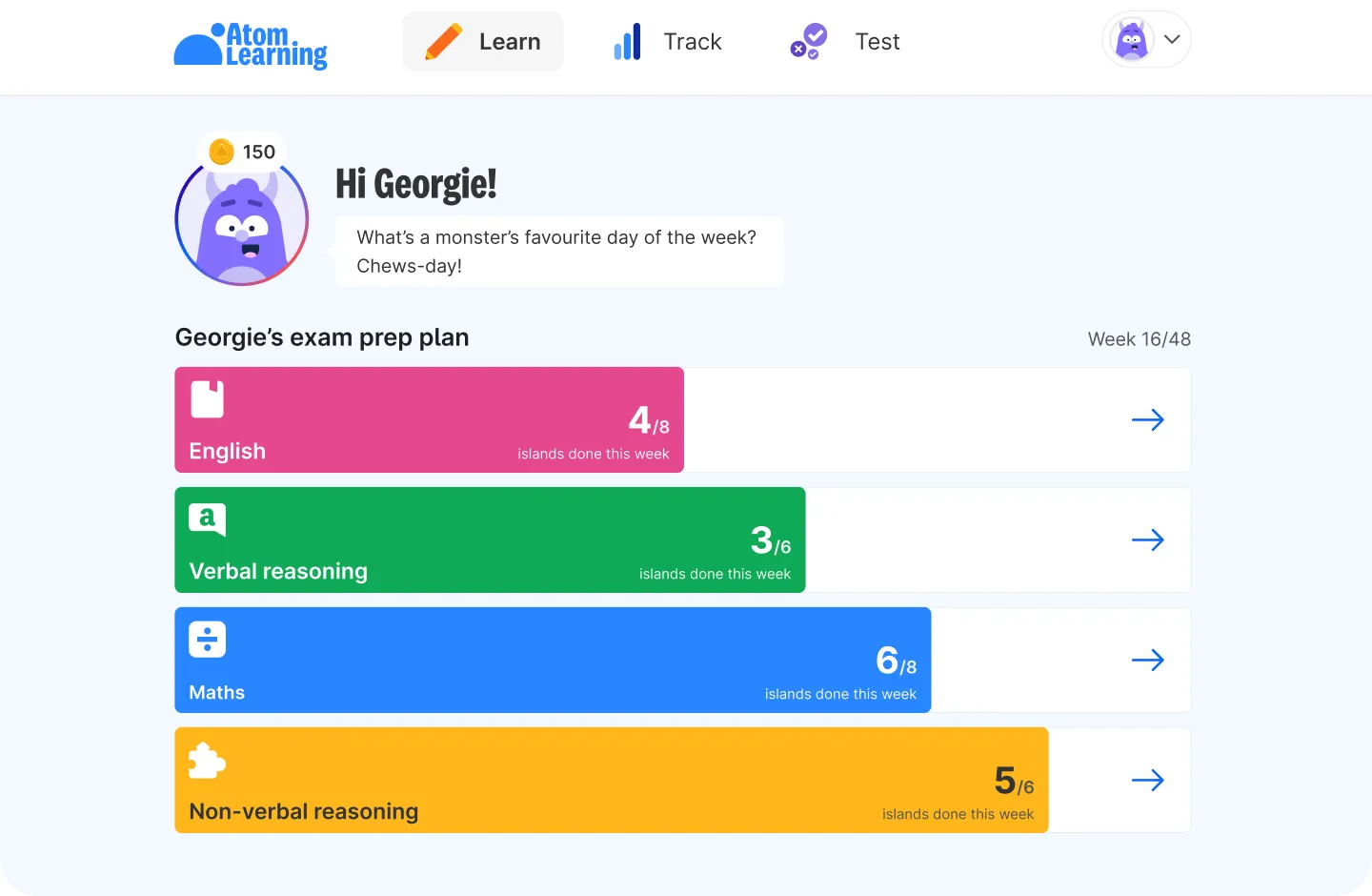
When you sign up, Atom builds your child a personalised plan around your specific target schools, their current level, and the time available before exam day.
It covers English, maths, verbal and non-verbal reasoning, with each topic introduced in a logical order so that every new concept builds on what your child has already mastered, updated week by week.
You don't need to research what to cover or figure out the right sequence. Atom maps it all out for you and your child.
Learning islands: see exactly where your child is
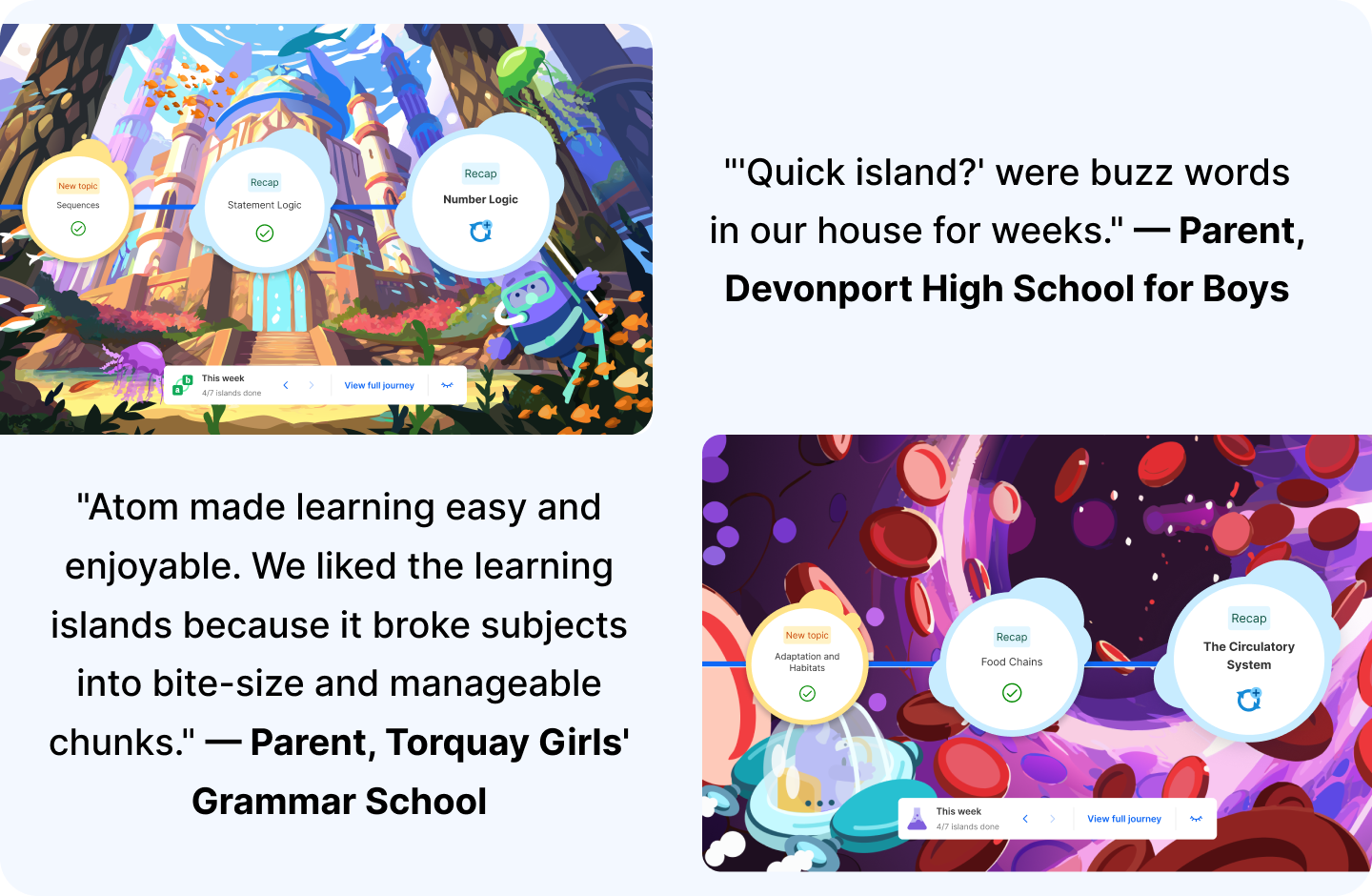
Atom's learning islands are how your child works through their preparation plan each week.
Each island focuses on a specific concept, so progress is built topic by topic rather than subject by subject. As a parent, you can see exactly which islands your child has completed, giving you a much clearer picture than a general sense of how they're getting on. Rather than a vague feeling that maths is going well or could do with more attention, you can see precisely which concepts have clicked and which ones just need a little more time.
And for your child, they're genuinely engaging. The bite-sized format keeps sessions feeling manageable rather than overwhelming, and for many children they quickly become a habit in their own right.

Parent dashboard: the full picture, updated after every session
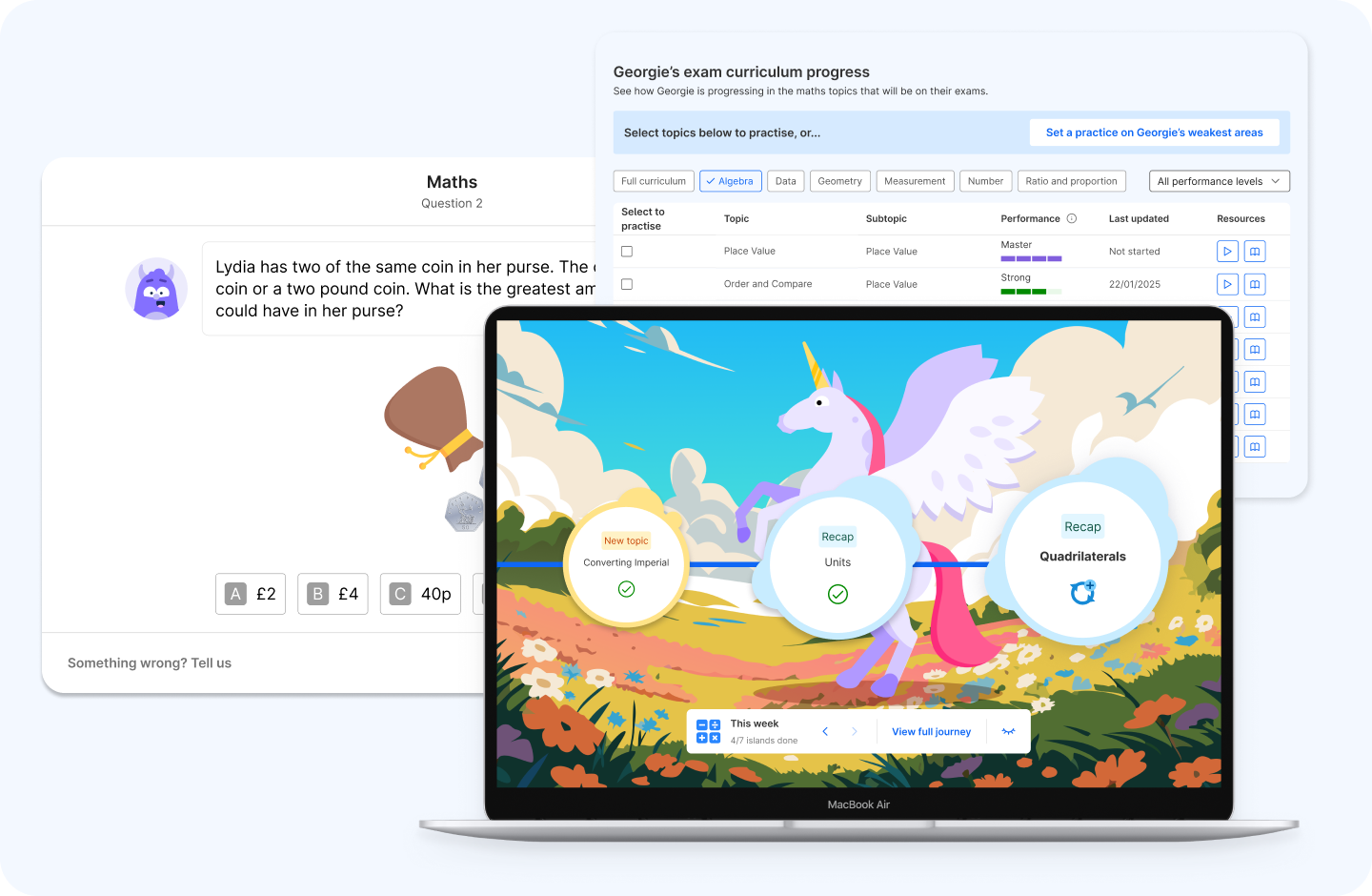
The parent dashboard gives you a clear view of how your child is progressing across every subject and every topic. You can see at a glance where confidence is building and where a little more focus would help, tracked against a benchmark based on children accepted to your target school.
It's the weekly reassurance you need to know your child is on track for the 11+.
This is what Year 4 is for
The families who find Year 5 manageable didn't do more. They started earlier, stayed consistent, and arrived with the foundations already in place: a working routine, a clear picture of their child's strengths and gaps, and a plan that had already covered a meaningful portion of the curriculum.
That's what Year 4 is for. And what gets built along the way is something that outlasts the exam entirely: a child who knows that showing up for something difficult, day after day, actually works. That's the real prize.