
What should my Year 3 child be doing for the 11+? A calm, clear guide for parents

It often starts with a conversation at the school gate, or a thread on Mumsnet at 10pm. Someone's child has been doing 11+ prep since Year 2. Suddenly you're asking: are we behind?
You're not. Year 3 is, if anything, the most valuable time to start, not because your child needs to be drilling past papers, but because the foundations you build now make everything in Year 4 and 5 feel manageable rather than frantic.
This guide will show you exactly what those foundations look like and how Atom supports each one.
What does the 11+ actually test?
Before thinking about what your child should be doing, it helps to understand what they're preparing for.
The 11+ is an entrance exam used by grammar schools and many independent schools to assess academic ability. Depending on your target school and region, it will test some combination of:
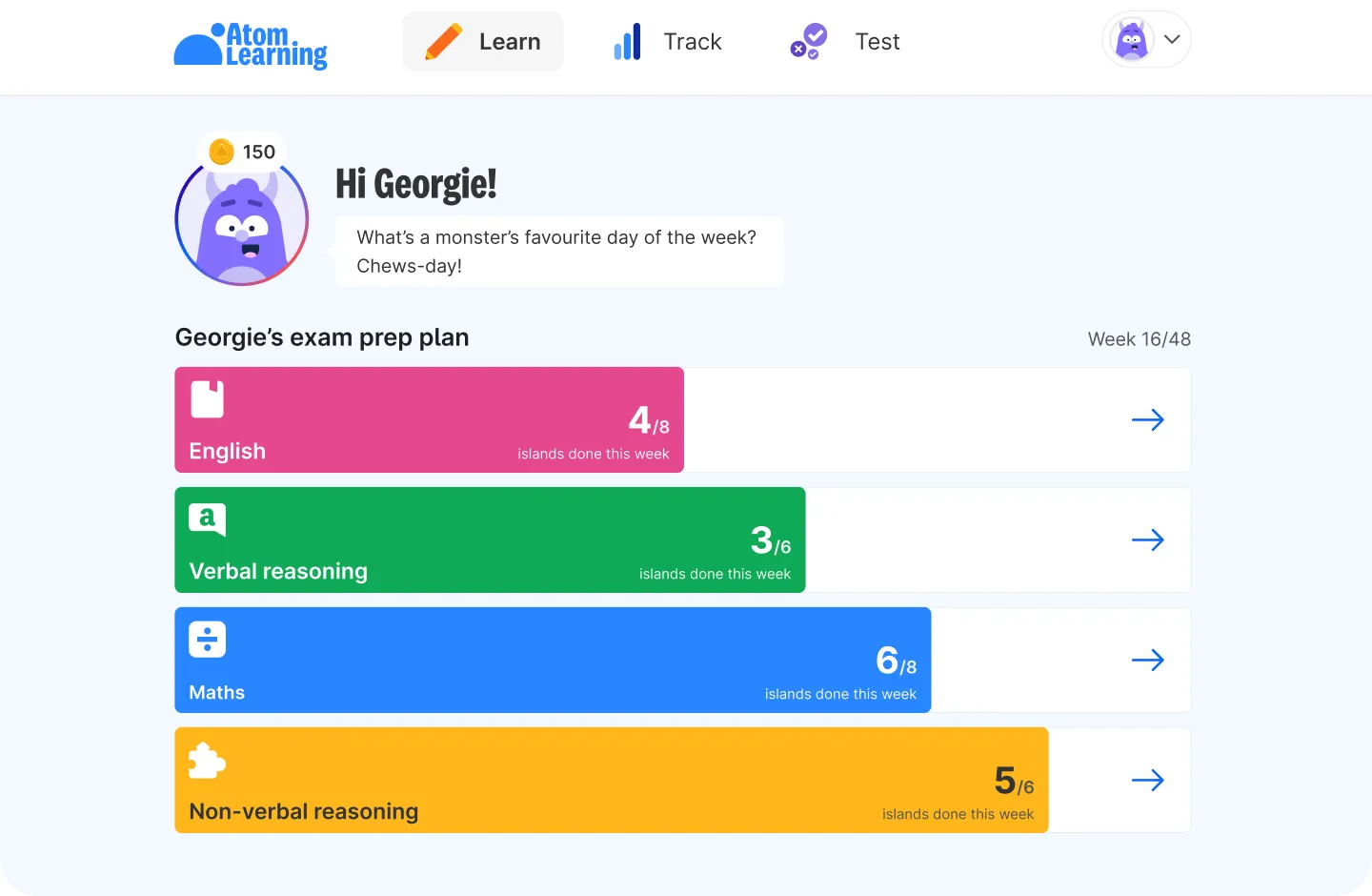
- English — reading comprehension and sometimes creative writing. This tests a child's ability to read carefully, infer meaning, and express ideas clearly.
- Maths — based on the primary curriculum up to and including Year 6. Tests number fluency, problem-solving and mathematical reasoning.
- Verbal reasoning — logical problems using words, letters and language patterns. Unlike English and maths, this isn't covered in the primary school curriculum, so most children will need to be introduced to it separately.
- Non-verbal reasoning — logical problems using shapes and diagrams. Like verbal reasoning, this sits outside the primary curriculum.
The exact format varies by school and region. It's worth finding out what your target school tests before committing to a preparation approach, the subjects, format and weighting can differ significantly.
Find out which grammar schools are near you, including individual school guides covering everything you need to know about each school's exam.
What your Year 3 child should be doing
Most parents starting out share the same problem: they know preparation matters, but they don't know what it should look like at this age, how to structure it, or whether what they're doing is enough.
The answer in Year 3 is simpler than most expect. It comes down to four foundations and habits that are far easier to build at seven than at ten, before the pressure of Year 5 arrives. Get these right, and everything that follows feels manageable.
1. Reading
A child who reads widely throughout Year 3 carries an advantage into the exam room that no amount of last-minute preparation can replicate.
Reading builds vocabulary, comprehension and inference — all of which feed directly into every subject in the 11+ and is a skill that cannot be crammed.
The habits that build these skills are simpler than you might think:
- Let your child choose their own books. Ownership builds the habit.
- Encourage fiction and non-fiction across different genres. Variety builds the reading flexibility that the 11+ rewards.
- Read together and talk about what you've read. Why do you think the character made that choice? These conversations build inference skills that 11+ English papers test directly.
Looking for somewhere to start? Atom's list of 100 books every 7–9 year old should read covers fiction and non-fiction across a range of genres, with something for every kind of reader.
2. Maths fluency
By the end of Year 3, children are expected to know their times tables up to 12×12. Everything that comes after, fractions, ratios, algebra, geometry, is built on that foundation. If it's not secure, later topics are harder than they need to be.
Short, regular practice builds times table recall far more effectively than occasional longer sessions. A few minutes of mental maths most evenings, working through multiplication, division and number bonds, will do more for fluency than cramming it into one sitting.
The goal at this stage isn't to push ahead into Year 4 or 5 topics; it's to make sure multiplication, place value and basic arithmetic are automatic before the curriculum moves on.
3. Vocabulary
A wide vocabulary is one of the strongest predictors of 11+ performance. The children who do well aren't those who have crammed before the exam, they're the ones who have been absorbing language for years through reading, conversation and everyday curiosity about words.
One simple way to build it: sign up to Atom's Vocab Word of the Day. Every day one word drawn from real 11+ papers, is sent straight to your inbox.
4. A daily learning habit
The most valuable thing you can establish in Year 3 has nothing to do with any specific subject. It's the habit of consistently sitting down and doing a little.
The shift from 'we sometimes do some work at home' to 'we have a routine most evenings' is far easier to make at eight than at ten, when the pressure is real, and the timeline is short. It doesn't need to be long. Just ten to fifteen minutes most evenings, across reading, maths or vocab, builds something meaningful over time.
If you want something to structure that habit around, Atom is built for exactly this.
What not to do yet
Knowing what to hold back in Year 3 is just as useful as knowing what to start. Here's what to leave for later and why.
Past papers and timed mock tests
Past papers are a Year 5 tool. Sitting a Year 6 exam paper in Year 3 tells you very little that is useful, and an experience of struggling through content that is years ahead can put children off the whole process. Save them for when they can give you a realistic picture of readiness.
Worrying about what everyone else is doing
The Year 2 tutoring parent exists. But earlier isn't always better; it can just as easily mean burnout before the exam arrives. The families who find this process most manageable are the ones who started at a sensible point, built good habits, and stayed consistent. That's exactly what Year 3 is for.
The right foundations, built at the right pace
Year 3 isn't the time to replicate Year 5. It's the time to build the habits of reading, maths fluency, vocabulary and consistency that make Year 5 feel manageable when it arrives.
The families who find this process least stressful aren't the ones who started earliest or worked hardest. They're the ones who started sensibly, built steadily, and didn't burn out before the exam arrived.
Year 3 is exactly the right place to begin. If you want to understand what that preparation could look like for your child, find out how Atom supports families from Year 3 onwards.
Sixteen minutes a day. That's all it takes.
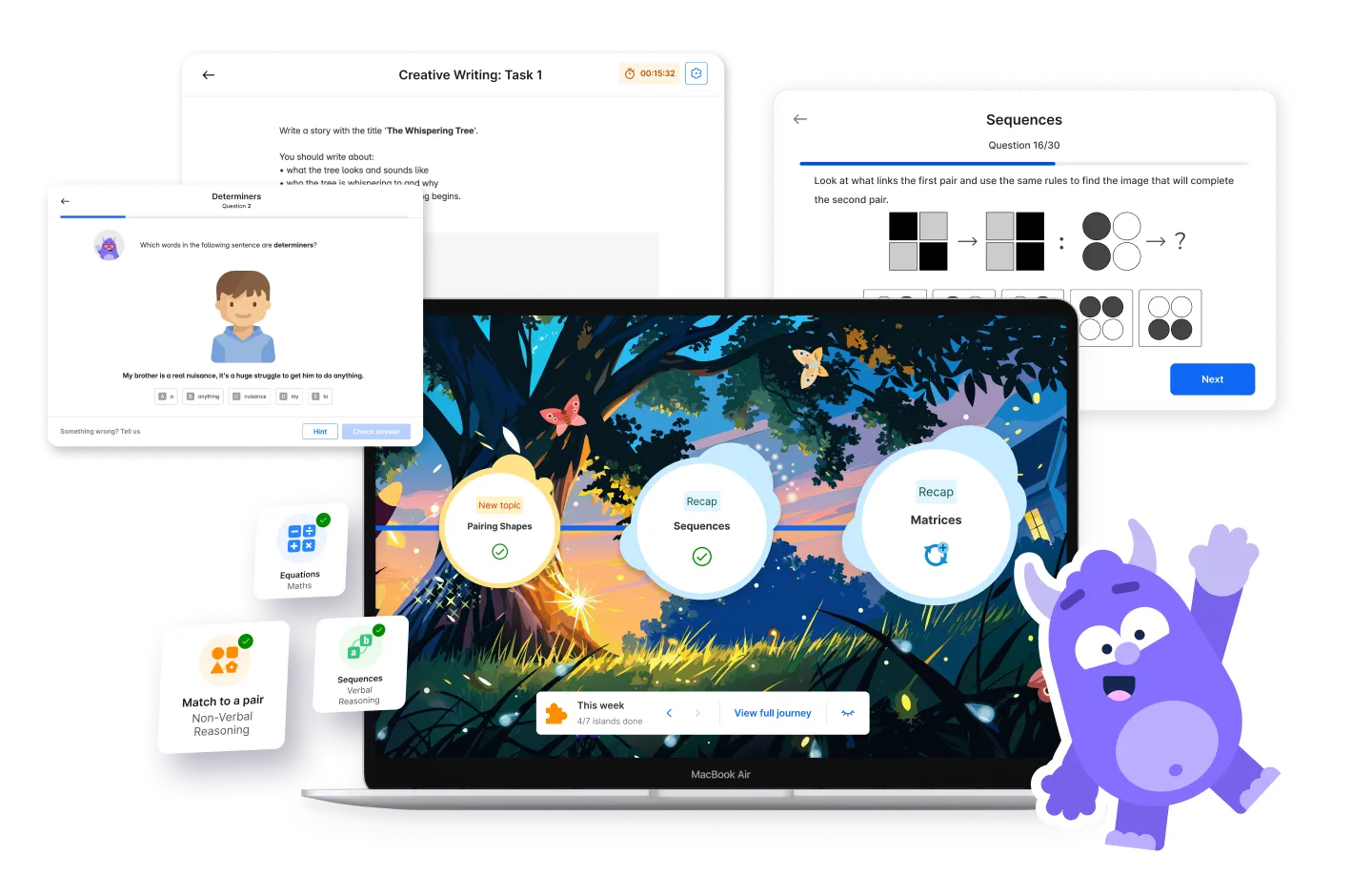
A short daily session on Atom does more than you'd expect. It builds a habit. It builds confidence. Day by day, it builds a child who sits down to learn without being asked, because they actually enjoy it.
Atom adapts to your child's level, so they're always practising the right things. Not too easy, not too hard. Just right.
- Follow personalised daily practice plans that adapt to your child's level automatically
- Build real understanding across maths, English and reasoning in just 16 minutes a day
- Watch confidence grow as your child sees their own progress, concept by concept
Start your free trial and help your child build the habits that make learning stick