Applying to Sale Grammar School for September 2028? This guide covers the new FSCE entrance test in September 2027, the qualifying score, how the 190 Year 7 places are allocated and the key dates for September 2028 entry.
The entrance test has changed. From September 2028 entry, the five Trafford consortium grammar schools use the FSCE entrance test, set by Future Stories Community Enterprise, a not-for-profit subsidiary of Reading School. It replaces the GL Assessment test. The content moves away from verbal, non-verbal and mathematical reasoning, and instead draws on the Key Stage 2 English and mathematics national curriculum up to the end of Year 5.
For 2028 entry the test is still sat in September of Year 6. From 2029 entry it moves earlier, to the latter part of the summer term of Year 5.
Sale Grammar School 11+ at a glance
School type: co-educational selective grammar school
Location: Sale, Trafford
Number of places in Year 7: 190 (2027-entry figure — Sale Grammar School confirms each year's admission number in its determined arrangements, published the spring before entry.)
Qualifying score: not yet published for 2028 entry (see below)
11+ test: FSCE entrance test, sat in September 2027 (Year 6). Paper details follow in the familiarisation material released before the test.
Catchment or priority area: yes — M33, plus Trafford addresses in M23, WA14 and WA15
Source: Trafford grammar schools consortium admissions announcements and the school's admissions policy. Last checked October 2026.
Key dates for September 2028 entry
The Trafford consortium has confirmed that the 2028-entry test will be sat in September of Year 6, which is September 2027. It hasn't yet published the exact day or the registration window. For 2027 entry, when the test was still provided by GL Assessment, registration ran from Thursday 23 April 2026 to Friday 19 June 2026 and the test took place on Monday 14 September 2026. The new FSCE test may not follow the same timetable, so we haven't estimated the 2028-entry registration dates. We'll update this page as soon as the schools publish them.
Key dates for Sale Grammar School 11+ entry in September 2028, with expected windows where the school has not yet confirmed exact dates.
Date
What happens
To be confirmed
Test registration — the consortium hasn't published the 2028-entry registration window yet
September 2027
FSCE entrance test — the consortium will confirm the exact day
Sunday 31 October 2027
Deadline to apply for secondary school places through your home local authority. This date falls on a Sunday.
Wednesday 1 March 2028
National offer day for secondary school places
Worried about missing an important 11+ deadline?
Get grammar school reminders with the key dates for your target school delivered straight to your inbox.
Sale Grammar School is selective, so your child needs to sit the 11+ test to be considered for a place.
Registration for the 2028-entry test hasn't opened yet. For 2027 entry, the school's admissions policy asked parents to check the school website from April 2026 and complete the online registration form by the deadline it promoted there. We'll confirm the 2028 process as soon as it's published.
Once you have your child's result, you apply by naming Sale Grammar School on your common application form, which goes to your home local authority. For September 2028 entry the deadline is Sunday 31 October 2027. As it falls on a Sunday, you may find it easier to submit your form in the days before.
Reaching the qualifying score makes your child eligible, but it doesn't guarantee a place. If more qualifying children apply than there are places, the school uses its oversubscription criteria, set out further down this page.
What will my child be tested on?
From September 2028 entry, the test assesses Key Stage 2 English and maths, as taught up to the end of Year 5. It no longer includes verbal, non-verbal or mathematical reasoning. The table below shows how the test changes across three entry years.
The consortium has confirmed that the test covers Key Stage 2 English and maths. Paper lengths and question formats are published in the familiarisation material released before the test.
Qualifying score: not yet published for 2028 entry. Sale Grammar School's test is provided by FSCE from the September 2027 test onwards. Scores from previous years were set against the GL test and don't carry across to the new one. The school will publish a qualifying standard for the new test in its own time.
How the Trafford grammar schools entrance test changes across the 2027, 2028 and 2029 entry cycles.
Entry year
Test provider
What is assessed
When the test is sat
2027 entry
GL Assessment
Verbal, non-verbal and mathematical reasoning
September of Year 6
2028 entry
FSCE
Key Stage 2 English and maths, up to the end of Year 5
September of Year 6
2029 entry onwards
FSCE
Key Stage 2 English and maths, up to the end of Year 5
Latter part of the summer term of Year 5
How are places allocated at Sale Grammar School?
If more children reach the qualifying standard than there are 190 Year 7 places, Sale Grammar School offers places in the order below. This order comes from the school's admissions policy for 2027 entry. The school sets its 2028-entry policy separately, and we'll update this table if anything changes.
Sale Grammar School oversubscription criteria in priority order, from the 2027 entry admissions policy.
Priority
Who it covers
1
Looked after and previously looked after children, including children adopted from state care outside England
2
Up to 15 children who qualify for Pupil Premium: first those living in the priority admission area (closest first), then those attending a Trafford state-funded primary school who live elsewhere in Trafford (by score)
3
Children living in the priority admission area (see below), closest to the school first
4
Children living outside the priority admission area, in order of their test scores
No items found.
Every applicant must reach the qualifying score, and children whose EHC plan names Sale Grammar School are admitted before these criteria are applied. Inside the priority admission area places go by distance; outside it they go by score. The qualifying score for 2028 entry will be set on the new FSCE scale.
Does Sale Grammar School have a catchment area?
The priority admission area is the M33 postcode, plus addresses within Trafford in the M23, WA14 and WA15 postcodes. If more qualifying children in the area apply than there are places, those living closest to the school are offered places first.
Distance is measured in a straight line from the child's home to the school, using Trafford's property co-ordinates. Outside the priority area, if several children have the same score for the final place, the one living closer is offered it. If two children live the same distance away and can't otherwise be separated, random allocation, supervised by someone independent of the school, decides.
If you don't live close to the school, it's worth thinking about how your child will get there every day. How long will the journey take? What transport options are available? Will they be travelling independently or with support?
A longer or more complex journey can affect your child's daily routine, including how much time they have for homework, rest and after-school activities. It's a good idea to think about how manageable the school run will be and whether it will work for your family day to day.
How can I help my child prepare for the FSCE test?
Atom Learning is not an official or authorised source of information about FSCE assessments. This guide is based on publicly available information. FSCE assessments are tailored to each school and can change from year to year. For definitive information, always use the familiarisation materials published by the school you are applying to.
There are no FSCE past papers, and question styles can change from year to year — so there is no pattern to learn. What the test does reward is a confident grasp of Key Stage 2 English and maths up to the end of Year 5, applied to unfamiliar questions.
Build solid KS2 knowledge
Because the FSCE test draws on the English and maths your child has already been taught, the strongest preparation is making sure those foundations are secure.
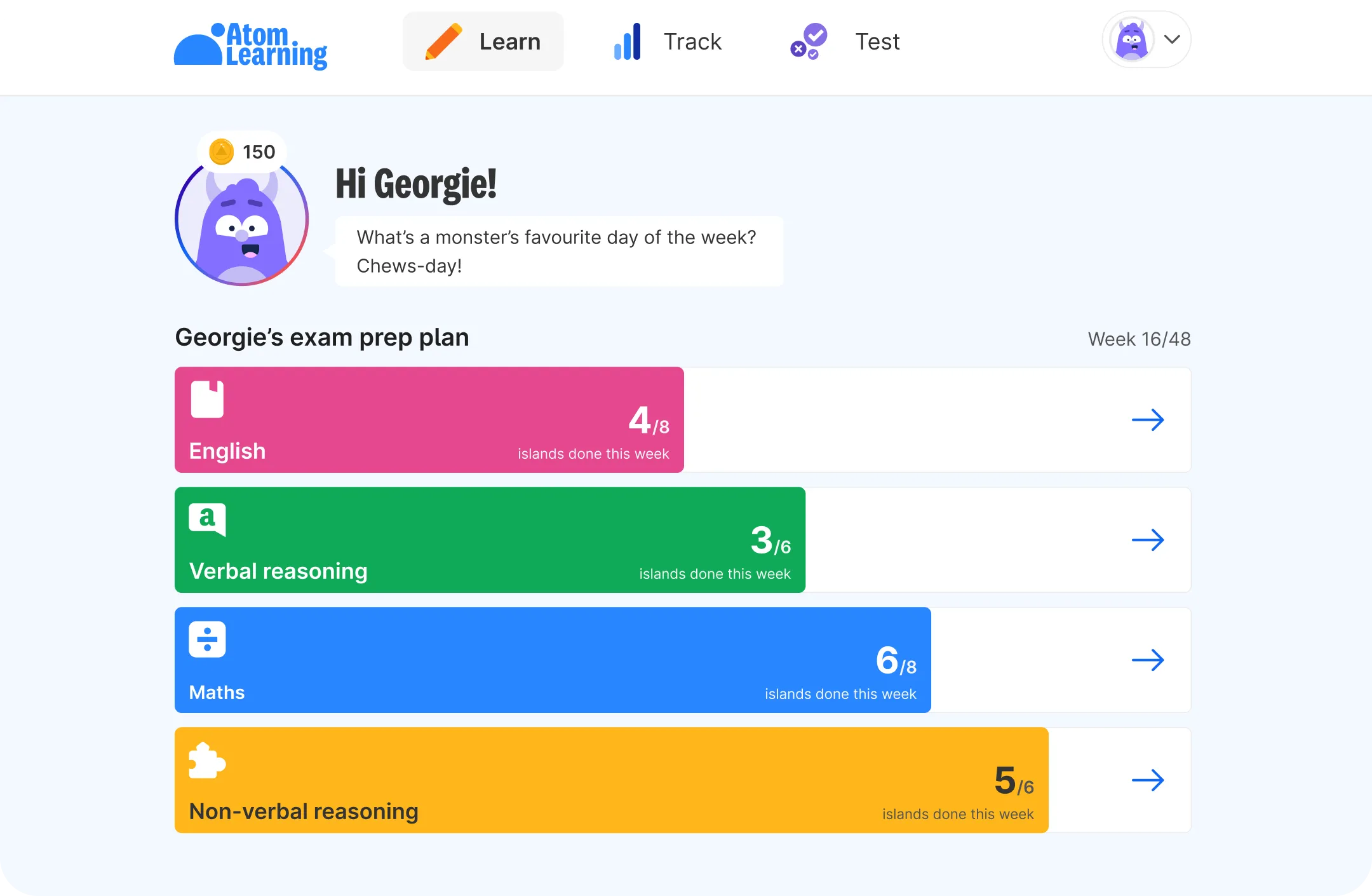
a personalised weekly learning plan tied to their target schools
adaptive questions that meet them at the right level of difficulty
coverage of KS2 English and maths topics
Enter your target schools on Atom Home and get started with a free trial today.
Encourage regular reading
Reading underpins much of the FSCE test, from comprehension to vocabulary. Aim for 10–15 minutes a day, with variety: fiction and non-fiction, different genres and authors.
When the school publishes its familiarisation materials for this test, read them with your child so the layout of the papers and answer sheets looks familiar on the day.
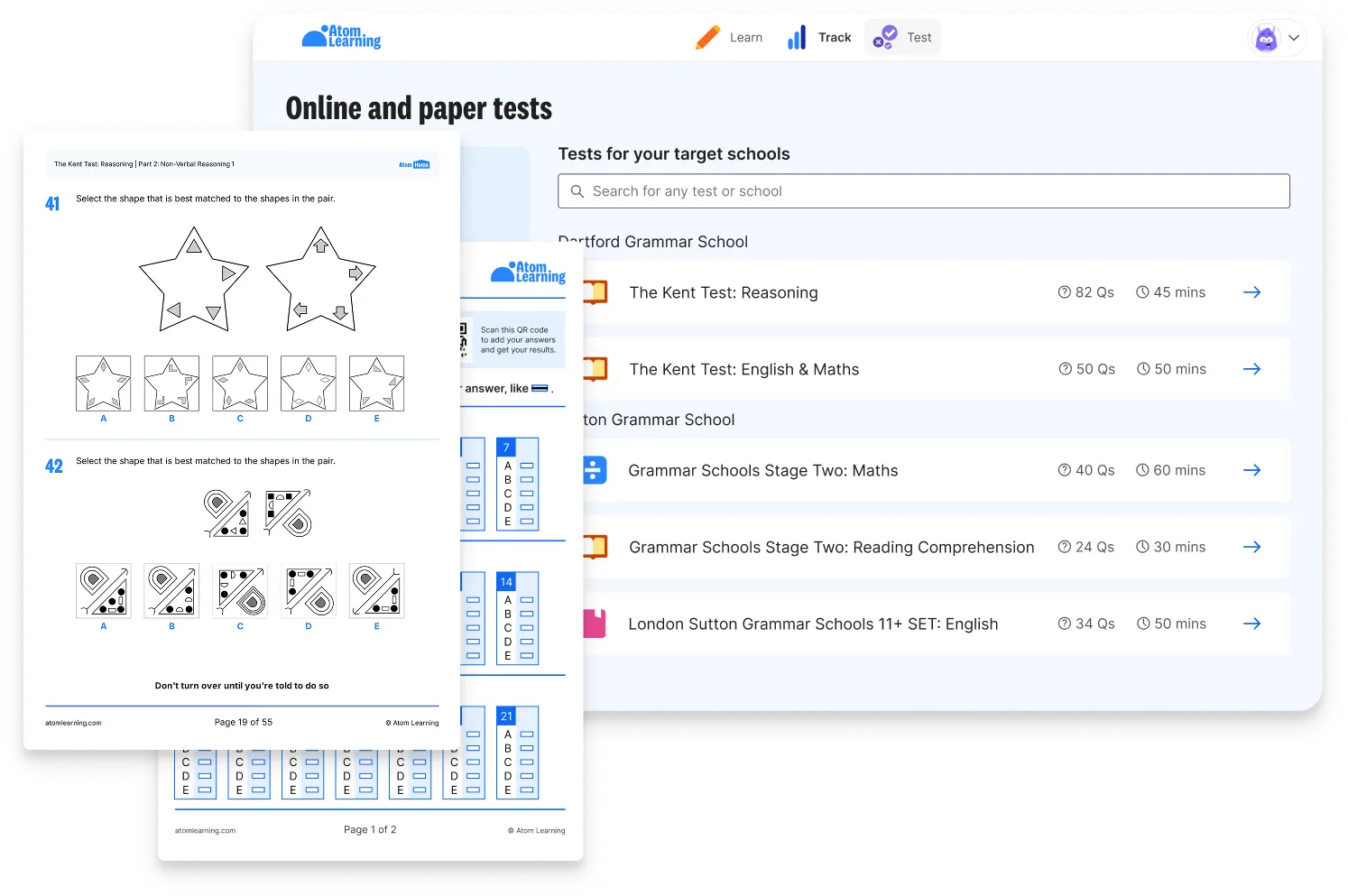
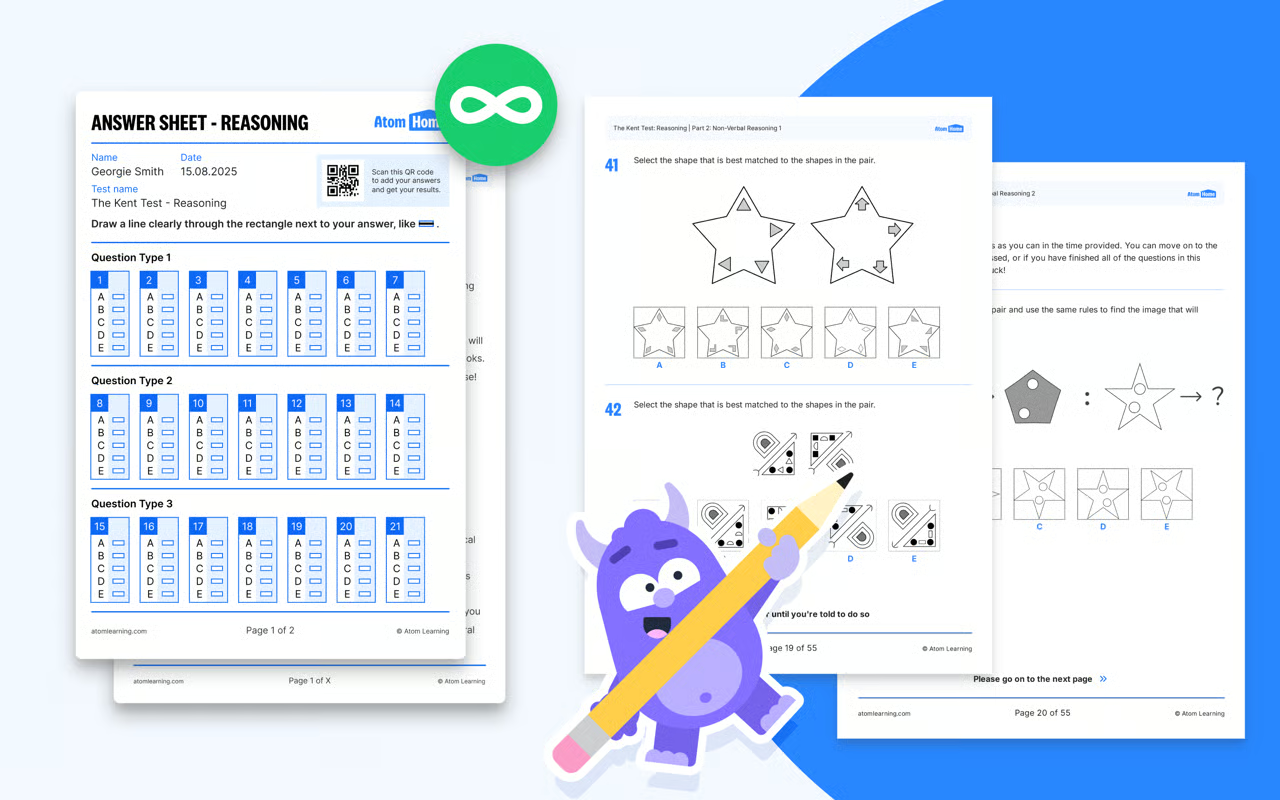
Beyond that, Atom's practice papers build the habit of working accurately under timed conditions and filling in an answer sheet correctly. Photograph the answer sheets and upload them for instant marking, a Standardised Age Score, and a clear view of which topics to work on next.
Celebrate progress, not just scores
Atom's progress tracking shows how your child is doing across topics and how that is developing over time, so you can keep motivation steady and focus on consistent improvement.
No items found.
Take control of your child’s 11+ preparation.
Not sure if your child is on track for the grammar school 11+? You don’t need to guess what to cover or whether they’re ready. Atom shows you exactly what to practise each week and how they’re performing, so you can stay ahead of the process without the stress.