New to the 11+ System? What International and First-Generation Grammar Families Need to Know

If you're new to the UK's 11+ system, or you're the first in your family to go through secondary school admissions here, you've found the right place to start.
This guide explains grammar schools in plain terms: what they are, how they differ from other secondary schools, what the 11+ exam involves, and what the process actually looks like, one step at a time. There's a lot to take in, but nothing here assumes you already know how the system works.
Key takeaways
- What a grammar school is, and how it differs from independent and state schools.
- What the 11+ exam actually involves, and why it looks different from area to area.
- The five stages of the process, from early research through to accepting a place.
- The key terms you'll come across along the way, explained simply.
What is a grammar school?
Grammar schools are state secondary schools, so, like any other state school, they're free to attend. What sets them apart is how they select pupils: instead of admitting everyone in the local area, they select some or all of their intake by academic ability, using the 11+ test explained further down this guide.
England has 163 grammar schools, and they aren't spread evenly. There are high concentrations in Kent, Buckinghamshire, Lincolnshire, parts of London and the West Midlands. Where they do exist, demand for a place tends to be high, since a selective, free secondary education appeals to a lot of families chasing a limited number of spaces.
With relatively few places available nationally and every applicant assessed against the same test, grammar school places are genuinely competitive. Nationally, around 1 in 5 children who sit the 11+ secures a place, for a closer look at how that varies by school and region, see Atom's full breakdown of grammar school competition.
What is the difference between a grammar and independent school?
England has three broad types of secondary school, and it helps to know where each one sits before going further.
State comprehensive schools take pupils from the local area without an entrance test. They're free to attend, and the large majority of children in England, attend a state-funded secondary school.
Grammar schools are also state schools, so they're free too, but they only admit children who pass the 11+ entrance test described below. They only exist in some parts of the country. Atom's grammar schools hub shows whether there's one within reach of where you live.
Independent schools (sometimes called private schools) charge fees, and each one sets its own entrance requirements and process independently, rather than following one shared national format. Atom's guide to independent schools explains how their admissions process differs from the grammar school system.
The right fit depends on the child and the family, not just a school's reputation, and many families genuinely weigh up more than one type before deciding where to apply.
The 11+ entrance exam
The 11+ is an entrance test taken in Year 6, usually in September, that decides who gets a grammar school place. It usually covers some combination of the following four subjects:
- English — usually reading comprehension, and sometimes a creative writing task too.
- Maths — drawn from the Key Stage 2 curriculum, sometimes with more demanding problem-solving questions than a child will have met in class.
- Verbal reasoning — puzzles built from words, letters and codes, testing how a child works with language to spot patterns and relationships.
- Non-verbal reasoning — puzzles built from shapes and diagrams, testing pattern recognition and spatial thinking rather than language.
How it's organised depends on where you live. In some areas, including Kent and Buckinghamshire, almost every Year 6 child sits a single county-wide test. Elsewhere, an individual grammar school sets its own test, and only the children applying to that specific school sit it. There's no single national "11+ exam." There are dozens of local versions, each with its own register, deadline and pass mark, which catches out UK-born parents just as much as newcomers, since so much of it is organised locally rather than by one national body.
Atom's guide to grammar schools sets out how the different test providers, GL Assessment, Quest Assessments and school-set papers, compare in more depth. Whichever version your child is sitting, Atom builds their weekly practice around the exact test they'll face, not a generic mix of question types, so every session covers what's actually going to come up on the day.
Get your free 11+ learning plan and topic list
Find out exactly what your child needs to study for their target grammar school. Simply enter the school, and Atom will generate a personalised 11+ learning plan and topic list aligned to that school’s exams – so you can focus on what really matters.

The timeline for a place at grammar school
Research, Year 3-4.
There's no need for formal exam preparation yet. This is a good time to get a general sense of which grammar schools are near you and how each one runs its process, so none of it feels unfamiliar later.
Head to our grammar schools hub to get started with all the information you need for the grammar schools near you! It's also worth getting your child started on Atom now, so you can see where their current strengths and gaps sit and give them personalised activities that build their knowledge and confidence gradually, well ahead of any exam pressure.
Prepare, Year 5.
Narrow down which grammar schools are realistic options, including whether they use a catchment area, sit within a consortium, and which test provider they use. This is also the point to note each school's own registration window, since these vary and rarely appear on one combined calendar. It's worth checking each target school's dates as soon as you've narrowed down where to apply.
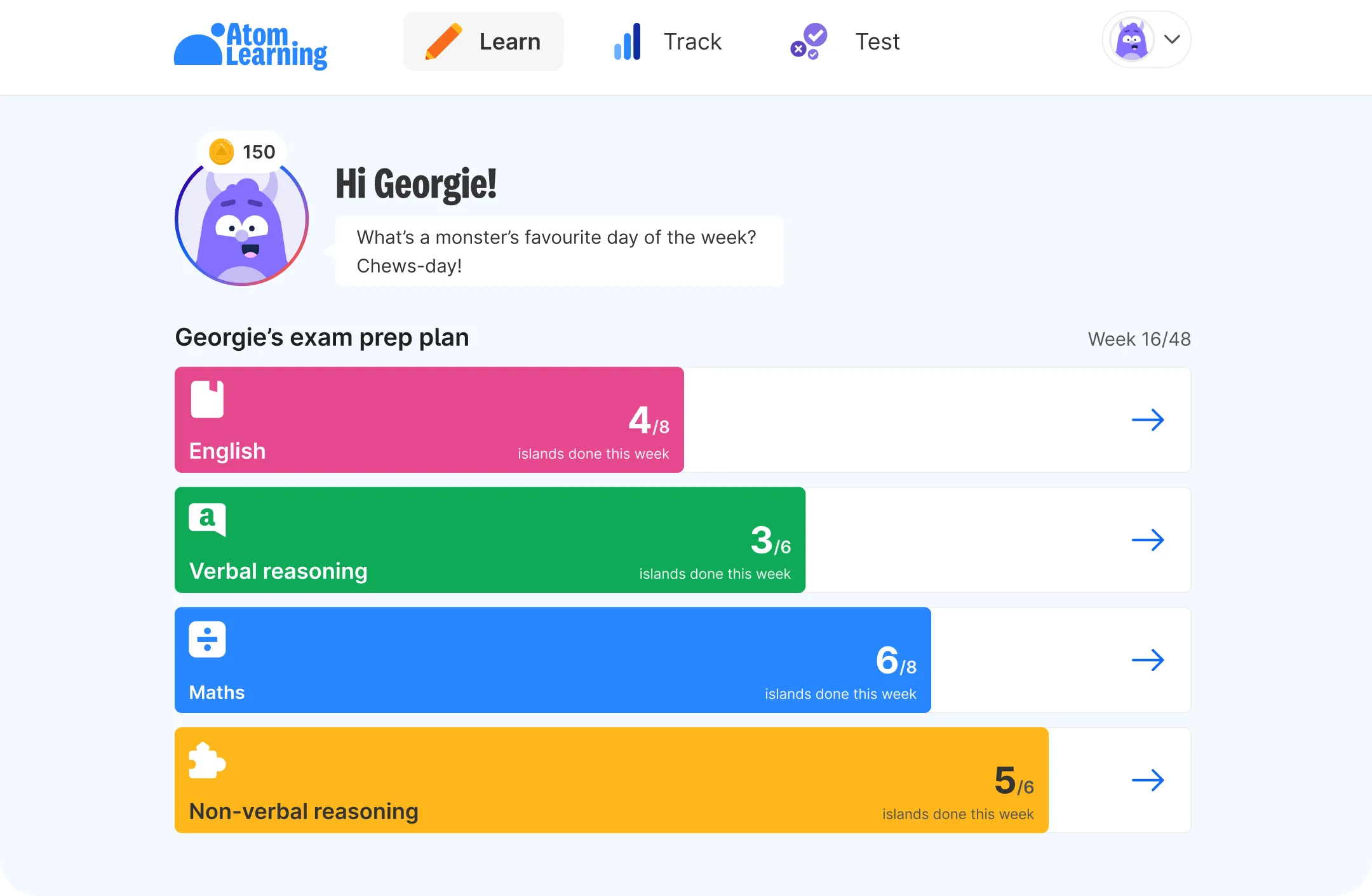
Year 5 is the time to build up your child's revision and exam prep. Atom gives you a structured, personalised plan matched to the exact test your child will sit, pinpoints the topics that need the most attention, and steps up weekly practice steadily as exam day approaches, so your child goes into Year 6 feeling familiar with the format and confident in what they know.
Exam day, most commonly September of Year 6.
Sit the 11+ test or tests this month. Many of the larger county-wide tests, including the Kent Test, are held this month.
Results, October of Year 6.
Test results typically arrive in the weeks following exam day. This is also when the Common Application Form (CAF) is due, by 31 October, listing every preferred school, in any county, in true order of preference.
Offer, 1 March of Year 6, with waiting lists running into Year 7.
National Offer Day. Offers usually arrive by email or through the council's online portal. If a preferred school isn't offered straight away, waiting lists stay open through at least the first term of Year 7, so a place can still come through later.
None of this is a race against other families. It's a fixed sequence of steps with real dates attached, and following it in order is what gets a family through it, not starting earlier than everyone else.
The key terms to look out for
A few words come up again and again during the 11+ process. Here's what each one means:
Common Application Form (CAF). The one form every family in England fills in for a secondary school place, not just grammar schools. It's submitted to the council covering where you live, listing every school you want in order of preference. Atom's guide to completing the Common Application Form walks through it field by field.
Consortium. A group of grammar schools, sometimes spanning more than one county, that all accept the same test result from any child who sits it at one of their linked schools. Sitting the test once can be enough to be considered by every school in the group.
Catchment area. The zone a school gives priority to once a child has passed the entrance test. Passing the test doesn't guarantee a place if a school is oversubscribed and your family lives outside its catchment. Some grammar schools don't use one at all, and rank purely by test score.
National Offer Day. 1 March, the day secondary school offers are sent out for the following September.
Waiting list. If a preferred school isn't offered on National Offer Day, most councils keep a waiting list open, sometimes into the autumn term of Year 7, so a place can still come through later.
Standardised score. A test result adjusted for a child's exact age in months, so a child born in August isn't compared unfairly against a child born the previous September. Most 11+ results are reported this way rather than as a raw mark out of the total.
Super-selective school. A small number of grammar schools, often among the most oversubscribed in the country, that draw applicants from a wide area rather than a single catchment and set their own particularly competitive test.
Keeping these seven terms straight makes the rest of this guide, and most of what you'll read elsewhere about the 11+, much easier to follow.
Take control of your child’s 11+ preparation.

Not sure if your child is on track for the grammar school 11+? You don’t need to guess what to cover or whether they’re ready. Atom shows you exactly what to practise each week and how they’re performing, so you can stay ahead of the process without the stress.
- Follow personalised weekly exam plans that show them what to learn next.
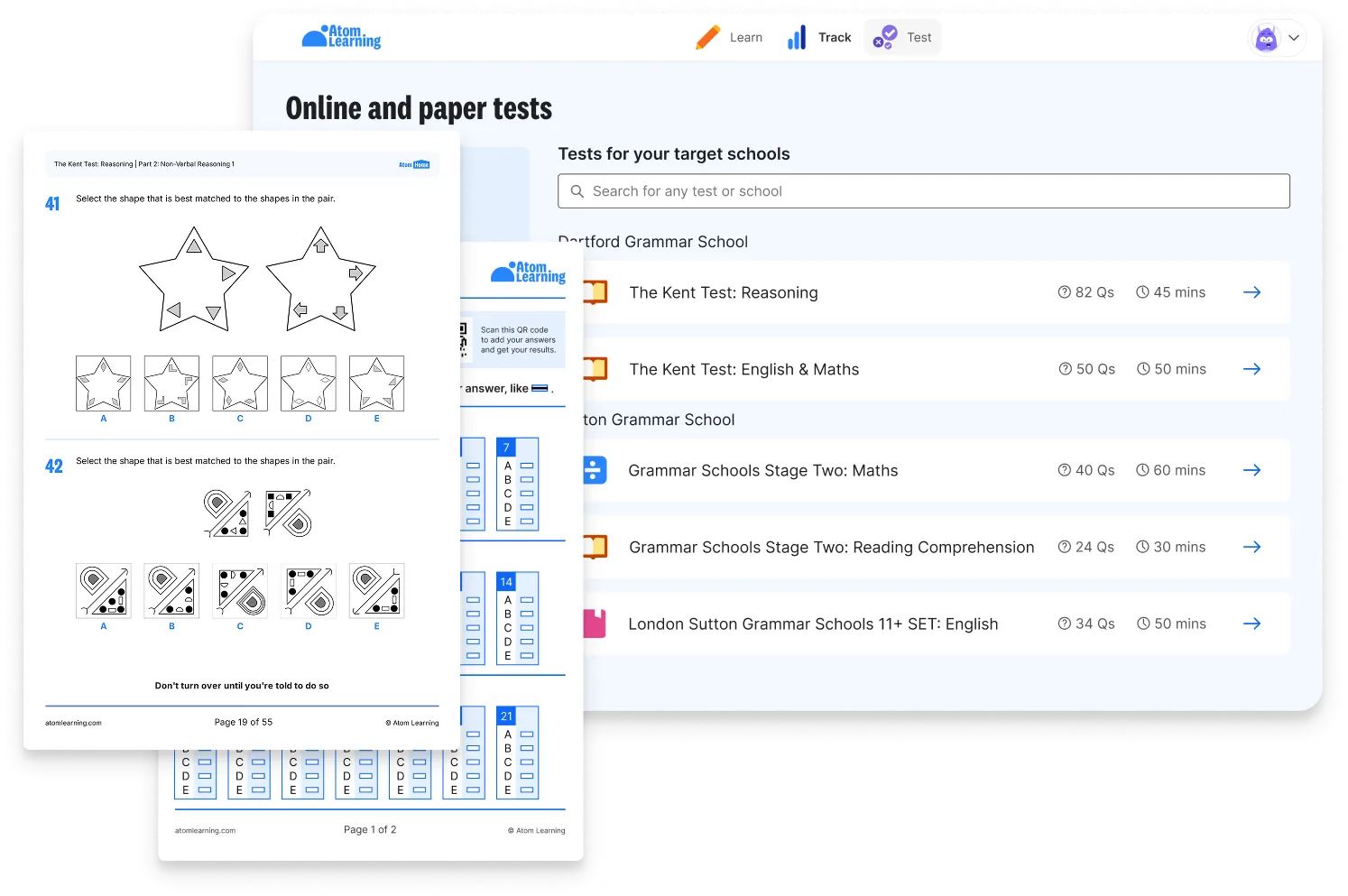
- Download realistic 11+ practice papers and upload a photo for instant, stress-free marking.
- Track progress and see how they compare to others applying to the same schools.
Start your free trial and help your child feel fully prepared for the 11+.