Grammar schools in the UK — every region, every test, every guide

Find a grammar school, understand the 11+, and prepare for entry in 2026 or 2027.
Last updated: May 2026 · Sources: DfE 2024-25 performance tables, local authority admissions arrangements 2026-27

163
Grammar schools in England
5
Children competing for every place (UK avg)
28000
Y7 grammar places per year
130000
Applicants each year
163 grammar schools in England
5 children competing for every place (UK average)
28,000 Y7 grammar places per year
130,000 applicants each year

Where to start

Grammar school admissions cover a lot of ground. We've grouped everything on this page into five steps so it's easier to follow. Start at the top, or skip to the bit you need.

Research

What is the 11+?

The 11+ is the entrance exam for grammar schools, sat in Year 6. It tests maths, English, and verbal and non-verbal reasoning. Each region runs its own version, so the format depends on where you live.
Read the full guide ->

How do grammar school admissions work?

Children sit the 11+ and need to reach their region's pass mark. Places are offered by priority, taking in things like catchment and siblings. You apply through your local authority in the autumn of Year 6.
Read the full guide ->

Top 50 grammar schools by Attainment 8

These rankings use Attainment 8 — the average GCSE score across 8 subjects (max ~90) — from the DfE 2024-25 performance tables. We’ve used Attainment 8 rather than Progress 8 because the DfE paused Progress 8 reporting post-COVID and has not resumed it for 2024-25. Rankings answer one question: how high pupils score at GCSE. They don’t account for catchment, entrance test difficulty, or fit. The national grammar school average is 72.1.
11
Pate’s Grammar School
Gloucestershire
Co-ed
82.7
View -->
12
Colchester Royal Grammar School
Essex
Boys
82.1
View -->
13
Chelmsford County High School for Girls
Essex
Girls
80.7
View -->
14
Altrincham Grammar School for Girls
Greater Manchester
Girls
80.6
View -->
15
Colchester County High School for Girls
Essex
Girls
80.6
View -->
16
Stratford Girls' Grammar School
West Midlands
Girls
80.6
View -->
17
Nonsuch High School for Girls
Greater London
Girls
80.5
View -->
18
Wallington High School for Girls
Greater London
Girls
80.5
View -->
19
King Edward VI Camp Hill School for Girls
West Midlands
Girls
80.4
View -->
20
Sutton Grammar School
Greater London
Boys
80.3
View -->

Grammar schools by region in England

We’ve built comprehensive guides for all 163 grammar schools in England. Each guide covers admissions arrangements, test format, catchment area, SAS cut-off scores, application deadlines, and pass rates. Use the search below to find your school, or browse the full list.
Find your nearest grammar school ->

Region

testo qui

Read the full guide ->

Yorkshire

6 grammar schools
Various Tests: September
Applications close: June or August

View all schools ->

Wiltshire

2 grammar schools
Various Tests: September
Applications close: June or September

View all schools ->

West Midlands

18 grammar schools
West Midlands 11+: 12-14th September
Applications close: 26th June

View all schools ->

Merseyside

7 grammar schools
Various Tests: September
Applications close: June

View all schools ->

Medway

6 grammar schools
Medway Test: September
Applications close: 12th June

View all schools ->

Lincolnshire

15 grammar schools
Lincolnshire 11+: 11-19th September
Applications close: 31st March

View all schools ->

Lancashire

4 grammar schools
Various Tests: 26th September
Applications close: September

View all schools ->

Kent

32 grammar schools
Kent Test: 10-13th September
Applications close: 1st July

View all schools ->

Greater Manchester

7 grammar schools
Trafford Test: 14th September
Applications close: 19th June

View all schools ->

Sutton

5 grammar schools
SET: 15th September
Applications close: 31st July

View all schools ->

Redbridge

2 grammar schools
Redbridge 11+: 18th September
Applications close: 15th June

View all schools ->

Kingston upon Thames

2 grammar schools
Various Tests: October
Applications close: September

View all schools ->

Enfield

1 grammar school
Test: 3-5th September
Applications close: 2nd June

View all schools ->

Bromley

2 grammar schools
Various Tests: September
Applications close: June

View all schools ->

Bexley

4 grammar schools
Bexley Selection Test: September
Applications close: 31st March

View all schools ->

Barnet

3 grammar schools
Various Tests: September
Applications close: July

View all schools ->

Greater London

19 grammar schools
Various Tests: September or October
Applications close: Various months

View all schools ->

Gloucestershire

7 grammar schools
Gloucestershire 11+: 12th September
Applications close: 26th June

View all schools ->

Essex

11 grammar schools
CSSE Test: 19th September
Applications close: 19th June

View all schools ->

Dorset

4 grammar schools
Dorset 11+: 19th September
Applications close: 4th September

View all schools ->

Devon

7 grammar schools
Various Tests: September
Applications close: July or August

View all schools ->

Cumbria

1 grammar school
Test: 17th September
Applications close: 12th July

View all schools ->

Buckinghamshire

13 grammar schools
Secondary Transfer test: 10th September
Applications close: 2nd June

View all schools ->

Berkshire

6 grammar schools
Various Tests: July and September
Applications close: May or June

View all schools ->

Every grammar school in England — A–Z guides

We’ve built comprehensive guides for all 163 grammar schools in England. Each guide covers admissions arrangements, test format, catchment area, SAS cut-off scores, application deadlines, and pass rates. Use the search below to find your school, or browse the full list.
See all 163 schools ->



Alcester Grammar School

West Midlands
View guide ->

Altrincham Grammar School for Boys

Greater Manchester
View guide ->

Altrincham Grammar School for Girls

Greater Manchester
View guide ->

Aylesbury Grammar School

Buckinghamshire
View guide ->

Aylesbury High School

Buckinghamshire
View guide ->

Bacup & Rawtenstall Grammar School

Lancashire
View guide ->

Barton Court Grammar School

Kent
View guide ->

Beaconsfield High School

Buckinghamshire
View guide ->

Beths Grammar School

Greater London
View guide ->

Bexley Grammar School

Greater London
View guide ->

Bishop Vesey's Grammar School

West Midlands
View guide ->

Bishop Wordsworth's School

Wiltshire
View guide ->

See every grammar school guide

View all schools ->

Prepare

When should we start preparing?

Most families start preparing in Year 3 or Year 4. That’s enough time to build verbal and non-verbal reasoning skills — which children don’t otherwise learn at school — without crash-cramming. Year 3 is too early to start formally: focus on reading widely and confidence with English and maths foundations. Year 5 is too late to start from scratch, but useful for final polish.
Read the full guide ->

Test providers worth knowing at 11+

Not sure which test your child sits? The 11+ isn't one exam — a few providers create the tests, and your region or school decides which one. Here's who they are.

GL Assessment 11+

The most widely used 11+ provider, covering the majority of grammar regions. Many areas run their own version built on GL papers, including the Kent Test and the Buckinghamshire transfer test. Tests English, maths, and verbal and non-verbal reasoning.
Read the full guide-->

Quest Assessment

A newer provider growing across the grammar sector, and also used by many independent schools. The exam is paper-based and multiple-choice, with each school choosing which subjects to test.
Read the Quest guide ->

CAT4

A cognitive ability test rather than a grammar entrance exam. Schools mostly use it after a child has started, to set classes and spot potential. You may see it mentioned, but it isn't something to prepare for at 11+
Read the CAT4 guide ->

ISEB Common pre test

An online, adaptive test for independent senior schools, not state grammars. Schools use it as an early screen before their own exams and interviews. Worth recognising the name, but it likely won't apply if you're aiming for a state grammar.
Read the ISEB guide ->

Independent school entry

Independent schools set their own admissions. Formats vary, from the ISEB Common Pre-Test and Common Entrance to school-specific papers and Quest. This guide covers what your child might sit and when.
Read the guide ->

Free baseline tests

Free 15-minute diagnostic that shows where your child stands. Choose the version that matches the test they'll sit.

11+ baseline test

Find out whether your child is ready for the 11+ with Atom's free  baseline test. Results will include your child's Standardised Age Score (SAS).
11+ test

Kent baseline test

Find out whether your child is ready for the Kent 11+ with Atom's free, tailored baseline test. Results will include your child's Standardised Age Score (SAS).
Kent test

West Midlands baseline test

Find out whether your child is ready for the West Midlands 11+ with Atom's free, tailored baseline test. Results will include your child's Standardised Age Score (SAS).
West Midlands test

Exam day

Top tips for exam day

Nerves are normal. Pack pencils and a good eraser the night before, keep the morning routine calm, and allow plenty of time for the journey. Here's what to do in the final 24 hours to help your child walk in feeling ready.
Read the full guide ->

How to fill in the 11+ answer sheet correctly

Most 11+ papers use OMR answer sheets: your child draws a horizontal line through their chosen answer, not a tick or a circle. Small mistakes cost marks. Here's how it works and how to practise it beforehand.
Read the full guide ->

Results

Understanding your child's score

Pass marks vary by region and by school. A score that passes in Kent might not be enough for a super-selective in Barnet. Here’s how to read a SAS score and what counts as “good” at your child’s chosen school.
What's a good SAS score ->

How to fill out your CAF

The Common Application Form is how you actually apply for a grammar school place, filed through your home local authority by 31 October of Year 6. Results arrive weeks before, so timing matters. Here's how to complete it and what to prioritise on your preferences list.
Read the full guide ->

Offer

If your child wasn’t offered a place

If National Offer Day didn't go the way you hoped, you're not alone, and you're not out of options. Every year, some families are offered a school further down their list than they wanted, or a school they didn't apply for at all. This guide covers exactly what happens next.
Read the full guide ->

How appeals work

Grammar school appeals must be lodged within 20 school days of the rejection. Success rates vary, but appeals are won every year — especially on procedural grounds or where evidence wasn’t considered.
Read the full guide ->

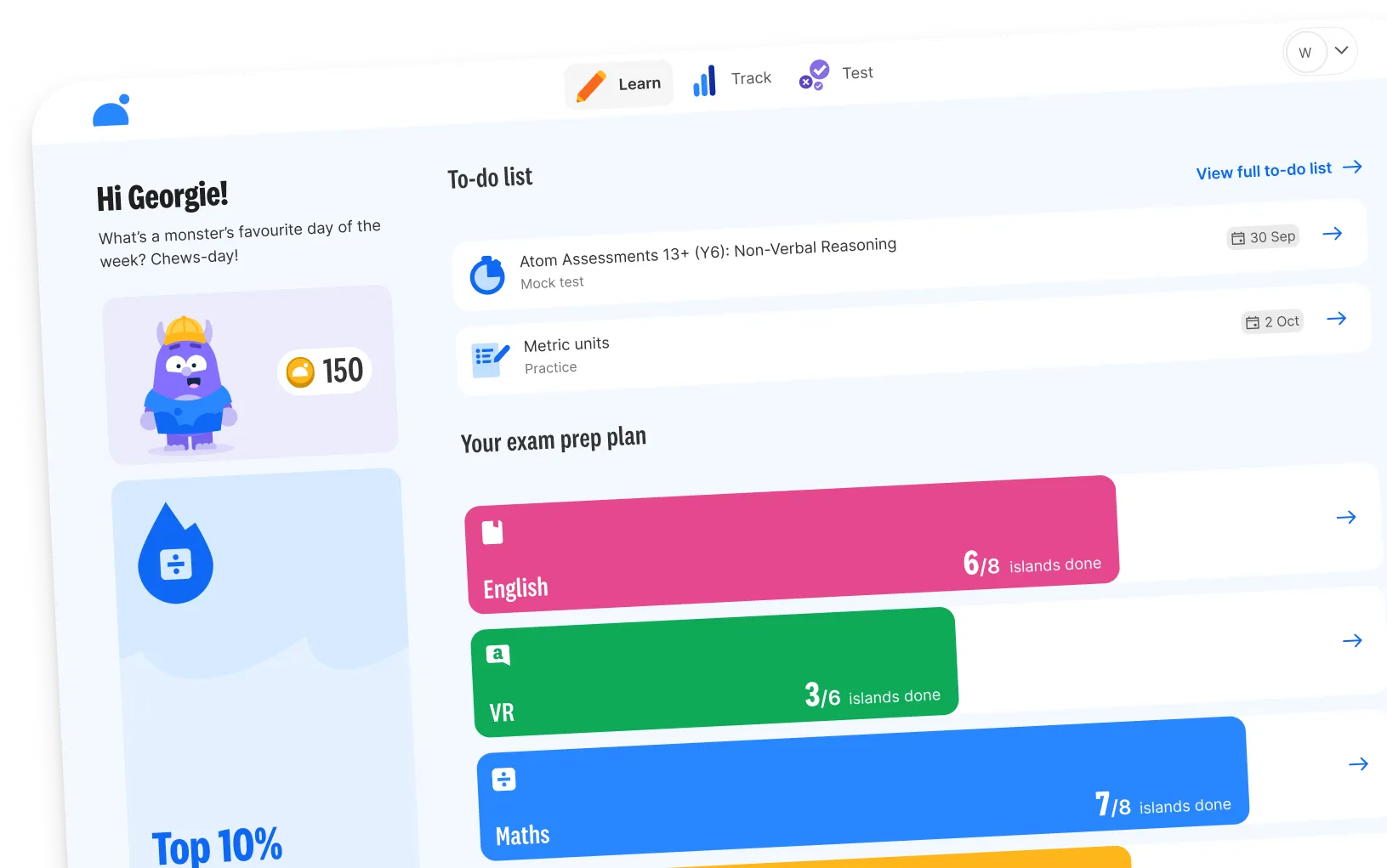
Atom helps you get into top grammar schools, no tutor required

The only 11+ platform built for your child. Personalised practice, online and paper mock tests, and clear progress tracking, all in one place.
- Personalised weekly exam plans
- Replica 11+ practice papers, marked instantly
- Track progress and benchmark to other applicants
Endorsed by grammar schools, trusted by families.

Frequently Asked Questions

What is a grammar school and how does it work?
What is the 11+ and how is it different from SATs?
Do grammar schools have catchment areas?
When do you apply for grammar school in Year 5 or 6?
Which regions in England still have grammar schools?
Are grammar schools free to attend?
Can my child take more than one 11+ test?
What's the difference between the 11+ and a CAT4 test?
How competitive are grammar schools?
What SAS score do you need to pass the 11+?
Can you appeal a grammar school rejection?
Do I need a tutor for the 11+?
What's the difference between a grammar school and a private school?
Is Atom private tuition?

11+ Glossary

11+
The competitive entrance exam used by grammar schools in England, sat in September of Year 6.
Attainment 8
The average GCSE score across 8 subjects (max ~90), used by the DfE to measure school outcomes.
CAT4
A cognitive abilities test used by many secondary schools to set or stream pupils after admission.
Catchment area
A defined geographical area around a school, used as a tiebreaker when more children pass the 11+ than there are places.
CEM Select
A cognitive abilities test used by many secondary schools to set or stream pupils after admission.
Consortium
A group of grammar schools that share a single 11+ test (e.g. Sutton SET, Trafford Consortium, Slough Consortium).
CSE
The Consortium of Selective Schools in Essex, which administers the Essex 11+.
DfE
The Department for Education.
GL Assessment
An 11+ test format used by grammar schools in several regions.
GIAS
Get Information About Schools, the DfE’s school directory.
ISEB Common Pre-Test
An online adaptive test used by many independent schools as part of Year 7 entrance.
National Offer Day
1 March, when secondary school places are confirmed.
OMR
Optical Mark Recognition. The answer-sheet format used by paper 11+ tests where children draw a line through their chosen answer.
Oversubscription criteria
The rules a school uses to allocate places when more children apply than there are spaces.
Progress 8
A DfE measure of pupil progress from KS2 to KS4. Paused since COVID and not resumed for 2024–25.
Pupil Premium
Extra funding from the government for state schools to support disadvantaged pupils. Pupil-Premium-eligible families can access Atom Home free of charge.
Quest (Quest Admissions)
An exam provider used by 130+ UK independent schools and a growing number of grammar schools.
SAS
Standardised age score. The score format most 11+ tests use, typically between 69 and 141. Adjusts a child’s raw mark for age.
Super-selective
A grammar school that admits purely on test score, with no catchment requirement (e.g. Henrietta Barnett, Queen Elizabeth’s Boys Barnet).